Showing posts with label BIG STATUES OF JESUS AND MARY. Show all posts

Monday, August 1, 2011

Lyon Churches

So, as may be apparent, there's a lot of learning for me that doesn't happen until I sit down to write about the places I've visited. I'm not sure about the usefulness about most of this knowledge, though some of it is quite fun. Like, for instance, funicular. Without any context clues, I would assume that this had something to do with maybe fungus or maybe cuticles but t actually means "a cable railway in which a cable attached to a pair of tram-like vehicles on rails moves them up and down a steep slope; the ascending and descending vehicles counterbalance each other." (wikipedia again)

Which is precisely what I rode up to Notre Dame de Fourviere, a church on a hill that has the two oldest funicular lines in the world. Fourviere, by the by, is the site (maybe sight... oh English, how you continue to thwart my pretense of education and intelligence) of the Roman settlement that grew to be Lyon. Lyon, also by the by, has interesting history that you can read here. Anyway, Lyon picked the Virgin Mary as its patron saint (which is really is almost cheating to me- it's just one step below saying, "Are you sure we can't pick Jesus as our patron saint? I mean, He's the best, isn't He?") and you get the Basilica up on the hill the same time Sacre Coeur is being built it Paris, and for the same reasons.

I did like the church, especially its mosaics.

The main church upstairs,

the one that sits in the shadow of a huge statue of Mary,
Really, sometimes I think the French are diverting my attention. Like, "Here, be distracted by a HUGE STATUE OF MARY."
 is much more formal than the smaller chapel downstairs

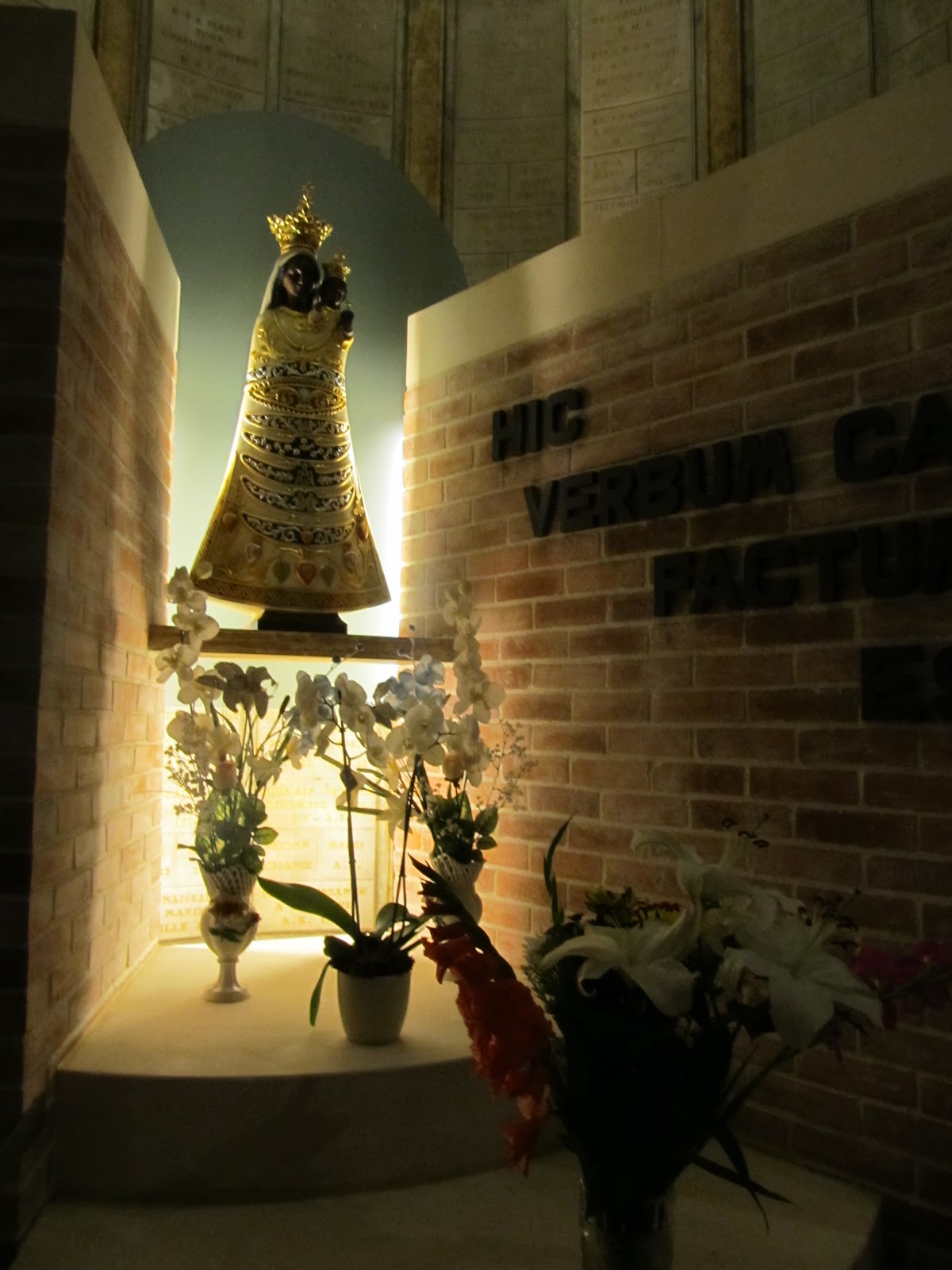
which hosts many different statues of the Virgin Mary and her first baby boy. I could talk again about the way the church and the world in general is connected, but I think I'm just going to put up a couple of pictures and hope that you like them as well as I did.


Down the hill is the cathedral of the city which is overshadowed physically and in popularity by the basilica because, well, because the basilica is on a hill and the cathedral is not. It's still significant though- it was founded by Saint Pothinus and Saint Irenaeus and Saint Irenaeus is one of the four doctors of the western church often represented in sacred architecture. Also, it was made the primary church in Gaul, which is what France was called by the Romans and people like the pope who talked like the Romans even four hundred years after the Western Roman empire fell. I think. Ugh, history face palm!

It struck me as an empty church- not much decoration at all, which threw me off guard. I'm used to every free space on the wall filled with carvings representing this saint or depicting that biblical story.

 It was actually a bit of a relief to find a quiet church with a tiny crowd. I took pictures of the choir stalls, because I just can't get away from them,

and of the astrological clock, from the 14th century.
Here's a video of it ringing which seems like it would be lame at the beginning but actually turns out to be kinda cool.

And that's about all I can muster for these churches. Notre Dame de Fourviere has Byzantine aspects and reminded me quite a bit of Notre Dame de la Guarde and the cathedral is another one of those Gothic churches with twists- you've got Romanesque aspects in the choir and in the apse.
See? Gothic peaks up top and Romanesque curves below. 
There are all sorts of fun stories associated with any church- in this case, if you've got the time and the googling skills, you can learn about the marriage of King Henry IV of France to Marie de Medici of the Medici family of Florence who were particularly powerful (but the only reason I know about them is because Galileo initially names the moons of Jupiter after his patron Count Medici). Nothing here blew me away, which I feel quite guilty about. I mean, ostensibly, the only thing to make Sacre Coeur or Notre Dame more interesting is the fact that they're in Paris. But really, despite the parallels, I was much more excited for the churches in Paris. And Lyon is an interesting step on the ladder of my European journey, but that's all.

Saturday, July 30, 2011

Popes 'n Avignon

I have to admit defeat in this instance. It turns out that I know nothing about the pope, despite having seen him live and in person. I planned this to be a short little post about the Avignon popes but as I delve into this, I realize that there is so much about the history of the church that I had no clue about. I sat in Starbucks for hours wading through wikipedia articles on the history of the church (and the Roman Empire and the Byzantine Empire and various saints) before I gave up trying to understand the bigger picture on my own. As a high point in my research, I stumbled across this amusing summary of the history of the western world- warning: coarse language. It was a pretty pleasant couple of hours, though, because I got a chance to listen to Bec Sandridge. She's quite good and you should all go give her a listen- she's on iTunes as well- as she was one of my roommates at the hostel in Glasgow and she's a bit phenomenal.

But, despite my procrastination (I am so good at that- I should have minored in that, maybe even majored in it), I did manage to ascertain some facts that I shall now present to you. Things to know about the popes (mostly taken from the well-annotated wiki article):

1) Pope is the title of the Bishop of Rome, who's now seen as the spiritual head of the Roman Catholic Church.
2) Peter is generally considered to be the first pope, though he didn't use the title. In fact, the title of pope wasn't given exclusively to the bishop of Rome until centuries after the apostles lived and died.
3) After the fall of the Roman empire, popes took over care of the city of Rome and began to negotiate treaties with rulers of the other powers around them.
4) In 800 AD, Leo II crowned Charlemagne and officially set up the policy that emperors had to be anoited by the pope. Now you've got all sorts of political power invested in the pope and the papacy isn't exactly the thing we think of today, though it got cleaned up starting around 1049 by Leo IX.
5) In 1054, the church split into East and West halves. Kinda a big deal.
6) During the Middle Ages, you've got Western popes vying for power with the monarchs of Europe. (If you think of the Pardoner's Tale, you're probably on the right track. Also the scene with the pope in Doctor Faustus.)
6a) The pope actually moved his court to Avignon from 1309-1377. The popes in this time were French and allied with the French king. They had quite the set up in Avignon, as can be seen by the papal palace there. You've got luxury to the max, and, according to the wiki, it Avignon Papacy was known for greed and corruption.
And a palace.
7) For a while there, you've got Popes and Anti-popes and the papacy changed back to Rome, though there might still be a rival pope set up in Avignon.
8) All this begins to end as a response to the Protestant Reformation in the 16th century. The church responds to the reformers' criticisms and in the end of it all, you end up with the dynamics we see today- a church already split East-West and now split Protestant-Catholic, not to mention all the other various branches that have come off of the main church as a part of the growing of a religion.
9) The First Vatican Council, coming around in 1870, declared that when the pope speaks ex cathedra (from the chair [of Peter]) he's saying something infallible.
From this chair, in fact.
This has only been used once since it was set out, in 1950, to declare the Assumption of Mary as dogma.
10) In 1962 you've got the Second Vatican Council, which started some of the reforms and changes we can see in Catholic churches today.

Of course, this is a minor sprinkling of events throughout a long and complex history of the church (but now you know why no one ever tries to teach you church history in Sunday school- it's a bit too involved for the hour between services) and I've definitely left out all of the thought behind the actions of all of the parties in the church. All this is to say that the Avignon Papacy is just one stage in a long, long history of the popes and the leaders of the church in Rome. I almost feel bad, looking at all of this as an outsider, because I sometimes think that I should feel like this church is my church. I can't pretend there isn't centuries of history between the apostles, the church fathers and then the Protestant Reformation, and in those centuries, the church was the Church. It's the traditions out of which we all grew.

And of course, it's easy to denounce the popes in Avignon (and in Rome- have you seen the Vatican?) as having been extravagant but, then again, it's not like many Christian leaders today are jumping into vows of poverty. Well, I should probably clarify that I'm talking about mainstream Christian leaders in America. Because if there's one thing that I can learn from being in Avignon, beyond the fact that the French like big golden statues

 and dancing on bridges that can't handle it,

it's that I don't know much even about Western church traditions, much less the state of Christians worldwide today. It's a big and varied place, our Church. Bit of a ponderous thing to see, really.

Thursday, July 28, 2011

Notre Dame de la Guarde

Pam read to me from her app on things to do in the city as Pam and I sat on the bus to Marseille. Apparently there was this big church on a hill that would be cool to visit, along with the Old Port area and did you know that  it's the second largest city in France after Paris and the third largest metropolitan area after Paris and Lyon and therefore, I've been to the three biggest cities in France? Yeah, France planning win.

So we decided that we'd venture up to the church on the hill and walk around the Vieux Port and just in general see what was up in Marseille. It'd been warm in the south of France so armed with nothing more than our water bottles, sunglasses and purses, we began our walk around the city, following signs and tramping through backstreets and alleys to begin the climb up the hill.

You can see the church on the way into the city. In fact, you can see it forty miles out to sea. You can definitely see it from the islands in the bay of Marseille, because Alexandre Dumas talks about it on the first page of the Count of Monte Cristo. The big thing you think is maybe a cross from far away becomes Mary and Jesus, waving people into the city, blessing all who call on them.
That's a big church on a hill. It's funny how this...

turns into this.
And from what I can read of Our Lady of the Guard, it's been a spot for many people to come and be blessed. There are ships, many ships, people and football teams that all have left their thanks to Our Lady of the Guard along the walls of the church. 
It's also a place of pilgrimage on the day of the Assumption, which is in August, I think. (All of these sainty-festivally-feasty things will be categorized and clarified [or at least linked to] in a future post, I promise.) It's a pretty cool church even without all of the remembrances of the people who've past inside. It's in the Neo-Byzantine style, which means it takes elements from the eastern church into its design. I notice Byzantine things the same way I notice Moorish influences- the striped arches, though these don't look like they came from Agrabah. The golden domes are a pretty good giveaway as well. The crypt, though, is Romanesque. 
Gasp! Not pointed arches! It... it can't be Gothic. How will I know what it is???
I thought I had pictures of the crypt, but that's actually Notre Dame de Fourviere in Lyon, another church on a hill with a big statue of Mary on it. See? See how confusing it is?
I don't even know where I am anymore and Jesus is picking Mary's nose! What is the world coming to?
It was a pretty cool church, with plenty of nautical themed decorations in the interior and exterior.

This is awesome. I've seen it in other places as well, but it is still awesome here.
We walked around the outside to view the city and then up to the gift shop because, hey, why not. Also, they might have water there. And, as if just to disprove my righteous disapproval of gift shops, I had a moment flipping through the prayers on the tall turning card holder more profound than any moment in the crowded basilica.

I ran across the prayer of St. Francis of Assisi. It was in French, but I ran down the lines of the familiar prayer, not needing a translation. 

Seigneur, faites de moi un instrument de votre paix.
Là où il y a de la haine, que je mette l'amour.
Là où il y a l'offense, que je mette le pardon.
Là où il y a la discorde, que je mette l'union.
Là où il y a l'erreur, que je mette la vérité.
Là où il y a le doute, que je mette la foi.
Là où il y a le désespoir, que je mette l'espérance.
Là où il y a les ténèbres, que je mette votre lumière.
Là où il y a la tristesse, que je mette la joie.
Ô Maître, que je ne cherche pas tant à être consolé qu'à consoler, à être compris qu'à comprendre, à être aimé qu'à aimer, car c'est en donnant qu'on reçoit, c'est en s'oubliant qu'on trouve, c'est en pardonnant qu'on est pardonné, c'est en mourant qu'on ressuscite à l'éternelle vie.

It's a prayer to which I've always been partial, words that I've often thought were the best prayer I could pray. Lord, make me an instrument of thy peace. Where there is hatred, let me bring love. Where there is injury, let me bring pardon. Where there is discord, let me bring union; wrong, truth; doubt, faith; despair, hope; darkness, Your light; sadness, joy. Grant that I might not seek to be consoled as to console, to be understood as to understand, to be loved as to love because it is in giving that we receive, searching that we find, in pardoning that we are pardoned and dying that we are given eternal life. It throws me back to a different faith than the one I hold right now. And it's not often that one climbs up a hill to only find themselves at the top. 

So we walked back down the hill past scenes from the gospel carved into the stone of the wall down the sidewalk. Pam made up a song about our trip to the church on the hill in Marseille and I thought about the other people we've been that we meet on mountaintops, and the people we leave behind. And I don't need a card to remember a prayer. But it helps.