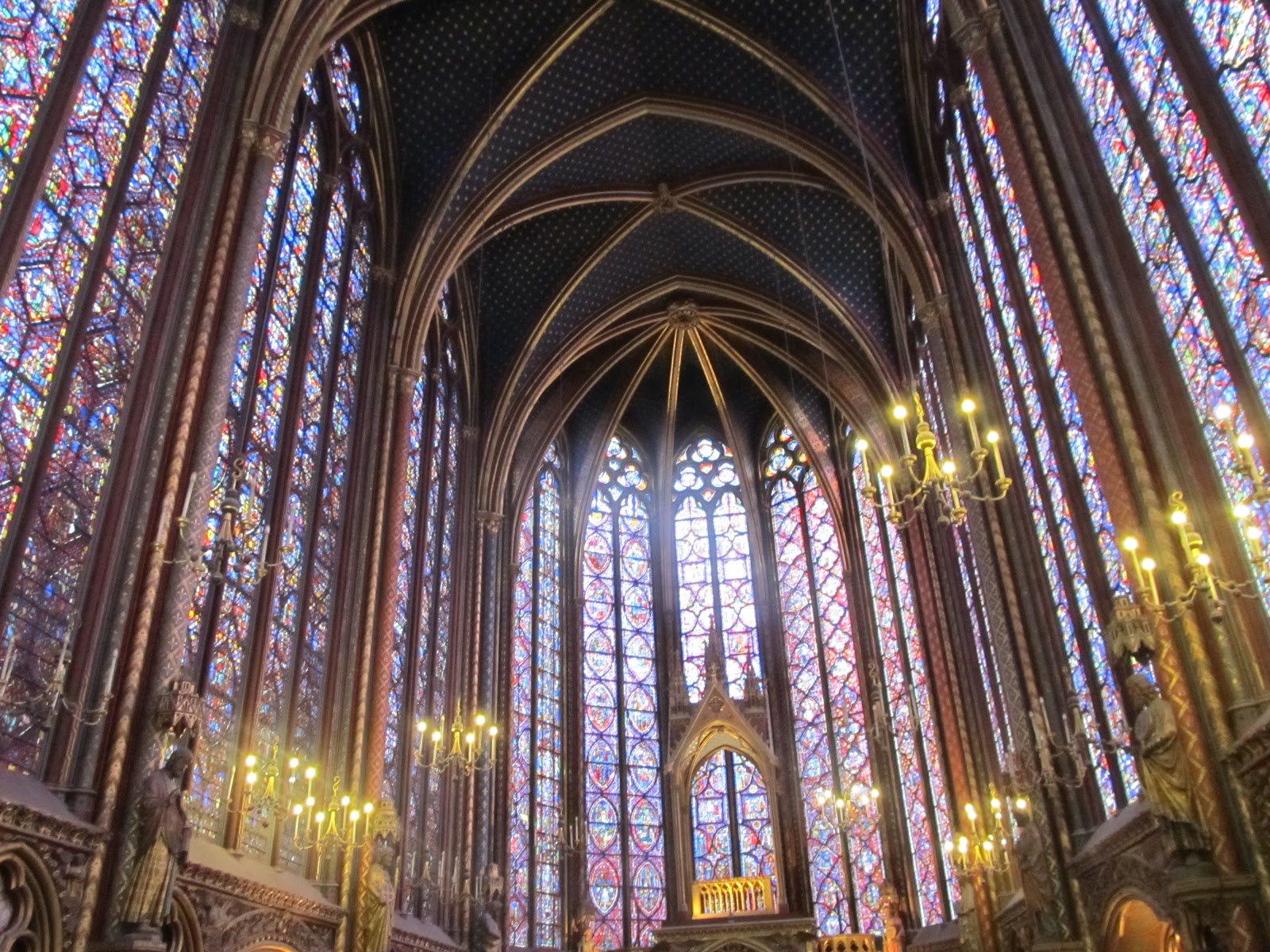
Did you know that during the second world war, they took the stained glass windows out of Notre-Dame and put them in storage, for fear they would get blown out? I've seen this in a couple of places and it makes me wonder how they did that. Seriously. You've got three rose windows- one at the west end, the big one, between the two front towers, and then one at each end of the transept, facing north and south. And beyond that, there must be near on a hundred stained glass windows besides the rose windows. They're everywhere. Notre-Dame's a Gothic Cathedral. It's the example you think of when you think of Gothic architecture. If you're me. So I'm puzzled and astounded by the amount of effort they had to put into it. Grateful, though.

Did you know that Notre Dame was probably the first place to use flying buttresses? They weren't even part of the original design, it's just that the walls were thinner in the Gothic style and they started to buckle under the weight of all the stones being added on top of them, so the architects threw these things in and they got popular as the style spread. It had a while to spread- the cathedral was finished in 1345. Just think! This is a building that's been around for nearly seven centuries. And somehow, with all our changes in fashion and taste and style, we still find it beautiful. Or I do, anyway. Me and all the people lined up across the parvais to see it.
Did you know that in the French Revolution they took out all the religious symbolism in the church and made it a Temple of Reason? They actually thought that the kings of Judah were kings of France and beheaded them. They replaced Mary over some of the altars with Lady Liberty. This place, this church that's so iconic to us, it was turned into a place were you didn't pray to God. I mean, this says all sorts of fascinating things philosophically, but I have such a hard time seeing this space as anything but a church. I love the gargoyles, pagan symbols though they be, and if you hadn't told me those were kings, I wouldn't have known, and the saints lining the doors could be any old people from that time period- well, maybe all of them except for St. Denis.
 |
| Noted Cephalophore. |
Did you know that Victor Hugo wrote The Hunchback of Notre Dame about a time period much before his? We get confused about these things- all history is history to most of us. He was alive in the 1800's, after Napoleon had restored Christianity to the cathedral and been coronated in it. But Victor Hugo wrote it about the end of the 15th century, I think. I love the themes Mr. Hugo talks about in the book- there's all this about whether we actually have free will and the problem with class differences and the objectification of women. He also advocates for the repair of the cathedral, which, in his time, had fallen into disrepair, without being entirely restored from the damages of the revolution, and preservation of historic buildings is something I can certainly get behind. The cathedral is the main character of his book- it weathers all the injustice and stands solitary at the end.
Other people have taken the story and put a different moral spin on it. Disney, not famous for preserving plot lines anyway, makes the moral of the story acceptance of people who are different. Not universally, of course- Quasimodo ends up blessing the union of Esmeralda and Phoebus, because the two pretty people are the ones that should be together, but, you know, Quasimodo's had his one day out there and can happily go back to his bells and his church without the oppression of his former master, having been accepted as a good friend to Esmeralda and Phoebus alike. Notre-Dame is really the actor who paved the way for all of this justice- she protected Quasimodo from death as an infant and she allowed Frollo to fall, giving Quasimodo life as an adult.
 If you see Notre-Dame de Paris, the musical based off of the story, there's this overarching theme of justice for the immigrants, for the gypsies that have made Paris their home. They demand sanctuary from Our Lady, and liberation. The cathedtal is a safe place, more than it ever is in the book, where the gargoyles watch over Esmeralda, where in the winter it's not too cold and in the summer it's not too hot. The bells are Quasimodo's loves. Even if, by the end of the musical, all has fallen into tragedy, the words of the songs have made their point- the gypsies and the outcast bellringer are the heroes of the story, not the captain of the archers or the curator of the cathedral. The opening song of the opera says that this, the time of the story, is the time of cathedrals. Man has reached for the stars, to write his story in glass and in stone.
Is it an exclusionary story, the one written above the doors and in the stained glass of Notre-Dame? What does someone with no idea who these people lining the doorways see, what does a pagan see in Mary when she walks into the building dedicated to her?
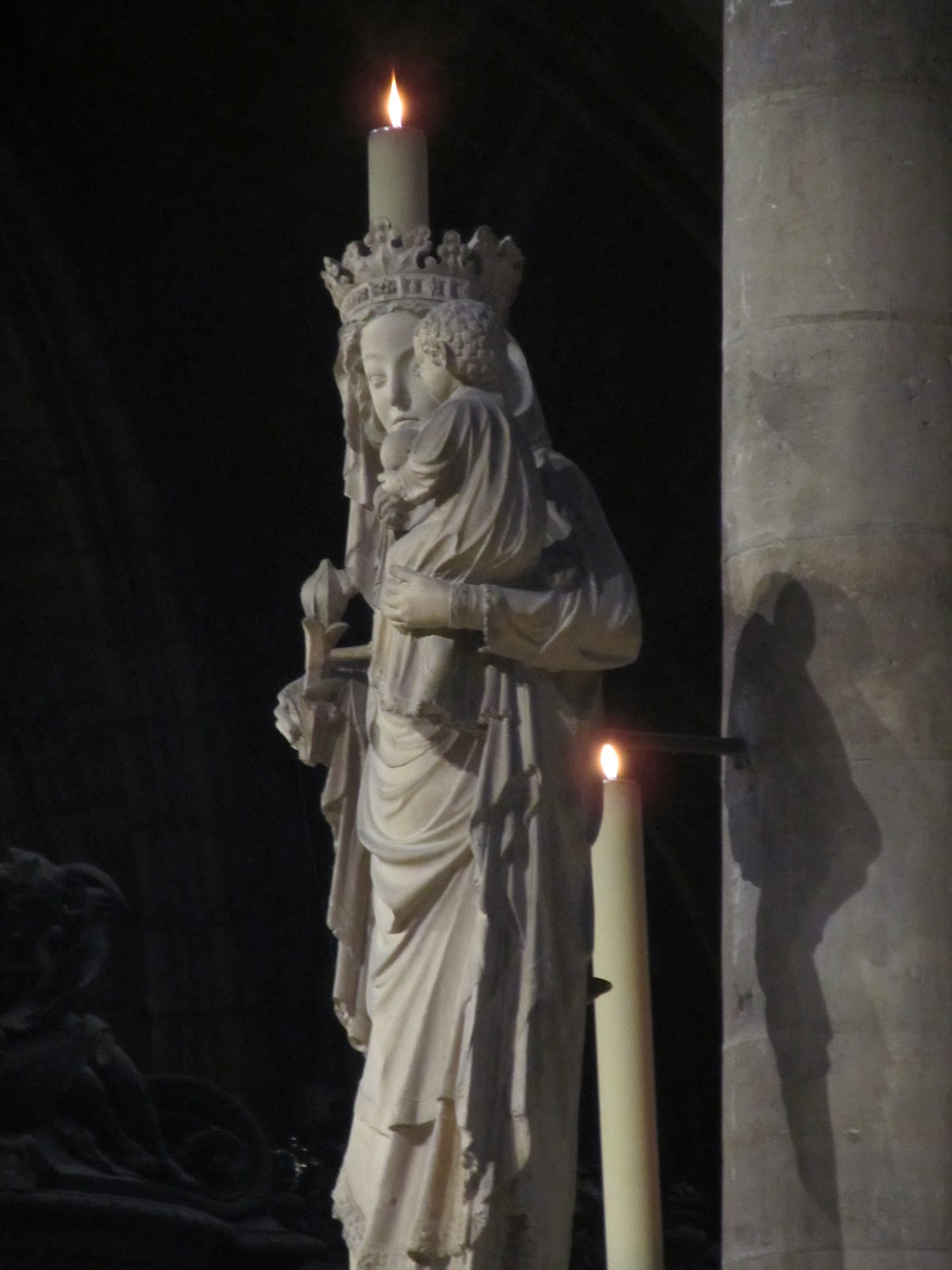
That's actually one of the things that I notice most in the three versions of the story I'm most familiar with, Esmeralda praying to Mary. In the book, it's rather tongue in cheek- Esmeralda is deathly afraid while the cathedral is being attacked by her liberators, and Victor Hugo says that, in times of need, one always prays to the god to which you're closest. In the Disney movie, a wiser Esmeralda walks along the halls of the cathedral, asking for God's help for the outcasts. We get to hear from the good people of Paris too, asking for love and glory and God and his angels' blessings, but Esmeralda doesn't ask for anything for herself, just for those less lucky than she is. And in Notre Dame de Paris, Esmeralda asks for protection from Mary, but she also asks for the barrier between herself and Mary and between brothers everywhere be taken down. I think all the prayers have beautiful points to them.
I wore my Esmeralda skirt on the Sunday when I went to mass at Notre Dame. I carried it around Europe for two months because it was definitely, definitely below the knee, a flowing green skirt that reached halfway down my shin. It really saved me in Rome, making sure I could get into St. Peter's without suffering in my jeans all day. I was being better safe than sorry in Notre-Dame. Really, given the choice, I would have loved to walk in barefoot and fit the part of a gypsy- my skin was still tan from Rome and Spain and sunny days in the south of France and my hair has grown to a remarkable length, curling unruly along the way. All I need are some gold earrings and I'm set, total gypsy. And that's all I ever want to be. I want to be the other, the outsider, the underprivileged, the one deserving pity and the one commended for rising above the sorry lot life has given me. Then it's not me that has to change the way I look at the world. The world has to adjust to me and my claims to be fair. It's so much easier to be on this end.

I bet you thought I was going to talk about the building, didn't you? The famous gargoyles, not even half as old as the building itself, the flying butresses, the carved altar stalls and the pieta and the statue of King Louis XIII and the crown of thorns in the treasury? Or maybe about the saints outside the doors, St Denis and the statues of Mary and Jesus and Peter and Paul, or the saints inside the doors, the statue of Joan of Arc whose redemption from heresy was carried out inside these very walls? Maybe I would detail the services for you, talking about the intriguing sermon preached in French from the surprising priest who stood behind the lectern with one elbow leaned against the Bible in front of him or about the sound of the organ as it played, sweet and beautiful, throughout the building, just softer than the choir that sang on Sunday morning hidden back in the choir stalls, or about the procession from the sacistry, incense smoke leading the way through the tourists still filling the halls and up the center aisle between the chairs and back out again, standing in silence broken by music as the cross came into and left the sanctuary?
But I've seen so many cathedrals. I've been to so many masses. Without the words to differentiate them, they're all the same. And these churches, they're all laid out the same, they're all used the same, when they're used for mass. The difference between all of these churches lies in their stories, and Notre-Dame de Paris has so many stories attributed to it. They're stories that I hold dear, because I love each and every one of the renditions of Mr. Hugo's novel. I love his idea and his protest against the injustice he saw. I love the ideas and the themes explored by the musical. I even love the Disney version with the unquenchable hope of Quasimodo only momentarily displaced from his bells.
This church, this cathedral, inspired one man to write a story and that story has been adapted so that people can hear it anew and can focus it on the problems they face in their own worlds. And that's what cathedrals are for. Yes, they are places of worship, yes, they are places that display the percieved power and glory of the God that blessed each of these nations with enough money and might to build such a building, but now, after all the history that has passed between the building of these cathedrals and us, all these buildings have left are their stories, their proclamations of times gone by. But this place, this one cathedral more than any other, has allowed her story to be molded to benefit others, to benefit, in point of fact in all cases, the least of these and though the building and furnishing of this cathedral proclaim's religions benefit to those with much, that's not what Christ came to do.
I love a faithful church.