Showing posts with label Rome. Show all posts

Monday, July 18, 2011

Roman Anthology: Corpus Christi and My Last Few Days in Italy

After returning from the beach and our adventure in Pompeii, can you blame us for wanting to take it easy for a day? So we did, and the next two days after I wandered around Rome tying up some loose ends, visiting St. Paul's Outside the Walls and walking around that neighborhood and wandering again through the streets by the forum and the Colosseum on my way to visit Santa Maria in Cosmedin (named so because it was used by the Greek community after it had been turned into a church and was really well decorated back in the day (cosmetics, yeah?)). Back at the hostel we wouild change rooms and meet new people, striking up conversations with Australians and Canadians and Americans, always relieved when we found people who spoke English with very little confusion.

Thus the end of our time in Rome passed pretty peacibly. We were sticking around until Corpus Christi, which is a celebration of Eucharist because Christine had heard there was a big to-do, it being a holy day in the summer, etc. I'm just learning all sorts of holy days over here. Anyway, on Corpus Christi the pope holds mass at San Giovanni in Laterano and then leads a procession over to Santa Maria Maggiore and it's kinda a cool thing. So I figured, hey, these churches are both on my list. I'll head over to San Giovanni and get there a little early, get a seat near the back and then walk over. There can't be that many people, can there?

Oh, how naive I am.

I'm not entirely sure who you had to be to get tickets inside, but I showed up around 4:30 (and the mass started at 8) and waited behind those steel fence-looking barriers for hours and never got any closer than this. I watched the whole mass (in Latin, so none of us understood it) from a video screen.
This video screen, in fact.

 So I don't have pictures of the inside of the church devoted to both St. John the Baptist and St. John the Evangelist, but I can send you here for a virtual tour that is so jokes (jokes=cool, too much Vlogbrothers). Here's another for Santa Maria Maggiore.OK, now we're all caught up. Back to the story.

But I sat outside for hours, listening to Italian, German, Spanish and then I stepped back and looked at the crowd that had gathered outside of the cathedral to just watch the mass on the screen.

This. This is why we have cathedrals.

Now I'm not saying that's the only reason why, but this is a holiday I didn't know existed until Christine brought it up for me. Can you imagine the number of people something more famous like Easter might draw to this city? Christianity is kinda a big thing and regardless of the purposes of the designs and the symbols, a church is foremost an assembly hall, potentially for a lot of people. To that end, the cathedral and churches of Rome do their job well.

 As the service drew to a close, the clergy inside began to process out of the church. We outside had already seen the pope platform on the back of a pickup truck but we all, nuns and priests and common folk alike, swarmed over in front of the church to watch the lines of cardinals and bishops I guess form around the path the pope would take out. And like everyone else there, even though I'm not Catholic by any stretch of the imagination, I stood on my toes to catch several blurry pictures of the pope as he drove by. Because, hey, how many times in your life have you seen the pope?
Times I've Seen the Pope IRL: 1
Then we all began walking over to Santa Maria Maggiore. It was a wonderful, wonderful experience to walk down the streets of Rome with literally hundreds of other people, singing along to the words printed in my mass book and humming the tunes projected over the speakers that lined the roads we were walking. We passed other churches with their doors open on the way, and you always had to be careful of a particularly pious person pausing the kneel momentarily in acknowledgment of the altar seen through the doorways. I moved between groups of nuns with habits of all colors, people who looked like me, dressed in clothes no finer than a regular day in Rome affords and Italian military men in their dress uniforms, walking in a circle around their chaplain. I've never been in a such a large, solemn crowd.

Then we arrived at the church and as many of us as could filled the square in front.
Sorry to distract- I just love laser beam light pictures. And you can see all of us filling the square.
 No one went inside- a large altar had been brought outside for the ceremony.

All that remained was the benediction and, that having completed the service, the crowd started the chant Vive la Papa! Vive! It was another moment to be caught up in and even though I didn't cheer along, it was good to hear the Italian's love for their pope. Even after the strong voices in the crowd let the cheer die out, a little boy's voice piped up, Vive la Papa! and a few of the kinder hearted souls around him shouted Vive!

On my walk back to the hostel I passed behind the great church dedicated to Mary, planned on this spot because the Virgin left footprints in the snow marking this spot, and found a large crowd on the corner between me and the street I wanted to take, just staring. I realized they were waiting again on the pope and this time I waved, from a much smaller crowd, as the pope was driven by us, his car following others from the ceremony. He smiled and waved at us and the same cheer was brought up again and I couldn't help but shout the response along with those beside me.

When in Rome, you know?

Santa Maria in Cosmedin

I had a list of, no lie, ten churches that I wanted to see in Rome. Mostly they were ones that looked interesting on an initial survey of the places to see besides the four main papal churches that either had some historical significance, like Santa Maria sopra Minerva, a church dedicated to Mary built over a temple to Minerva, or had some cool architectural feature, like Santa Maria degli Angeli, which is actually built inside the Baths of Diocletian.

Santa Maria in Cosmedin didn't make this list.

And I'm not sure why. Maybe I hadn't yet seen Roman Holiday when I made the list, because if I had, SM in Cosmedin would have made it up there with St. Peter's and the Sistine Chapel, just on fame merit alone. On the porch of this church is a face from ancient Rome whose mouth might have been a water spout or something interesting like that which was moved to this church in the 17th century. But honestly, we all know it was moved here so Audrey Hepburn and Gregory Peck could take turns putting their hands in the mouth of the face, proving their innocence. If you're a liar and you put your hand in the Bocca Della Verita, it's supposed to be bitten off.
Mmmm tasty hands...
But the line to prove yourself truthful is extensive and as this was an expedition into Rome I was undertaking on my own, so I didn't get my picture taken with my hand in some strange face's mouth. I'd be a little nervous putting my hand in it anyway, habitual liar that I am. Though I did, in a recent instance, tell the truth rather than lie, so I think we're making great progress with that.

Instead I went inside the church, which is quite small, on the far side of the Circus Maximus as you look from the Colosseum, though it's quite close to all those other wonders of Rome. A tour group was coming by at the same time and it was from their correct entrance, and those of the people who followed them in, that I figured out that I had come in the exit. How do I always do that? But I stumbled my away around them and looked into the side chapels, amusing myself until I got a good look at the interior without a human wall in my way. It was in this excursion that I discovered that St. Valentine's skull is housed here
Creepy relics FTW!
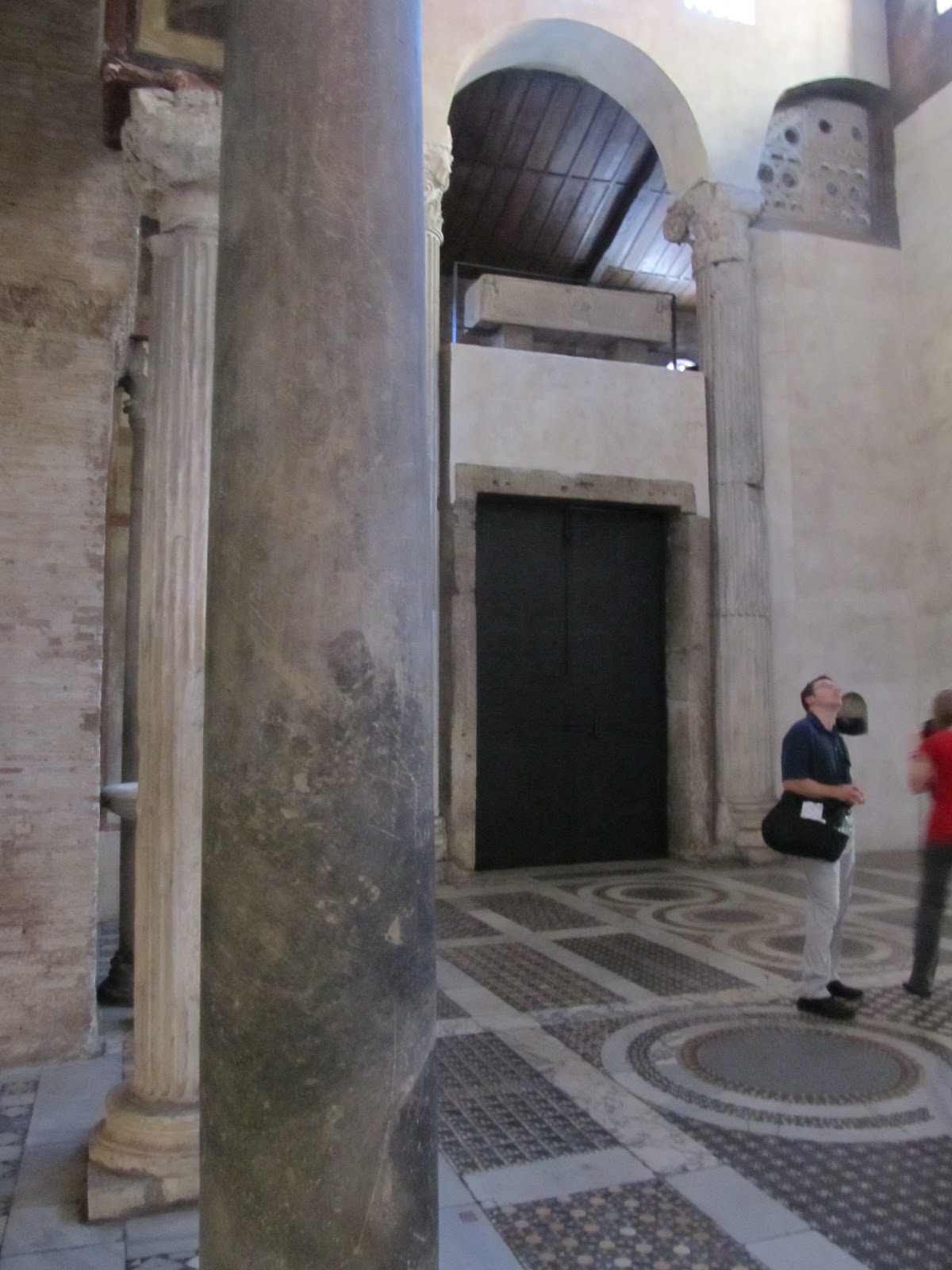
along with other people's dead body parts, though those are kept in the crypt. There are historic columns, including ones from when the church was a Roman office before it was a Christian house for helping the poor before it was turned into a church (seen in the back wall), plus the other ones in the nave,
Either from older Roman buildings, but they all date back to the 8th century.
and lovely mosaics.
11th century!

Up in the clerestory by the windows- that's paint that's older than the Magna Carta!

With all this impressive ancient stuff, I'm always surprised when I see something relatively new in an old church. I dunno, I just always forget that these places that I visit are living, breathing things that serve a purpose in people's lives beyond just the sightseeing that I inevitably fall into. So when I saw this picture of Mary and Jesus,

 I started, confused about its placement near the altar. Then I relaxed and contemplated it.

I've seen a lot of Marys. There are a lot of churches that honor Mary (every Santa Maria, every Notre Dame, every St. Mary's) and there are a lot of statues of the mother of Jesus as places of devotion, high on the wall on the corners of streets. I didn't think it was that big of a thing, but really, Mary's kinda the bomb in Catholicism. And out of all the Marys I've seen, I think I like Italian Marys the best. Though, several countries still to go, so maybe Spain will displace Italy in my entirely random perception of representations of the mother of Jesus.

I also love seeing the scared lions EVERYWHERE. Seriously, I'm going to make a post to just them. This is my equivalent of saying Refrigerator at the end of a haiku. Sometimes, you just gotta roll with it.

Sunday, July 17, 2011

St. Paul's Outside the Walls

So there's four big churches in Rome you're supposed to see. There's St. Peter's Basilica, clearly,  San Giovanni in Laterano, the actual cathedral of Rome, Santa Maria Maggiorie, the biggest of the churches devoted to St. Mary in Rome, and finally, Basilica Papale di San Paolo fuori le Mura, or, as most of us will call it, St. Paul's Outside the Walls.
St. Paul's...

And the walls it is outside
Now St. Peter's is actually in Vatican City, so it's not technically in Rome, I guess. San Giovanni in Laterano is down the way from Santa Maria Maggiorie, 'cause I walked there, following the pope (details to come), but both of them are maybe fifteen minutes from the Colosseum, which is pretty distant from the Vatican. Walkable, but distant. St. POtW, as I will now call it, due to sheer sloth, is like, the next to last metro stop on that line or something ridiculous. It's not outside of Rome, but it is outside the walls built by Aurelius and the dude who came after him, and was damaged when the Sarcens (Arabs) invaded Rome in the 9th century. Thank you, wikipedia. Also, thank you to Hank Green for amusing me on my planned recovery days and teaching me the correct pronunciation of wikipedia at 1:40. (Though not the correct spelling of communication. One year of that.) The point of all that discussion is to show you that it takes a little bit of effort to hop around to these places. Rome is full of churches and I didn't get to see all of them by any stretch of the imagination. Good thing I chucked coins in the Trevi Fountain like no one's business.

I got to take a great picture of the hall, as there was no one around. It's too far, I guess. Sorry this picture has nothing to do with the Trevi Fountain.

St. POtW is a basilica like St. Peter's and like St. Peter's, it holds the remains of an important apostle. Down the stairs between the papal altar and the hall of the basilica you can see the tomb of St. Paul, along with chains that held him at some point in his ministry, which was a wow moment for me. I mean, Paul was the apostle to the gentiles and his letters make up a sizable portion of the New Testament, correctly attributed and otherwise. So even though St. Paul's has an astounding hall like St. Peter's and a large papal altar like St. Peter's, the thing that impressed me the most had to be seen kneeling in front of a tiny square or light.


Here, before I ramble, let me show you a picture I found really funny and then you can close out the post, because the rest of it is just a rambling story. It's a difficult habit to break.
Here's Jesus, with Peter and Paul beside him...

And a really freaky old man beetle getting ready to bite his oddly shaped big toe!

I have this terrible tendency to wander into churches right before a mass happens. I mean, maybe it's not a terrible tendency, and part of it is that I'll do the dome climb for places at the last minute, which means I'm near the top during mass, but beyond that, I just end up in a church at the right (?) time. (I was going to say wrong, but it doesn't do to call the time for mass wrong.) But this time, it was not my fault, as a special mass had been called. Now, I always kinda internally giggled when churches had signs saying that you could schedule your own mass as long as you brought your own priest. It gave me this mental image of someone pulling a priest out of a suitcase saying something like, "Thanks goodness we didn't forget the priest!"

It makes a lot more sense when it's, say, an American Catholic youth group going on a pilgrimage. I sat down in some chairs away from the benches in front of the main altar when I saw people starting to gather since I hadn't looked around all I wanted to and I always like sitting through mass, despite the obvious and frequent language barriers. I was surprised and relieved when the head priest started talking in English and sat through a pretty pleasant service. It was good to actually understand a sermon for once.


Well, I say 'understand.' They were celebrating St. Paul's mass (that could be a total lie, Catholic friends- I'm just going off of what I remember the guy saying) which made sense, since, you know, St. Paul was right there, but the sermon surprised me. He talked a lot about believing in the church, which I'm all for. I support faith in an organization that has great potential to bring good and wonderful things into the world at the base level, and I believe that the Church can be a balm to the world around us, providing inspiration and courage. So I am all for believing in the church, regardless of denomination or creed. But then he said that the church had always been and will always be a source of complete truth for anything you'll ever need.

And I, being terrible at hiding my emotions, sat up and gave the preaching priest a look that I don't think I've sent anyone since an evangelical Christian had the audacity to condemn all scientists in my hearing, in front of a group of trusting children without access to auxiliary views. I feel like I need to bring the increduosity for other people. Yes, I think that the church is a great source of truth in the world. But I don't know that you can trust any human organization as purely as he was implying. And I hate to bring up a resolved example, but in his own time, Galileo was subjected to the church's error. The church can be wrong. All churches can be wrong, and have been wrong. I didn't think people advocated for an infallible organization anymore.

I mean, it's good for youth today to hear a vote of confidence for the church. And the rest of it rang out like a normal youth group sermon, with a wonderful fresh outlook for me on the good of a pilgrimage, though with the ever irksome insistence on girls guarding their affection and boys guarding their eyes. After the mass was over, I took pictures of side altars and headed out of the church, snapping more photos of giant statues and the facade. A service in English made me think again about how much I depend on words to make a service worthwhile for me. It also made me think about how much I analyze every word thrown my way.

Then again, I also analyze every word of Paul's thrown my way as well. Makes me wish I had a better way of thanking him than picking apart goodhearted texts.

St. Peter's Basilica

Editor's Note: You're stuck with some unfortunate reflections of a personal nature in addition to the expected expounding of history and ideas. Feel free to disagree and correct as needed. Much thanks.

An indulgence is a pardon from time in purgatory, time which is required by God's justice, even though the guilt of the sin is forgiven by God's grace. Indulgences are given by the pope or by bishops or others given authority by the pope, who gets his authority as the successor of St. Peter, to whom Christ gave the keys to the kingdom and the power to bind things on earth that will be bound in heaven. They're given with the caveat that the parishioner who recieves the indulgence does some good work or an act of piety, like going on a pilgrimage or giving to the poor or the building of something for the public good, like, say, a bridge or a church.

It's odd then, to think that in the 16th century, one could use this privilege of the church to simply buy one's way out of purgatory. It strikes me as odd that the people who have the best access to scriptures that speak against greed and the hoarding of fine things and that the religion whose founder turned over seller's tables in the temple because the sellers were abusing a sacred space should then sell a faster ticket to heaven like a museum sells a tour pass that lets you bypass the lines outside. I remember when I first heard about indulgences, unclearly explained by my 10th grade world history student teacher in a rare moment of actual historical instruction. I was amazed that such a thing actually happened. I mean, the issue is always a little more subtle than you have time to cover in class, but to me it sounded like a money-making scheme, something a villian in a noel would do, something entirely unsuited to the church. It just seemed wrong. And what did they need all that money for anyway?

Oh. To build a church. This church, in fact.

Now, I'm not the only one who though there was something off about all this. The sanctioned selling of indulgences to build St. Peter's Basilica as you see it now is one of the things that set Martin Luther off on his 95 Thesis, started the Protestant Reformation and changed the face of Christianity as it was known. Even the Catholic Church itself wasn't left out of this change: the Protestant Reformation started a Counter Reformation that can be seen in the architecture of the time- churches were built to display more wonder and awe, to remind people of the amazing and astounding nature of the God to whom they came to pay homage, to worship. It was a great time of change in the world, with the Renaissance and all sorts of humanist ideas flying around among this era of debate and rupture in the Church.

Knowing all of this should have made walking into St. Peter's a more solemn, momentous moment, one full of conflict about visiting a place with such historical and cultural significance. Or so you'd think. But Sarai and I came down rather suddenly from the climb up to the cupola (definitely worth your while) and stumbled our way into a side door, spilling accidentally and abruptly out into the nave to stand astonished at this massive, beautiful, awesome space.

The nave at St. Peter's can fit most other churches in the world inside of it. It's bigger than the Florence Duomo with its inexpressible size and even if I tried to amaze you with the height and length and width of the church, you would not feel the awe that this space inspires. I made Sarai give me a couple of minutes to walk around by myself because this kind of amazement is not something that I'm particularly good at sharing with other people.

Hold on, let me give you some pictures for a second and some facts in the captions and then we can reconvene to talk about this place.
Michelangelo's Dome, whose top is 448 feet from the floor 


A statue in the nave. That little angel, you know, the one chilling at the bottom? TALLER THAN  A REGULAR HUMAN. 

Baldachin over the papal altar by Bernini. It's the height of a 7 story building.


The orange glow in my picture of the nave was this window. It was two American football fields away from where I took the picture. The dove itself is 6 feet tall.

Now, St. Peter's isn't the cathedral in Rome. I know, you're disappointed, your life is a lie, etc. The cathedral is, as previously mentioned, the seat of the bishop, in this case, the bishop of Rome, or the pope. And the pope's chair in Rome is San Giovanni in Laterano. St. Peter's is just a basilica, or a papal basilica since the pope tends to celebrate mass here when he's around, and a basilica is a church that is given that status because it contains some kind of relic. In this case, it's the tomb of this guy, St. Peter, whom you might have heard of as one of Jesus' closest friends and the first pope, you know, something like that. (I use sarcasm here because I have difficulty dealing with the importance of this spot.) Peter was martyred by that great guy Nero in AD 64, crucified upside down because he didn't think he was worthy to die in the same manner as his Lord, and buried right under where the altar stands in this church.

I was going to tell you about the history of building the church, starting out with the shrine over the burial site of St. Peter, which was originally marked with just a red rock, to the building of Old St. Peter's, started by Constantine, to the original plan for the church, but I figure you can read the wikipedia article just as well as I can. What stuck out to me, though, is when Michelangelo (man, he's just turning out to be my recent favorite of the ninja turtles) took over the design from Bramante & co, he said that he did it to the glory of God and to the honor of the apostle. Over the course of this trip, I've spent a lot of time thinking about why we have these huge churches, why there are these cathedrals. It's not a question I can answer, but I like what Michelangelo said. And if God truly needed a church to explain His glory to the world, though, I would point to this one.


You have saints lining the nave and side chapels with a couple of popes in tombs, so many sculptures to draw the eyes up to the distant ceiling. You can stand at the back and feel the expanse of the church without knowing the height of the distant construction over the papal altar. As you approach it, the canopy looms larger, just barely misaligned with Michelangelo's dome still higher above, truer to the burial place of the saint. There are the accouterments of a church dedicated to such a large fixture in Christianity- a statue of Peter with his curly hair, sitting where his feet can be worn smooth by approaching pilgrims,


 the Cathedra Petri or the throne of St. Peter, encased in bronze and enshrined above the altar in the main apse,

and two meter high letters declaring Peter the rock on which Christ will build the church as you look up towards the dome.

 At the same time, there's a wonderful peaceful dove window above the chair, supported by four church fathers, including two from the Greek tradition. The original plan was a Greek cross with even arms, until the nave was expanded to make a Latin cross. The current design still pays homage to that idea.

The thing is, you've got all of us walking around, made insignificant by the size of this church. You've got people climbing up to the dome- we watched part of a mass being performed in one of the side chapels in the transept from a safe distance on our climb up. You've got people crowding around the Pieta, which is such a wonderful, beautiful piece of sculpture that I had difficulty tearing my eyes from, hidden behind a bullet-proof glass divider.

And all of us, in all this space, what are we doing? You there, with the camera and guide book, do you know the great artists that designed this church? You, walking hand in hand with your mother, do you know who St. Peter was? You, sitting in the chairs in the back of the chapel, do you understand how many people have been here, how many have prayed here? How many popes, leaders of the largest group of followers of Christ on the planet, have been in this very same room as all of us, massive though this room is?

I cannot own this church. I cannot make it mine. I can listen to the telling and retelling of the stories of Peter and I can make the apostle a favorite character in my own understanding of the Gospel. I can love the Pieta and carry the image of the young Mary holding the dead Jesus in my heart and make it an outcry of my own mourning. And I can wonder and marvel at the saints up and down the nave and the dome and the ceiling, so far away, but I cannot own anything except that wonder. This space, this church, could never be a place that I worship the God I understand. It's too big, it's too distant, it's un-understandable for me.

But I can own the feeling of seeing the inside of this place for the first time, that kind of running excitement discovery that steps back when it realizes that this is not a conquerable landscape. (God, what a metaphor for You in my life.) I want to preserve that feeling forever, remembering the few seconds of my life when the things I know about a place didn't matter. Just being there was enough.

Friday, July 15, 2011

Sistine Chapel

Editor's note: Contains no pictures (I'm a good tourist... mostly) and ramblings. Very skipable. 

Imagine a regular sized chapel, with a regular sized ceiling and a regular sized altar. Now, cover every inch of that ceiling, all 5900 square feet, with scenes from Genesis, cover the walls with the prophets and the apostles, and cover that plain wall behind the regular altar with a huge, busy painting of the Last Judgement, so full of characters that there's no one easy place to let your eye rest. Now, cram that room full of tourists, tour guides and tour groups, plus a couple of security members, and you've got the Sistine Chapel.

I would almost pay (more) money to be able to have time to peruse the entirety of Michelangelo's chapel, without being jostled away to crane my neck up at the ceiling from a corner. Still, despite the inconvenience of other people (oh other people, how shall I ever learn to deal with you?), you really can't help being impressed by the work. Or I can't. Though you might be even more impressed if you didn't know too much about human history in general, like the girl who sat with her friends on a bench by the exit, gazing up in wonder and saying, in English, of course, "Can you imagine what it would be like to discover this?"

Oh, dear.

But then, I can pretend she was being more profound than intended. Michelangelo, when he scultped, said that he didn't create a sculpture so much as he freed what God had already put there. So to be in Michelangelo's head, as he designed the figures and painted them for four long years around the room, would have been something amazing beyond my comprehension. I don't understand artists. I could never have been this creative. It's easy enough to throw in a joke here to make things less serious (because Michelangelo totally had an awesome sense of humor), but save the link-clicking until we're done and then you can laugh away. Preserve the moment, friends.

Sarai and I had lost Christine in the Vatican museums as Sarai had gone back to look again at Raphael's School of Athens and The Disputa, so we swam through the crowds to some place that we could use Rick Steves' guidance to making sense of the massive artwork all around us. We traded the book back and forth and found the Creation of Adam- oddly difficult to find, seeing how it's so iconic and everything- and remarked on the missing plaster and all sorts of interesting things. But what captivated me, once I had flipped a few pages ahead, was the paragraphs on the Last Judgment. I actually left the spot Sarai and I had been standing and almost ran over to the metal screen that separates the back of the chapel from the altar.

The Last Judgement was painted behind the altar twenty-three years after the rest of the chapel. And the rest of the chapel is quite cheery in comparison, playing up the humanist themes of the early Renaissance. Now, in 1541, the Protestant Reformation has started to take its toll and Michelangelo wasn't so optimistic. What drew me to the gate was a passive phrase of Rick Steves', that Christ is coming in wrath with his hand raised to smite the wicked, and that he looks almost happy to be doling out his judgement. No, I thought. People don't paint my Jesus like that. Such a ridiculous suggestion, that Christ would come with glee in his wrath, if there was wrath at all.

You know, it's a different Jesus.

And the Last Judgement is enthralling. There are sinners and demons, angels and righetous ghosts. There's Mary and there's Charon. Even heaven doesn't look too appealing- it's all storm clouds and trumpets. I'm sure you've seen the picture of the condemned man, sitting on his cloud with his hands over his face, leaving one eye uncovered to stare at you in despair. I'd think the pope was being melodramatic when he said upon seeing the painting, "Lord, charge me not with my sins when thou shalt come on the day of judgement!" but, honestly, I could be a little worried about my salvation myself, and this just from looking at pigments on a wall.

And poor Michelangelo! I wouldn't have wanted to be in his head to discover this part of the chapel. I couldn't have painted this and I wouldn't want to be around in a time that inspired a painting such as this. There's a saint coming up to Christ, holding the sagging skin of a melted man, which is said to be Michelangelo's self-portrait. I've said the painting is enthralling- given the chance, it entrances you and draws you in, the kind of work that you have to be drawn out of with a shiver.

Makes you think maybe we shouldn't have split the church in the first place.

Pantheon

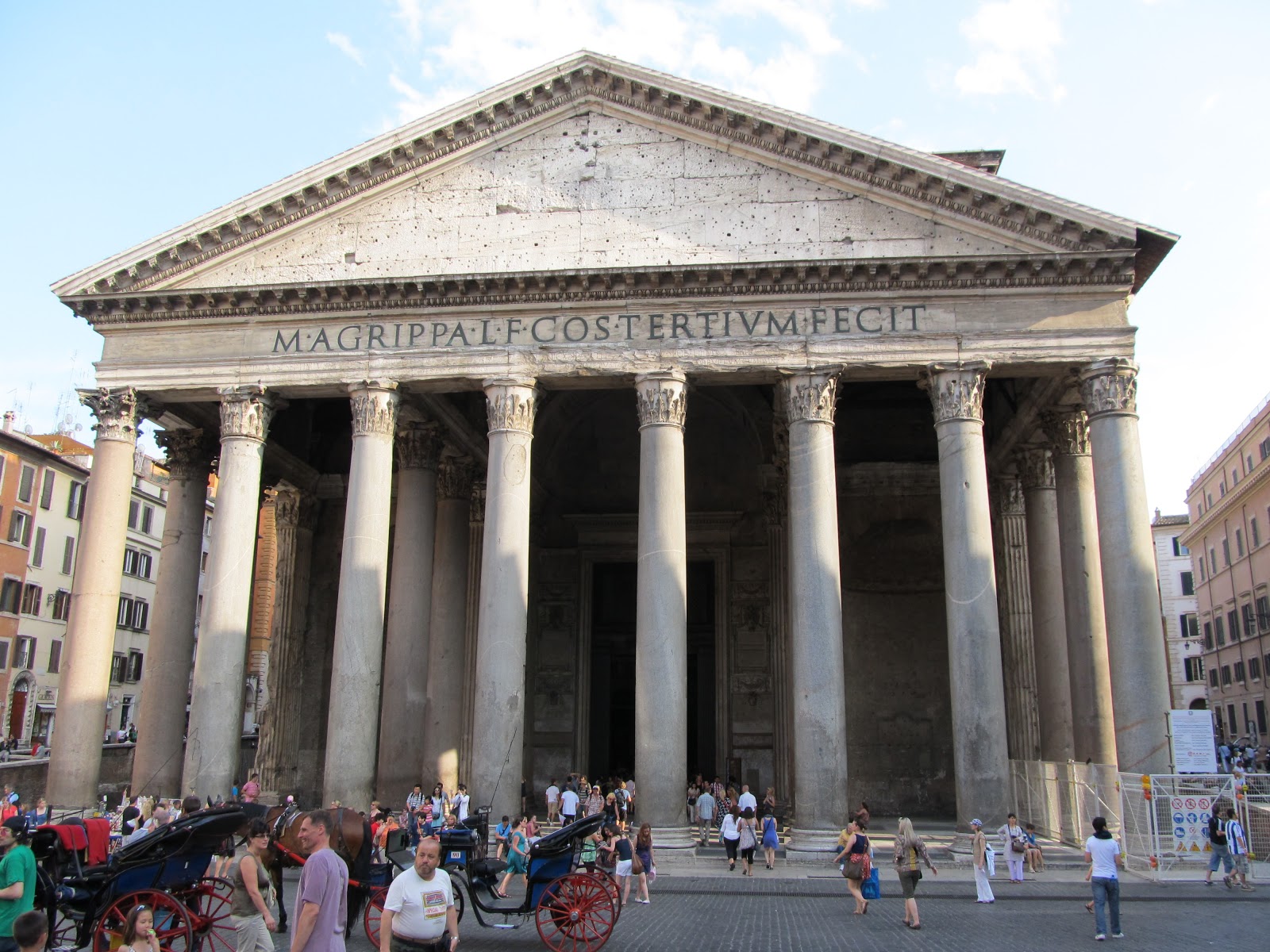
The Pantheon is actually the only building from ancient Rome that's been in continual use since its construction. [Citation: Rick Steves, and I have no idea where he gets his stuff from, so that could be a lie.] It was originally build by Marcus Agrippa in 27 BC, but the one we see today was rebuilt by Hadrian, one of my favorite emperors, in 120 AD. Its dome, which is 142 feet from floor to ceiling, was a model for the dome in Florence (which I've seen), St. Peter's (which I've also seen), and our capitol building (which I would be ashamed if I hadn't seen). From, the outside, it has impressive columns and huge gilded letters that say, Marcus Agrippa built this. He didn't, of course, but Hadrian wanted to preserve the prestige, I guess. From the inside, a single skylight lets down the only illumination the room gets, sending beams of sun from the sky to the corners of the room from the oculus.

Now, this building may have been in use so long that it's sunk a couple of inches below all the streets of Rome outside, but it hasn't always had the same use. The Pantheon was a temple to all the gods and the nooks that now hold statues to Mary and the saints used to hold altars for various gods, with the altar to Jupiter, the big shot of the Roman gods, at the place where the main altar now stands. It actually stayed in use as a temple for a couple of centuries- it wasn't converted to a church until 609.

I would love to say that there's an air of the ancient in the Pantheon, that it has preserved all the history of the other temples that have since fallen into ruins in the forum, bearing witness to the once powerful Roman gods. But since the oculus lets in rain as well as light, the floor gets redone every once in a while, and the statues are all kept clean and new looking. Much more modern people are entombed there- Raphael sits in a recess beside his Madonna and Child that he designed for his tomb, and some of Italy's most recent kings while away the hours of eternity there as well. That, combined with the announcement for Silence, please, in a variety of languages over the loudspeaker every few minutes, generally kills the ambiance of the ancient.


Raphael's tomb. The man had taste.
I'm not saying that it's not a wonderful sacred place. It's just one of those sacred spaces that seem a little less sacred because of the number of people in it treating it like a museum, or maybe a glorified bench. People approached the altar and sat down in the pews in front of it only to pull out a map or a guildebook and plan the next stage of their journey. Some talked over the announcement for silence, please. There was a veritable line of people in front of the altar, waiting to have their picture taken.

And how would you use this as a church, anyway? Is there a place for a sacistry around the back? There's no organ, no choir, though I've found that masses don't require songs. I'm so used to the processional space afforded by a longitudinal church with its rows of pews and columns, I'm not even sure where a priest would come in or go from here. It's more like a chapel than a church, made primarily for private devotion, of which there was not much while I was there.

I paused for a while in front of Raphael's tomb because it was lovely and because I admire the painter. I paused for a while in front of a few of the statues beacuse they caught my eye more than because I had a reason to pray in front of them. But really, I would have felt more comfortable sitting outside and leaning against one of the columns, much more familiar to me, out in the plain air and away from these imposing figures ignored by the people who ran from place to place snapping shots with their cameras.

Why do we visit churches anyway?

Tuesday, July 12, 2011

Roman Beaches

You know, generally, in life, I'm a fan of the beach. There's plenty of sun and when you get hot, there's plenty of water. You need a copious (man, I haven't used that word in a while. Copious.) amount of sunscreen to make it through, but really, it's a lovely time to loose yourself in a book or nap or people watch.

The thing about the Roman beach, though, apart from the black-grey sand (seriously, the beach looked like pepper and I was quite surprised), is that it's a bit of a trip from the city out to the coast. We probably spent a good three hours getting to our vacation away from our vacation, spending only a euro but, in terms of stress, should strain and sweat, we might as well have taken a cab.

It was wonderful to be at a beach town, though. They have McDonalds and little beach shops and, most importantly, easy access to the beach. It was literally right across the road from our hostel. We spent most, almost all, of our few days at the Roman beach out on the beach, occasionally swimming out in the sea but mostly worshipping the sun god or hiding from his anger under our rented umbrella. I was a little jealous of the old Italian man who walked the beach setting up chairs and taking down the left-over umbrellas, impervious to the sun's rays as he shuffled over burning sand, pipe in mouth and trash collector in hand.

The amount of people on the beach was the surprising thing to me. You probably think at this point that all I do is walk around with my mouth open staring in wonder, but honestly, once you get past the different colored sand, a beach is a beach. The people are what make it different. The beach proved the assertion that Europeans are just a lot more comfortable with nudity than Americans in general are, but other than that, it was just full of families, groups of friends, couples, solo sun bathers, everyone enjoying the same stretch of potential glass.

But the beach was full. Even on Sunday morning (it was just so much easier to stay at the beach than to try to go to a morning service in town and anyway, once you've seen one simple morning mass, you've seen them all; plus, the pope was out of town, so there was no way he was holding mass in the city anyway), people swarmed the sand, distinctly not going to church. Maybe it shouldn't surprise me, but I figured the country that had a guard at the door of their basilica making sure your skirt wasn't a few inches too short would have empty beaches on a Sunday morning.

Still, you could say we were worshipping something. I can understand why ancients would have worshipped a sun god. Maybe the sunlight is particularly powerful because of our ruinous areosol practices, but anything that can turn my skin red from such a distance, high in the sky, deserves my attention at the very least. It's just simpler- no doctrines to listen to people argue over, no deeply packed symbolism to try to uncover, no potenital mistakes to be made.

Just laying on a beach, worshipping the sun.

Vatican and Night Tours

I just realized that I don't have too much to say about the Vatican. It's got an awesome museum with mummies and cuneiform tablets, and crazy amounts of Greek statues, and you can even take pictures in there, but we went to the Vatican museum. It's substantial, but it's still a museum. And no matter how much I want to, I cannot make a museum interesting.
Nor can Clio, muse of history
After moseying through the larger-than-you-think Vatican museum, we make it to the smaller-than-you-think Sistine Chapel, crowded with tourists and, ostensibly, doesn't allow photography. But, since it's still a chapel, it's going to go in its own blog post. But, just as a traveller's tip- the Creation of Man is also much smaller than you think it is.

Rick Steves says there's an exit to St. Peter's Basillica from the Sistine Chapel that's used for group tours of both buildings. We were going to try to sneak past the guards (as condoned in the guide book) but the only tour groups in there were old or Asian and we didn't really fit in with any of them. We walked through the end of the Vatican museum, bought food in the cafeteria (recommendation- pack your own sandwich) and began the 15 minute long walk around the walls of Vatican City to get to St. Peter's Square (hint- it's an oval).

Sarai and I were going to climb up the dome, so we left Christine to the pigeons in the square and made our way through the lines. (Tip- it's to the right. The left, with the Swiss guards in the funny uniforms- that's the exit.) We stood and talked and paid for our tickets up and really, it wasn't a bad climb. Much easier than the Florence Duomo, maybe about as bad as the Berliner Dom. You can pay 2 euro extra and ride an elevator part of the way up, like Stephansdom. The easiest way for me to fall in love with a city is to see it from above.

Rome is lovely.


And of course, I poked around in St. Peter's Basilica for a while, but that's another post. Here's a picture, though:


That night we went on a night walk around Rome and saw squares and fountains and more obelisks and columns that I would have thought possible. Really, the Pocket Rome Rick Steves guide that Sarai got from a book exchange at a hostel was quite a catch. I like Rome by night, when the only tourists you have to deal with are at the Trevi fountain, or maybe the Spanish steps.

The horse says Flee from this place of difficult picture taking!

Audrey Hepburn was here. Also, Melissa Joan Hart in Sabrina Goes to Rome.

 There's just so much to see and so much to do. Rome on two days is almost impossible. Good thing we had more.

Monday, July 11, 2011

Ancient Rome

Have you ever been run over by an exceedingly enthusiastic 5-foot-tall almost 21-year old person?

It's an experience I recommend at least once in your life.

After an exciting trip from Florence to Rome, we got off the train a little hungry and quite ready to have our packs off our backs. I began to look around for the McDonald's, because Sarai said that she would meet us there if she wasn't at our terminal by 2:45 for some reason. I headed off in the direction of the Golden Arches when Christine said, "There she is!" And so it came to be that I was tackled by my friend that had spent entirely too many days around people she had just met. It was quite a wonderful beginning to a week's worth of adventure.

Sarai has been travelling by herself down from Reykejavic through Sweden, France, Spain and who knows where else and had already been in Rome a few days. With the help of Rick Steves, she had our next few days planned out for us. "I've been waiting until you guys got here to do all the touristy stuff," she said. "It's miserable to do it without friends." We were slated to tour the ruins of ancient Rome the next day and the Vatican the next. Having a rather easy-going nature (especially when someone else offers to navigate), Christine and I agreed to the plan.

Rome is a walkable city. The hostel we were staying at was in a quiet, nice neighborhood with a laundromat and a supermarket ("It's like home, you guys! You can find all this at home!") and it was wonderful to spend an evening relaxing in that atmosphere. What was not as wonderful was the walk to the ruins in Rome the next morning. Well, afternoon. You can't expect us to be up that early. We trudged through neighborhoods and under ancient arches, past churches and obelisks and something along the lines of fifty gelatto shops.

Then, never failing in her eloquence, Sarai said, "Guys? That's the Colosseum." The first of many times.

The Colosseum is huge and impressive in real life. I mean, it's cool in pictures, but we've seen so many pictures that you can't be amazed by another one. But you can be amazed by the real thing. It's flooded with tourists and fake gladiators (the thought of which led us to several cries of "Rory!" with no regard to the difference between a centurion and a fake gladiator) and pockmarked with the abuse of several centuries of scavenging, but it's still a sight to see. We started out with the forum, though, because if you buy the ticket in the shorter line there, you get to pass the insanity-inducing ticket line at the Colosseum.

The Roman Forum is impressive to me mostly because I took a History of Rome class, where my professor had a British accent and a thousand stories about the Romans. I heard about the rise of the plebians and learned when to cite Scipio or Pompey as a leader or instigator in this or that war and fumbled through the line of emperors after Julius Caesar tossed off consulship for dictatorship. Most of the Rick Steve's tour was something half remembered for me, though it helped to have someone tell you the difference between these three collumns

and these two collumns

Or this arch

and this arch.

The Forum is a maze of leftover stones and temples, like the Temple of Saturn

or the house of the Vestial Virigins


or the place where they burned Julius Caesar's body, left as a temple to the deified Caesar by his heir, Augustus.

Seeking momentary shade from the afternoon sun, we climbed stairs that we hoped would lead us to Palatine Hill, the location of the palaces of the emperors, but instead we found a dark room with a fountain and a creepy, unmarked passageway that lead down a decaying flight of stairs to a corridor of unknown destination. Of course I went down it. Who isn't emboldened by an afternoon's history lesson about the workings of the Roman Republic and Roman Empire?

There isn't an epic end to this story, though. The hall turned into a dead end with a well and absolutely no zombies, werewolves, vampires, witches or wizards. Not even a skull for good measure. If I were going to tell this story in real life, I would say that I went down this creepy cave stairway...
 and then I found five Euro. Gotta make it interesting somehow.

Palatine Hill afforded a lovely view of Rome and a great many more ruins, but the trip over to the Colosseum was infinitely more interesting. First off, the stairways and paths out of the Colosseum were called the vomitorium because the Colosseum could spew people like a frat boy spews PJ, getting rid of its entire 50,000 spectator population in an esitmated 15 minutes. If you need anything more interesting than that, you can see the outlay of the backstage part of the Colosseum where they kept the various animals and people that the gladiators would fight. The museum part wasn't particularly exciting. You have to take a step back and realize that when you're looking at these shards of pottery and bits of animal bones, you're looking at someone's trash. I'm glad all of our stuff is paper and will therefore not withstand the test of time. Otherwise, people are going to think we exchanged precious money to worship the cult of the Golden Arches and philosophers will spend centuries pondering the significance of the Golden Arches' association with a clown.

Be distracted from my cynicism with a cross!

It was put there in memoriam of the Christians who may have been killed in the Colosseum. I mean, it's known, or at least reported, the Nero launched a massive persecution of Christians after the great fire in 64, even using them as torches to light his garden at night, but they probably weren't killed in the Colosseum. Still, it's a nice thought. The cross, not the burnings.

The Forum, Palatine Hill and the Colosseum are, in fact, not close to the Pantheon, which is different from the Parthenon, which is in Athens. We walked over to the Pantheon and took many wonderful pictures, but since it's now a church (who knew?), it'll get a post to itself.

And that's how I got massively sunburn walking around Rome.

The end!