Showing posts with label Gothic. Show all posts

Tuesday, July 26, 2011

Catalan Gothic

I am an intelligent young woman who has the potential to do great things. In fact, I have already achieved great things by my own standards. A BA in physics is not something to be laughed at outright. I am proud of myself and my accomplishments.

I have to have a statement of affirmation like for times like these.

Goodness, I'm in a cold sweat just thinking about it.

I'm going to try to explain Catalan Gothic to you, as opposed to the other kinds of Gothic architecture you'll see around the continent of Europe. (Note: most of my information comes from two wikipedia articles and a neat site called Sacred Destinations where I actually get a lot of my stuff from. I'll check it with a library when I get to back to Chapel Hill.)

And I have no experience with art or architecture history, which means I'm probably going to sound dumb. Sorry for sounding dumb. But here goes nothing!
Here, be momentarily distracted by a picture of a cathedral.
So most of the churches you're going to be visiting if you're visiting the famous ones around Europe are going to be from somewhere between the 6th (500s) and early 19th (1800s) centuries AD. This is, broadly the Romanesque, Gothic, Renaissance and Baroque time periods in architecture (according to the timeline at about.com, but there's also a pretty clickable and interesting timeline at HistoryWorld). Personally, I've seen a lot more Gothic in Germany, Austria and France and a lot more Renaissance and Baroque in Italy, but they're certainly not limited to these regions. Of course, each church was built under its own circumstances and influences, and you'll have modern churches, like La Sagrada Familia, being built in styles of their own but paying tribute to the styles before them, but a lot of the time, you'll walk into a church and the guide will have one of those architectural styles as the main style of the building.

Gothic isn't actually the word they used when they talked about the buildings we call Gothic at the time they were being built. They were being built in the "French" style then, and you do have a lot of your canoncial examples of Gothic architecture in France. Pointed arches, flying buttresses, awesome stained glass and rose windows, heavy decoration on most of the surfaces and twin towers at the facade of the church (these actually came from processions during Holy Week- you'd mount one set of stairs to be symbolically crucified and you'd descend the other to symbolically go to the grave). They only started calling it Gothic in the Renaissance or later, and even then, they called it that as a bit of a diss, equating Gothic with barbarian vandals.

So you take that kind of style, with the big churches, etc (that I have since seen a lot more of, so it seems that I did this whole thing backwards, especially if you think that I saw a lot of Renaissance before this) and you tweak it a bit in Catalonia, which is a region in Spain, like Andalusia, etc. You're mostly going to see this in Barcelona. The churches built in this style were built on that borderline between the Gothic and Renaissance stages in architecture and in particular, Barcelona Cathedral and Santa Maria del Mar, the two that I saw, were built by the same king- King Jaume II. Of course, this was built in a time when this part of Spain had a lot of influence- just as the cathedral in Seville was built after the Reconquest, these projects were started after a growth in power; Santa Maria del Mar was built after a victory at sea in 1324.

The main differences you're going to see in these churches are a lack of flying butresses, which, if you haven't seen 'em yet, you're not going to miss them; less emphasis on stained glass, which I could see; more somber decorations, so much less of the "let's carve every surface with a saint!" impulse that you'll see on other exteriors; equal height naves- you're not going to see the height of the church change at any stage; and less noticeable or non-existent transepts, the cross bars of the church. The bell towers that go along with these churches, if there are any, are generally separate buildings.

OK, that's done. I can break out of the nervousness. Barcelona Cathedral is in the gothic section of Barcelona and has one of my top ten favorite gargoyles.
Imagine a Howard Dean yell coming from this unicorn.

It's dedicated to Santa Eulalia, who's also a patron saint of Barcelona. She was just a kid when she was martyred by the Romans in the fourth century, burned at the stake. Her crypt is right below the main altar.

Barcelona's cathedral has a stand-alone choir like Seville's, but it's also got a glass door, so you're not entire blocked by the structure if you're stuck in the back.
Do you see the door? I do. 
My favorite thing about this cathedral, though, that sets it apart from all the others is the cloister.

With geese.
No one's sure how they got there, but they might symbolize the saint's virginity or the former glory of Rome. I'm sure they're delighted about both of these options.

Now Santa Maria del Mar is a prime example of Catalan Gothic.
Pretty low-key stained glass windows.

Not overly-decorated.

This actually doesn't have anything to do with Catalan Gothic, but I thought it did and spent a while taking pictures of it. Though, it's a seal of some kind and Catalan Gothic is due to an increase in prominence for the Barcelona crown, so maybe?


 Pretty much everything I listed goes here; most noticeably, the lack of decorations. This is also due, in part, to the burning of the interior that happened during the Spanish Civil War. The walls are still blackened in places.

It was actually a charming little church. Not busy, and you could see your way around the church. Quiet. How many of the people here knew that they were looking at a prime example of a specific type of Gothic architecture? How many of them would have cared? This is something that's really struck me while I've been going around- most of the people who are here saw a pretty building and stopped in. The story the church has to tell stays hidden until you go looking for it, unless you're looking at the darkened patches on the walls. The signs on the wall describing the facets of the church go mostly unread when they're around at all.

It just seems like there's a lot of good stories that are just getting missed out on.

Sunday, July 24, 2011

Seville Cathedral

Can I tell you a secret?

I've already seen the cathedral in Seville.

It's kinda the reason I went on this trip.

Whew, that's a relief. I'm glad we got that out there. See, I've been a world traveler since the 8th grade. I went with a group from Suzuki School of the Arts in Hickory where I took flute lessons to Germany, Austria and Switzerland over spring break in my last year in high school. Then, in the summer after my junior year of high school, I went with Crossflame Youth Choir, the choir from my church in Hickory, to Scotland. I played flute then too. And lastly, I went with Suzuki one more time over spring break senior year to visit Spain.

On our trip in Spain, the planned visit to Seville turned out to be more of a pain than expected- about three hours in the coach for a day trip to the town. But I had read about Seville in a footnote about a Shakespearean joke during my English project comparing three Shakespearean sets of lovers and I was determined to visit. I went into the cathedral with a lady from my church and I walked around totally confused. There were all these side chapels with these metal fences in between me and them, and then the altar was in this box by itself, in front of a crazy carved wall. There were four organs and this huge box in the middle of the cathedral, also blocked off. It made it so that any lay person attending a service here wouldn't be able to see anything. And where was the pulpit? Where did the choir sit? There wasn't a choir loft. I mean, it was big and pretty and I loved moving from chapel to chapel and looking at the art, but overall, I left confused. We climbed the bell tower and I saw a wonderful view of the city and was honestly quite in love with the space again.  (I was going to show you pictures from then because I didn't make it up to the top of the bell tower this time, but I shudder at the quality of pictures back then compared to now. So sorry, you're out of luck on this one.)

Now, coming back to Spain, I was quite excited to see Seville again. I'd have loved to see Segovia again with its acqueduct, and Cordoba would have made a good story with its converted mosques and Moorish influence, but I was quite content to walk back into this cathedral that started my questioning about sacred architecture.

I walked back in just as confused as always. After all, you have this huge space, the third largest in Europe by area but the largest by volume, soaring up from columns all around you, and then you plop this big box down in the middle of it.
That's not the altar. And I'm sorry that the whole cathedral appears yellow...

That big box, by the way, is the architectural choir. Often, you have clergy sitting in there, or choristers. It's a bit of a trademark of Spanish cathedrals to have an architecturally distinct choir. The choir stalls in there are from the 15th century.

 And just like I thought, all the lay people coming to the service have to sit either in this tiny space between the choir and the chancel, or out in the wings, being unable to see anything. It reinforces the power of the clergy and the wealthy.

And this cathedral is wealthy. It was built on the spot of the Almohad Mosque with the gold and jewels of the recent Reconquest, the taking of the Iberian penisula back from the Moors who had invaded. The large orange grove and the bell tower are the remnants of the mosque.


Ways I identify Moorish influence: Does it look like Aladdin could have been here? (My Islamic Civ prof is shaking his head at me.)


The bell tower used to be a minaret. The treasury has plenty of golden things at which to look.
Above: Examples of Shiny Things

and that busy wall behind the altar is actually the world's largest altar piece, made up of 45 scenes from the life of Christ and covered in gold. The whole place fairly shines.


I'm real bad at identifying scenes when distracted by the shiny.

And so I wandered around again, looking into side chapel after side chapel. I paused in front of the tomb of Christopher Columbus, brought back from its original home in Havannah in 1902 after Cuba gained independence from the US after being taken from Spain in the Spanish-American War.

 I also stopped again and looked at this picture of a giant that has never ceased to baffle me,

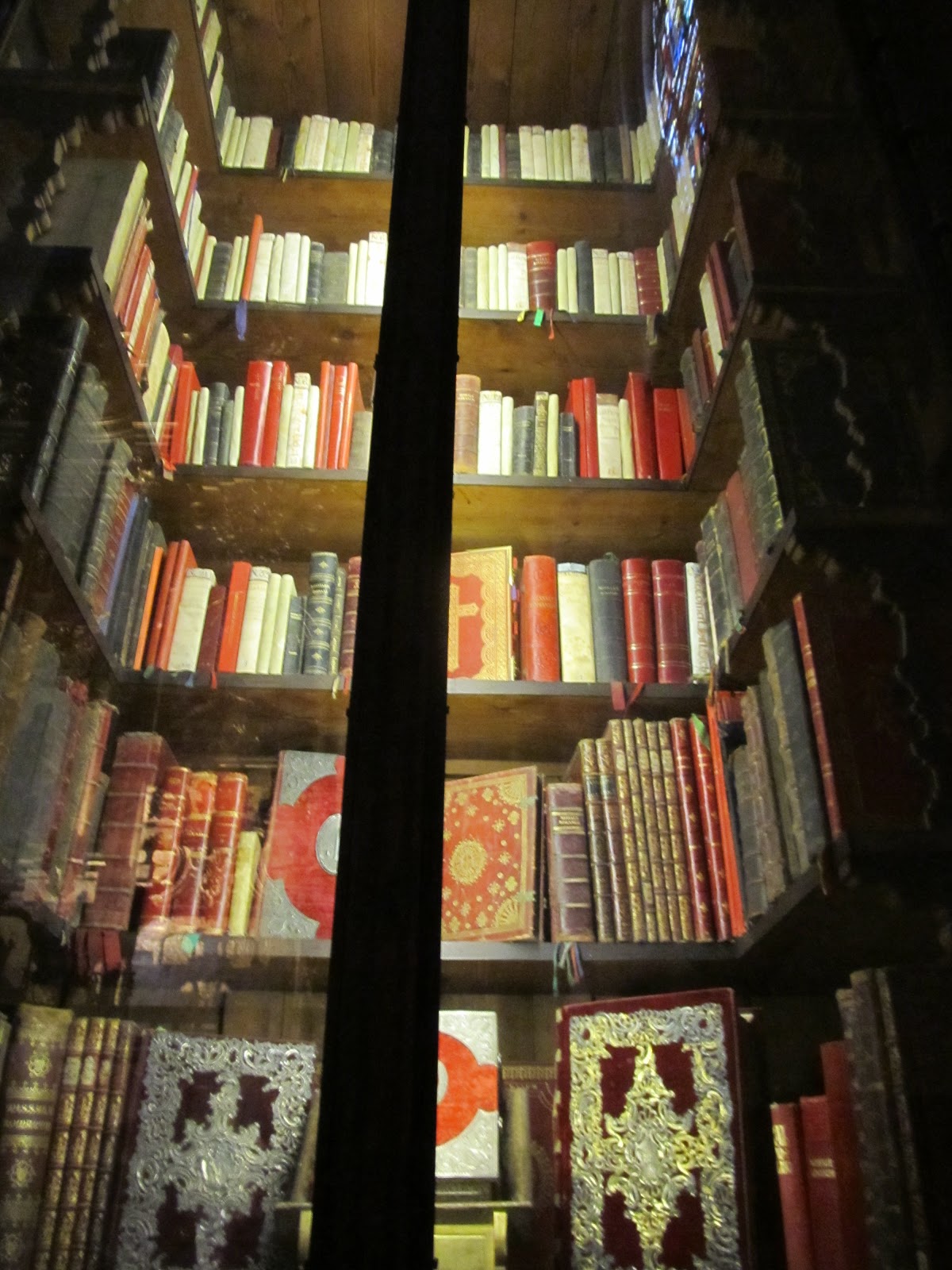
 and walked in to see a bookcase in one of the chapels.
The only books I've seen in a cathedral that aren't for sale.

One evening I came back for mass. There was a wedding on the other side of the church, but it's such a large space, a quiet mass in one of the chapels couldn't mess with the ceremonies going on in other places. During the service I let my eyes wander, once again being stuck in a service in a language I didn't understand. First I let my mind wander up to the top of the chapel, where a real bird flew back and forth in front of the painted dove. Next I followed the old Spanish ladies and their fans with my eyes, standing when they stood and kneeling when they knelt. One of the daughters of the older ladies came up and read the scripture before the sermon. Even as she walked back to her seat, I watched her mother's fan sweep back and forth, back and forth, bringing a little bit of cool in this building that still reflected the heat outside. The air was thick with the ceremonial incense by the end of the service. I felt oppressed by the sweet smell, delighted to go outside and away from the smoke by the end of it.

Cathedrals like this were built for show, to tell the world how the people who had the building built were blessed. I feel out of place here, in a building built for the division of classes of people. At the same time, it's beautiful and impressive, holding the history of a city and a country in its old walls and in its new patrons. While it will never be my favorite cathedral, I'm quite glad I got the chance to see Sevilla again.