Showing posts with label Paris. Show all posts

Saturday, August 6, 2011

Notre-Dame de Paris


Did you know that during the second world war, they took the stained glass windows out of Notre-Dame and put them in storage, for fear they would get blown out? I've seen this in a couple of places and it makes me wonder  how they did that. Seriously. You've got three rose windows- one at the west end, the big one, between the two front towers, and then one at each end of the transept, facing north and south. And beyond that, there must be near on a hundred stained glass windows besides the rose windows. They're everywhere. Notre-Dame's a Gothic Cathedral. It's the example you think of when you think of Gothic architecture. If you're me. So I'm puzzled and astounded by the amount of effort they had to put into it. Grateful, though.


Did you know that Notre Dame was probably the first place to use flying buttresses? They weren't even part of the original design, it's just that the walls were thinner in the Gothic style and they started to buckle under the weight of all the stones being added on top of them, so the architects threw these things in and they got popular as the style spread. It had a while to spread- the cathedral was finished in 1345. Just think! This is a building that's been around for nearly seven centuries. And somehow, with all our changes in fashion and taste and style, we still find it beautiful. Or I do, anyway. Me and all the people lined up across the parvais to see it.

Did you know that in the French Revolution they took out all the religious symbolism in the church and made it a Temple of Reason? They actually thought that the kings of Judah were kings of France and beheaded them. They replaced Mary over some of the altars with Lady Liberty. This place, this church that's so iconic to us, it was turned into a place were you didn't pray to God. I mean, this says all sorts of fascinating things philosophically, but I have such a hard time seeing this space as anything but a church. I love the gargoyles, pagan symbols though they be, and if you hadn't told me those were kings, I wouldn't have known, and the saints lining the doors could be any old people from that time period- well, maybe all of them except for St. Denis.
Noted Cephalophore
 But inside, smelling of incense and laid out in a massive cross with those choir stalls and those ceilings leading the eye up and up? They actually used this place to store food at one point in time. Strip the walls bare and it becomes a granary. And that's what some people saw in the cathedral.

Did you know that Victor Hugo wrote The Hunchback of Notre Dame about a time period much before his? We get confused about these things- all history is history to most of us. He was alive in the 1800's, after Napoleon had restored Christianity to the cathedral and been coronated in it. But Victor Hugo wrote it about the end of the 15th century, I think. I love the themes Mr. Hugo talks about in the book- there's all this about whether we actually have free will and the problem with class differences and the objectification of women. He also advocates for the repair of the cathedral, which, in his time, had fallen into disrepair, without being entirely restored from the damages of the revolution, and preservation of historic buildings is something I can certainly get behind. The cathedral is the main character of his book- it weathers all the injustice and stands solitary at the end.

Other people have taken the story and put a different moral spin on it. Disney, not famous for preserving plot lines anyway, makes the moral of the story acceptance of people who are different. Not universally, of course- Quasimodo ends up blessing the union of Esmeralda and Phoebus, because the two pretty people are the ones that should be together, but, you know, Quasimodo's had his one day out there and can happily go back to his bells and his church without the oppression of his former master, having been accepted as a good friend to Esmeralda and Phoebus alike. Notre-Dame is really the actor who paved the way for all of this justice- she protected Quasimodo from death as an infant and she allowed Frollo to fall, giving Quasimodo life as an adult.

If you see Notre-Dame de Paris, the musical based off of the story, there's this overarching theme of justice for the immigrants, for the gypsies that have made Paris their home. They demand sanctuary from Our Lady, and liberation. The cathedtal is a safe place, more than it ever is in the book, where the gargoyles watch over Esmeralda, where in the winter it's not too cold and in the summer it's not too hot. The bells are Quasimodo's loves. Even if, by the end of the musical, all has fallen into tragedy, the words of the songs have made their point- the gypsies and the outcast bellringer are the heroes of the story, not the captain of the archers or the curator of the cathedral. The opening song of the opera says that this, the time of the story, is the time of cathedrals. Man has reached for the stars, to write his story in glass and in stone.


Is it an exclusionary story, the one written above the doors and in the stained glass of Notre-Dame? What does someone with no idea who these people lining the doorways see, what does a pagan see in Mary when she walks into the building dedicated to her?
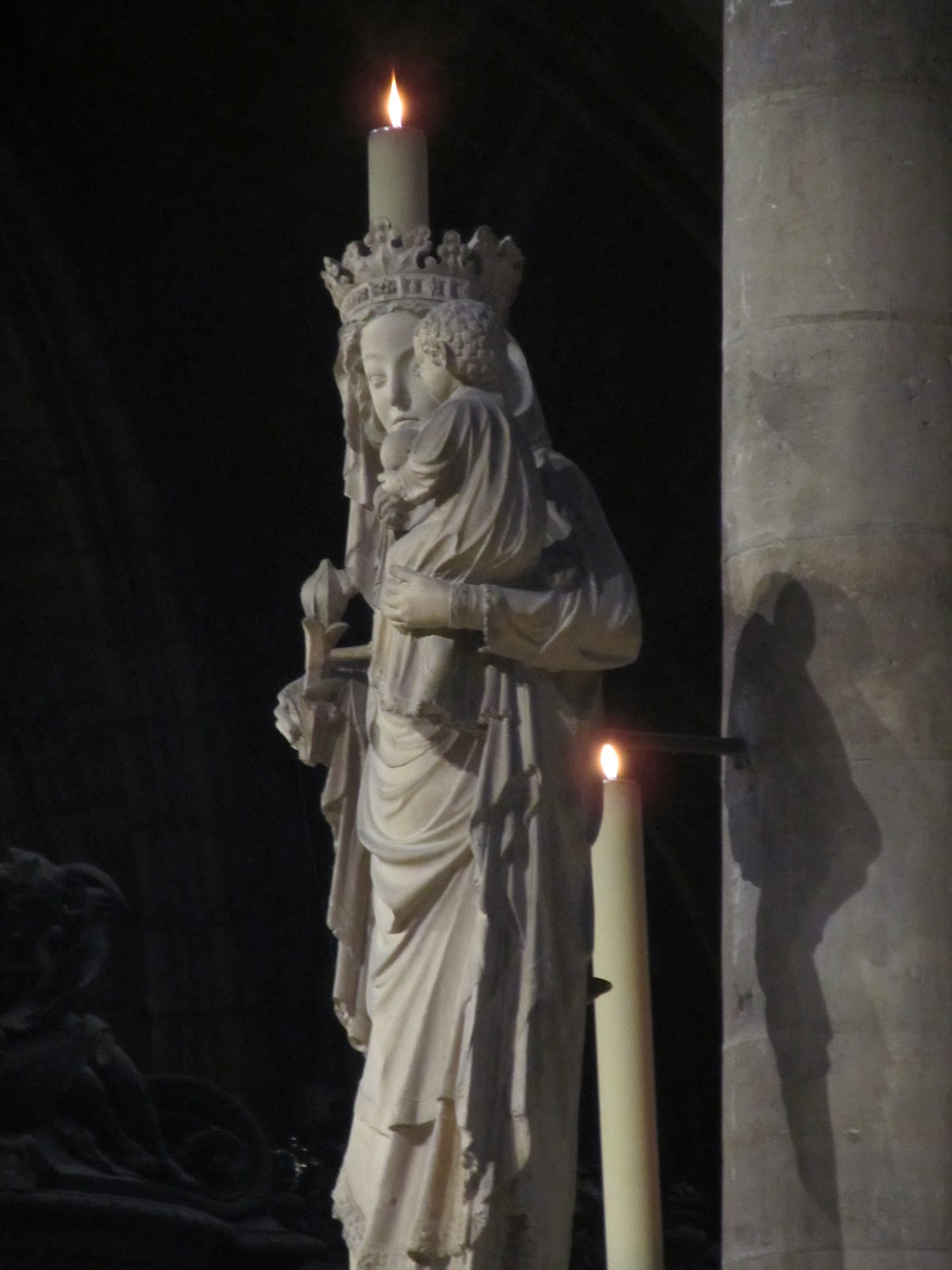
That's actually one of the things that I notice most in the three versions of the story I'm most familiar with, Esmeralda praying to Mary. In the book, it's rather tongue in cheek- Esmeralda is deathly afraid while the cathedral is being attacked by her liberators, and Victor Hugo says that, in times of need, one always prays to the god to which you're closest. In the Disney movie, a wiser Esmeralda walks along the halls of the cathedral, asking for God's help for the outcasts. We get to hear from the good people of Paris too, asking for love and glory and God and his angels' blessings, but Esmeralda doesn't ask for anything for herself, just for those less lucky than she is. And in Notre Dame de Paris, Esmeralda asks for protection from Mary, but she also asks for the barrier between herself and Mary and between brothers everywhere be taken down. I think all the prayers have beautiful points to them.

I wore my Esmeralda skirt on the Sunday when I went to mass at Notre Dame. I carried it around Europe for two months because it was definitely, definitely below the knee, a flowing green skirt that reached halfway down my shin. It really saved me in Rome, making sure I could get into St. Peter's without suffering in my jeans all day. I was being better safe than sorry in Notre-Dame. Really, given the choice, I would have loved to walk in barefoot and fit the part of a gypsy- my skin was still tan from Rome and Spain and sunny days in the south of France and my hair has grown to a remarkable length, curling unruly along the way. All I need are some gold earrings and I'm set, total gypsy. And that's all I ever want to be. I want to be the other, the outsider, the underprivileged, the one deserving pity and the one commended for rising above the sorry lot life has given me. Then it's not me that has to change the way I look at the world. The world has to adjust to me and my claims to be fair. It's so much easier to be on this end.

I bet you thought I was going to talk about the building, didn't you? The famous gargoyles, not even half as old as the building itself, the flying butresses, the carved altar stalls and the pieta and the statue of King Louis XIII and the crown of thorns in the treasury? Or maybe about the saints outside the doors, St Denis and the statues of Mary and Jesus and Peter and Paul, or the saints inside the doors, the statue of Joan of Arc whose redemption from heresy was carried out inside these very walls? Maybe I would detail the services for you, talking about the intriguing sermon preached in French from the surprising priest who stood behind the lectern with one elbow leaned against the Bible in front of him or about the sound of the organ as it played, sweet and beautiful, throughout the building, just softer than the choir that sang on Sunday morning hidden back in the choir stalls, or about the procession from the sacistry, incense smoke leading the way through the tourists still filling the halls and up the center aisle between the chairs and back out again, standing in silence broken by music as the cross came into and left the sanctuary?

But I've seen so many cathedrals. I've been to so many masses. Without the words to differentiate them, they're all the same. And these churches, they're all laid out the same, they're all used the same, when they're used for mass. The difference between all of these churches lies in their stories, and Notre-Dame de Paris has so many stories attributed to it. They're stories that I hold dear, because I love each and every one of the renditions of Mr. Hugo's novel. I love his idea and his protest against the injustice he saw. I love the ideas and the themes explored by the musical. I even love the Disney version with the unquenchable hope of Quasimodo only momentarily displaced from his bells.

This church, this cathedral, inspired one man to write a story and that story has been adapted so that people can hear it anew and can focus it on the problems they face in their own worlds. And that's what cathedrals are for. Yes, they are places of worship, yes, they are places that display the percieved power and glory of the God that blessed each of these nations with enough money and might to build such a building, but now, after all the history that has passed between the building of these cathedrals and us, all these buildings have left are their stories, their proclamations of times gone by. But this place, this one cathedral more than any other, has allowed her story to be molded to benefit others, to benefit, in point of fact in all cases, the least of these and though the building and furnishing of this cathedral proclaim's religions benefit to those with much, that's not what Christ came to do.

I love a faithful church.

St-Germain-des-Pres et St-Sulpice

St. Germain of Paris, according to the Catholic Encyclopedia, was the "Bishop of Paris; born near Autun, Saône-et-Loire, c. 496; died at Paris, 28 May, 576. He studied at Avalon and also at Luzy under the guidance of his cousin Scapilion, a priest. At the age of thirty-four he was ordained by St. Agrippinus of Autun and became Abbot of Saint-Symphorien near that town. His characteristic virtue, love for the poor, manifested itself so strongly in his alms-giving, that his monks, fearing he would give away everything, rebelled." It was for this awesome man that the oldest church in Paris is named.


St. Sulpice doesn't have the same kind of interesting biography, so we're going to talk about the gnomon of St-Sulpice. It consists of an obelisk, a meridian line that goes North-South and a little light from a window in the transept of the church that lets in a disk of light that moved up and down on the meridian and helps tell time. Unless it's raining. Which it often is in Paris. It was built at the initiative of a guy named  Jean-Baptiste Languet de Gergy,who has a really fun name to say, I have to say. There was also one of these set up in the Florence Duomo. They used them to help us figure out the calendar we use to day. Yay science and religion! Also, St-Sulpice? 2nd biggest church in Paris. 


Does this count as having done a blog post on these two churches? I mean, there are like three links and I'm fixing to put in pictures. Well, I just did, but you can't tell that unless I do a screen shot. Which I didn't think to do. So now I could have just lied to you. Also, what is that angel doing in the picture to my right of the gnomon of St-Sulpice?


This, this kind of exhaustion with the topic, is why you shouldn't visit more than one church in a day. I mean, maybe you can see two, if you're determined. But the thing is, I saw these two churches on my last day in Paris, and that was quite a busy day and anything I tell you is going to be pulled straight off of google, I can tell you that for a fact. I mean, I could tell you that it was raining that day and that there was a guy with a guitar on the steps of St-Sulpice and that St-Sulpice has a bamf organ... and that there's a cafe right across the street from St-Germain-des-Pres that was pretty popular with Hemingway. 
Also, St-Sulpice isn't balanced- the south tower was never finished. 


Paris has many amazing churches. Rome has many amazing churches. Europe has many amazing churches. You can spend forever in these places, seeking out different buildings and seeing new old things. You know what I'd love? I'd love the chance to actually explore these places. To climb up in the towers of the churches or back in the rooms we're not allowed to see. I've seen Gothic ceilings and arches and I've seen Romanesque and I've seen... pretty much everything you want to throw at me at this point. I want to explore now. I want to see how these churches function as churches. And that's something that a cursory visit won't tell you. That's something you have to, you know, actually talk to people about, set up appointments, etc. 


You know, something that requires effort. 

Thursday, August 4, 2011

Sacre Coeur

Joan of Arc was the bomb. Can we talk about that for a second? She fought and helped beat the English in some battles in the Hundred Years' War before being captured and sold to the English, who tried her for heresy and executed her. WHEN SHE WAS 19. I can't even understand. I feel shamed just reading about her. And I was going to talk about her when I talked about Notre-Dame but I got distracted. The things I would have liked to achieved by the time I was nineteen.

What does this have to do with Sacre Coeur? Oh. Well, there's a statue of her outside. Here, be distracted from my lack of photo by another one of those virtual tours. She's the one on the right.

You can't take pictures inside of Sacre Coeur, the Romanesque-Byzantine basilica on top of the highest hill in Paris, Montmartre, where St. Denis is said to have walked after being beheaded. The doors into the church are flanked by a king and Joan of Arc. That's how awesome Joan of Arc is. She's on par with a king. The church was built in the 19th century, paid for by the people of France and built in reparation for the sins of the country in the recent war.

I wish I could show you the inside so I could make a Katy Perry Firework joke. It's a basilica dedicated to the Sacred Heart of Jesus, depicting the Savior as caring and loving, as opposed to the one who comes in terrible glory on the Day of Judgement, which is what you normally see on the outside of churches. Really, I've seen so many Day of Judgement depictions. They're pretty easy 'cause then you get to put both angels and demons, virtues and vices, the saved and the condemned, in one place. Anyway. Sacre Coeur focuses on Jesus' heart, which is outlined with big golden rays of light. I can the Byzantine influence best if not in the domes, in the golden mosaics inside. (You should actually click on this link if you want to see the inside of the church.)

But really, I just wanted to be around the church. I wanted to be by the stairs that climbed La Butte, the hill that Sacre Coeur sits on and I only wanted to be there because I've listened to this song ad nauseam. Even though it's a love song, it talks about the stairways and how they're hard on the miserable. And I love that line- I have a bad habit of putting it in French as my Facebook status. I don't know what it is.

But then I actually went to Sacre Coeur and have added people selling things to tourists on my list of least favorite things in the world, coming in above Duke fans. Yes, those intrepid salesmen who shove cheap souvenirs in your face regardless of your preference in buying said souvenirs actually make the list above the Cameron Crazies. Now I hate for things to be ruined for me. It's like finding out that Han shot first and realizing that your life is a lie. This wasn't precisely on this scale, but I would love for a village of Bohemian writers at the turn of the century to retake Montmartre. And I would like for there never to be another tourist again. Ever. EVER.

I have these dumb noble thoughts about how the heart of Jesus is helping people and how He would be distraught to see the people on His hillside. Then again, maybe the people He'd like to help are already on His hillside. Maybe the tourists and the salesmen alike belong to the Sacred Heart.

But really?

Tourists?

You know, He could always care about people for whom I couldn't care. I've got a lot of learning to do.

Sainte-Chapelle

So Sainte-Chapelle, or the Holy Chapel, was built by Louis IX to house relics of Christ's passion. He decided that this would be a good idea after he got ahold of the Crown of Thorns. Which, quite honestly, if you could guarantee me that this was the real thing and I have no idea how you would do this scientifically, would be something that I would go see. And, to a people without the word science to hide behind, this Crown of Thorns obtained by Louis Number Nine was pretty much the... (really, if you lived my head you would appreciate the irony of the word I was going to put there) ... coolest thing ever. Not even the coolest thing since sliced bread, because they hadn't sliced bread yet.

But the Crown of Thorns is currently housed in Notre-Dame, just down the road on the Isle de la Cite in Paris, and so you don't really hear about that all that much. What you do hear about though, is the stained glass.

There's actually quite a lot of it there.

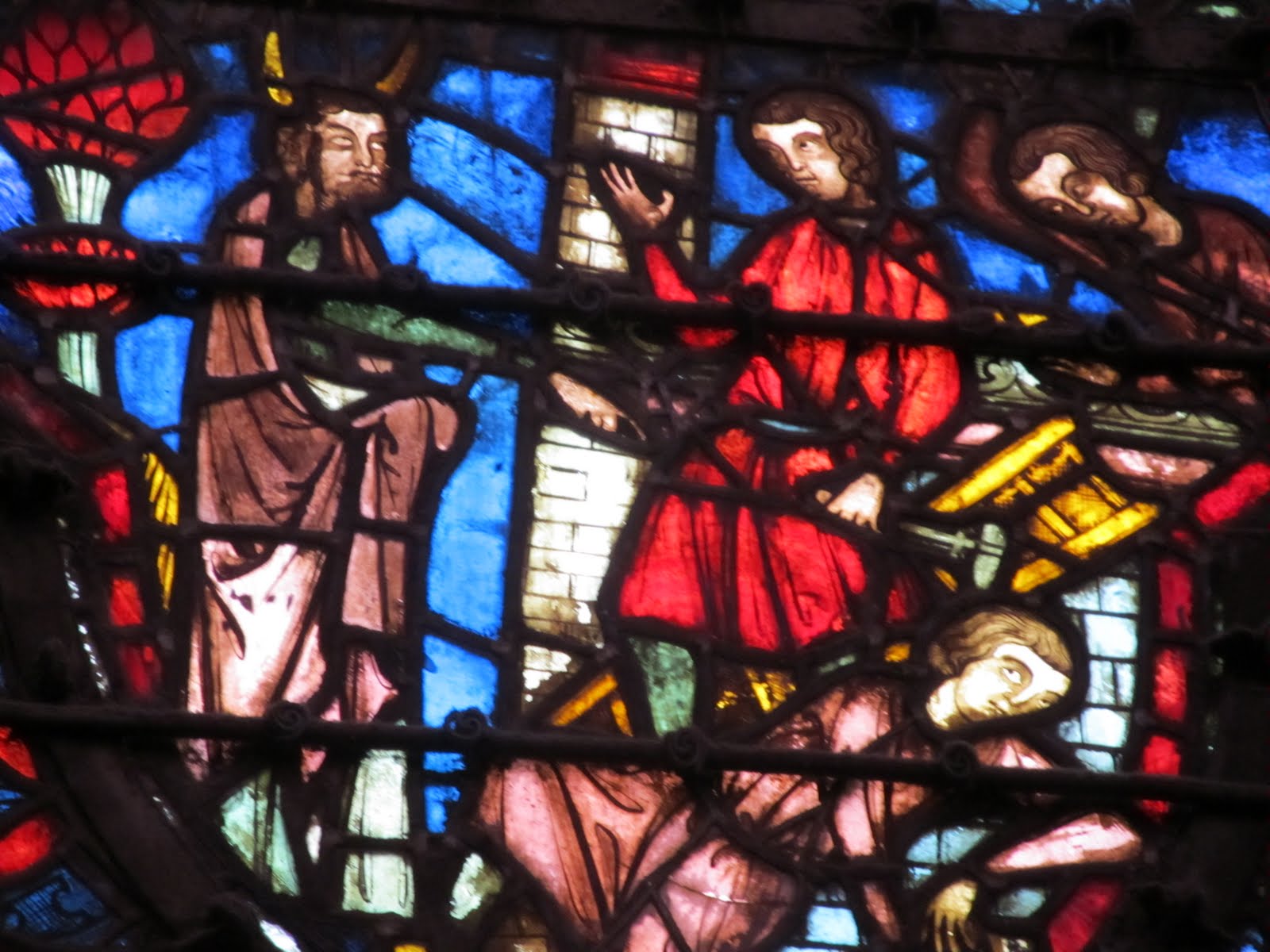
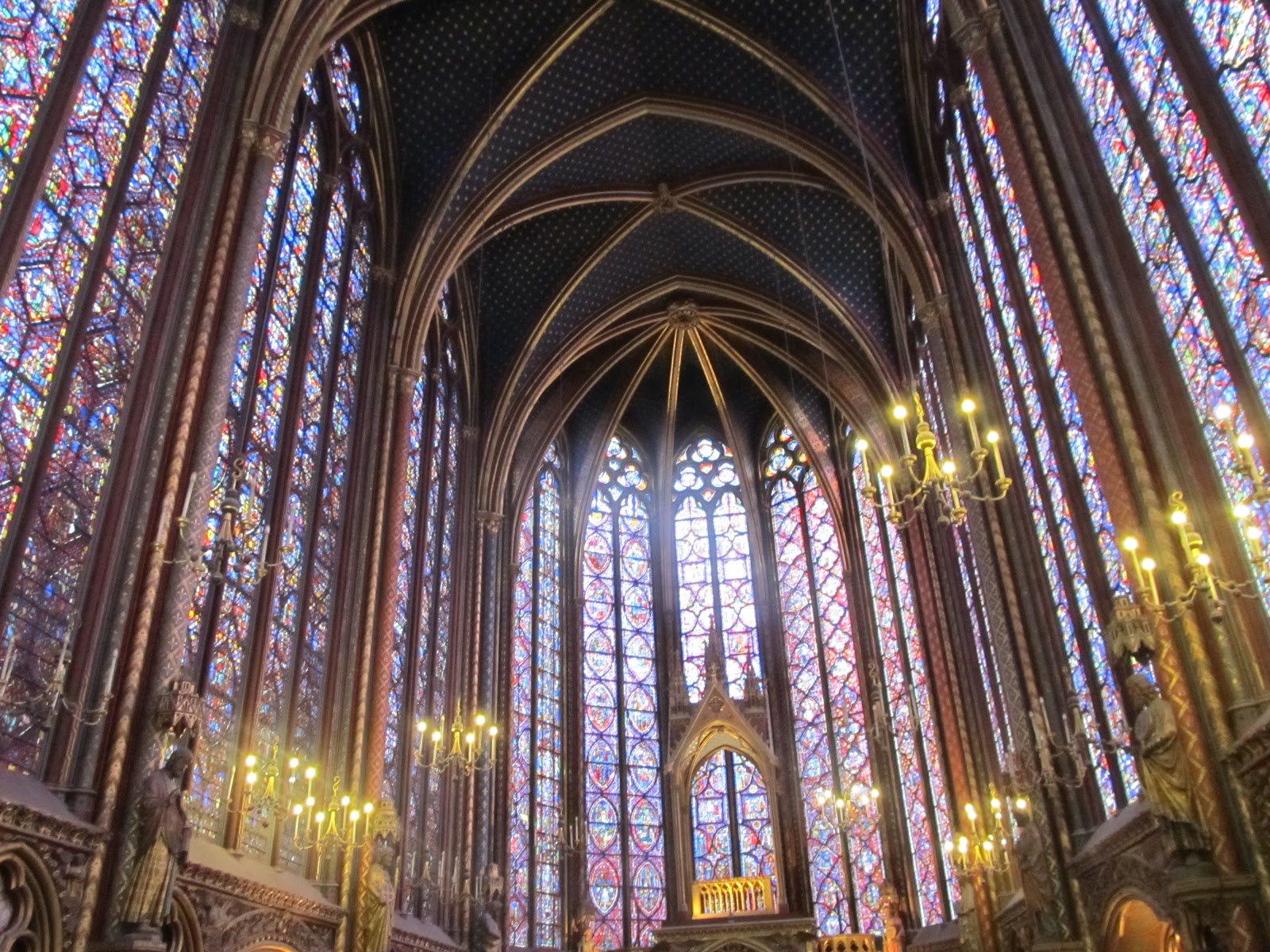
It's a jewel of Gothic architecture, according to most. Each of the panels of stained glass tells a different set of stories from the Bible. You've got Genesis and then Exodus and some Moses
You can tell it's Moses because he's got horns. Also, did I tell you my Biblical Hebrew professor named his son Moshe? Presh. 
 and then Numbers, not the most enthralling of the books of the Bible, Deuteronomy, Judges, Kings, etc, and then on to the New Testament with scenes from the Gospel and a Passion window right behind the altar. We run back to the old testament down the sides until you end up at the story of the discovery of the relics near the exit. There's a big rose window, too, and that's got Revelation. Here, you can look around for yourself in a virtual tour. I love those things.

Stained glass is actually pretty cool. I used to think it was a lot cooler than it is because of this urban legend that the stained glass in very old churches sunk to the bottom of the frames, leaving gaps at the tops and proving that glass was actually a liquid. I would always get this story confused with Non-Newtonian fluids like silly putty. This is false, it's actually just an attribute of the way the glass was made, but glass itself is pretty interesting, as far as amorphous solids go. But I digress. Glass is made from silica and the glass is colored by mixing in different metallic oxides. According to the guide in Sainte-Chapelle that I sat and read as I tried not to cry after I realized that a sizable chunk of my cash was missing (stillangryatthelittlethiefeventhoughIknowIshouldn'tbe andit'smyownfaultbutstillJERKSforabusingthedeafand dumbtohaveanopportunitytotakemymoneyaaaaaaahhhhhhh), there's only six colors that can be made- red, blue, green, yellow and purple. But this site tells me differently and gives a good list. So I don't know. But I do know that they painted glass in the Renaissance. Cheaters. It's so much more complex to design and cut the pieces of colored glass and glue them together with lead.

So there you go. Now you know a bit more about stained glass and why I would have to extensively prepare talks if I was a teacher. Because I ramble. And get distracted. And don't have much narrative cohesion.

Yay science and religion!
And in classic style, here's a picture of a statue of Mary, her hair being pulled by Jesus and standing on a human lizard thing.

La Madeleine

La Madeleine is a Neo-classic Roman Catholic church built by Napoleon after a few failed attempts to build a church on the site. He intended it for this victorious army, just like the Arc de Triomph, but it wasn't consecrated until 1842, quite a bit after the fall of Napoleon. It's dedicated to Mary Magdalene and has an awesome organ. Also, Chopin's funeral service was held there. Mmmm Chopin.


The interior is your basic basilica, not even any side chapels other than the apses scattered along the walls. I quite like the statue of Mary Magdalene,

who I honestly wouldn't have known from Mary mother of Jesus except she's not holding a baby or a dead Jesus. She's surrounded by angels though. That's something.
Oh hey Napoleon chilling in the middle. How you doing?
I rather preferred walking outside of La Madeleine, though, past the saints in the walls, so I figured I'd give you a little history of the saints, a little hagiograpy, if you will, or at least the interesting ones, or, really, the ones I liked, that adorn the outside of the church. So, without further ado...

1) Saint Michael
 St. Michael is the archangel Michael. Notice the wings? Michael is the guy... angel... who does most of the fighting in Christian stories, I feel like. He's a warrior angel, mentioned in Daniel and in Revelation. His name means Who is like God. He's also a patron saint of chivalry, along with St. George, dragon-killer. His feast day is September 29th. Now you know when Michaelmas is.

2) Saint Denis
Saint Denis is the patron saint of Paris as he was the bishop of the Parisii, the peeps who founded Paris. He's said to have had his head chopped off and then he proceeded to walk about ten miles to the hill of Mars, present-day Montmartre, which probably gets its name from being previously called the hill of Mars. He lived in the 3rd  century. His feast day is October 9th. So close, St. Denis. So close.

3) St. Jerome
 This is the kid that translated the Bible into Latin, giving us the Vulgate. But before he did that, he was a student in Rome and he did all the crazy things students did, you know, frat parties and the like. Actually, I think that our current day frat boys really keep up with traditions of students quite well. Anyway, Jerome would feel bad about this and go visit the catacombs and think on the tombs of the apostles and martyrs. He wandered around a lot, but he's known mostly as the scholar that gave us a version of the Bible that would be used for centuries.

4) St. Genevieve
 Saint Genevieve lived in 5th century France. She was born near Paris and met St. Germain (we'll get to him eventually, if not here) as a child. Later, she prayed and Attila the Hun decided that Paris wasn't the place he wanted to attack after all. See, she's even praying now. Sometimes you can identify her because she'll have a loaf of bread near her, a symbol of her charity to the needy.

5) Saint Luke
 This is Saint Luke, the gospel writer. All of the gospel writers have symbols associated with them, since they're so often depicted but no one knows what they looked like. Matthew has a human or an angel, Mark has a lion, John has an eagle and Luke has an ox or a bull. It's a symbol of sacrifice. Did you know Luke was supposedly tight with Paul? Make sense, since he wrote his gospel and the book of Acts. They go together. Also, this statue was beheaded by a German shell. That's what you were waiting for, wasn't it?

6) St. Cecilia
See the harp there? That means she's musical! St. Cecilia's pretty interesting- they tried to kill her by steam (suffocation, you know) and then they tried to behead her, but she refused to die until she had communion. She sang only to God and she's often depicted with an organ (not seen here, but the organ in La Madeleine is one of the best in Paris, if not the best).

There were a few more around there, but these are the ones I took pictures of. And really, I only took a picture of St. Cecilia because she got the song stuck in my head and it was quite pleasant at the time. So I strolled down by the flowers and out to the rest of Bastille Day. The end.

Wednesday, August 3, 2011

The Paris Metro

Editor's note- I am absurdly too lazy to put in the proper accents and other pronunciation symbols on the names of places. I apologize for my sloth. 


The Paris Metro is a thing of beauty, according to a friend of mine. I have seen many, many metro systems over the course of my travels around Europe and they're called a variety of things- the U-Bahn, the S-Bahn, the underground, the metro, the tubes. Quite honestly, the metro is the easiest way to get around Paris and you can see quite a bit of the city from just watching the people get on and off at different stops, tourists and families here, business men and women in suits there, a group of teenagers at this stop, slow little French men at that. I spent a lot of time on the Paris metro in all its grimy glory and so I present to you, as a representative sample of my time in Paris, my last day on the metro, as told through the tickets I had left to use.

Ticket 1: Crimee to Pigalle
I'd actually walked along this metro track before, heading over to the Crimee station by my hostel before deciding that I'd walk to Montmartre one fine morning. I passed Riquet and Stalingard, before that moment just words on a map to me before making my way around the charming part of town that hosts both Sacre Coeur, a huge church on a huge hill, the Moulin Rouge, a dance hall in the red light district of Paris. But this morning I was not up for the same long walk, especially not to visit a place I'd already been (I forgot my camera card and so had to go back and snap new pictures, you know, to prove I'd been there). So I took the 7 line to Stalingard and changed to the 2, getting off again at Pigalle.

I walked up the hill to the base of La Butte, looking once again at Sacre Coeur.


It's a beautiful place. I climbed the stairs, scaring the various sellers and scammers out of my way with a look and a firm Non! Children ran around and played on the steps and carousel, bringing their laughter up to a volume that rivaled the speaker of the harp player at a plaza on the top of the hill. I looked out again at the beautiful view of the city and then walked down the steps on the side, making my way down cobbled streets to the road that I knew would lead me to the Moulin Rouge, stopping on the way to buy postcards and a souvenir. Because I'm good like that.

At the Moulin Rouge I geeked out again, took a picture, hummed a few bars of whichever song on that soundtrack I had memorized popped into my head at that time and then walked over to the metro stop, called Blanche for the square it was in, marking what I would call irony in the naming of a square White when it contained the Moulin Rouge.
Holy Hannah, it's like a yeti sighting! I'm never on my blog!

Ticket 2: Blanche to Pere Lachaise
I had been wanting to visit this huge cemetery in Paris for a while and was glad it was conveniently on the same line as the train I had just stepped on. We had played a song that had a movement named for it in Symphony Band back when we still met in Hill 107, so it must have been freshman year and ever since then I've wanted to see the city of graves that inspired it. Pere Lachaise is named for the confessor of a french king, Father Lachaise, who used to own the land that this place is built on. There are many famous people there. You can vitrually visit the cemetery here. I only got see the graves of a few famous people before getting tired (and quite honestly a bit creeped out by the trees that seemed to be kept in a perpetual fall and the cold wind that flew through the cemetary, perfect for Halloween but chilling for July) and calling it an afternoon, though this was quite a good beginning for the Accidental Visiting of Famous Dead Scientists that I stumbled into over the next few weeks.


Ticket 3: Pere Lachaise to Saint-Germain-des-Pres
The next time I got on the metro I wasn't really sure where I was going. I decided that the best choice would be to join up the with 1 line at Nation, which I did and, upon consulting my map, picked out the stop for Saint-Germain-des-Pres, the oldest church in Paris. I changed from the 1 line at Nation to the 4 line at Chaelet and got off a few stops later at Saint-Germain-des-Pres.

It's quite a nice little church, actually, in a quaint section of Paris. I sat there for a while and then walked over to Saint-Sulpice, which was featured inTthe Da Vinci Code, a fact of which I was reminded when a few teenage boys slunk up to the altar rail and started to point at the gold line on ground. It's a big, impressive church despite its sullying through Dan Brown's narrative, but I rather enjoyed the few minutes I spent outside of the church listening to the guitar player busking on the steps more than the forty-five minutes I spent inside craning my neck yet again to look at ceilings too far away and saints too close by.

As I left the church it started to drizzle and as hazardous as rain is to my health (I don't think I mentioned this before, but I spent most of my time in Paris in a knee brace because I fell in the rain in Lyon with my pack on, falling with its entire weight on mine on my poor right knee), it drove me back to the metro for a distance I would have normally walked.

Ticket 4: Saint-Sulpice to Cite
Notre Dame is not far from a stop on the 4 line. I normally took the metro to Pont Neuf to go there because it involved no changes from the line that ran closest to my hostel, but the Cite stop actually lets you off on the Isle de la Cite, the heart of Paris where centuries ago a tribe of wanderers settled and started this city of cities. You can read all about it in The Hunchback of Notre Dame.

I was back here again for the last time, wanting to spend the last euros I had to spend before switching to pounds on a candle from Notre Dame. As far as souvenirs go, the candle isn't typical (and if anyone's climbing the tower at Notre Dame in the future, I want a tiny version of the gargoyle with his tongue sticking out because he's my favorite) but it's what I wanted and so I went again.

It was surprisingly less crowded than anticipated- I thought back to my second visit when I had been shoved back towards the doors flanked by Joan of Arc on the right and a church father on the left while I was trying to get closer to the altar. This time, though, there were fewer people around to listen to the clink of my euros as each coin hit the metal bed waiting for them, five coins dropping penitently into bin before I picked out my candle and put it in my oversized jacket pocket.

I sat in the back of Notre Dame for a while, unwilling to say goodbye to the building. I smiled to myself as a voice came over the sound system, first quietly sushing us and then reminding us, once again, that we are in a church and that in a church, one prays. Quietly. And I thought and thought about people needing to be reminded, in this place of all the places that I've seen, that they are in a church.

Ticket 5: Pont Neuf to Ecole Militaire
The metro stop Pont Neuf is a little farther from Notre Dame than I thought. I also dallied for a while on the Pont Notre Dame, trying to figure out how to fit my tiny extra lock on the big stone curls of the bridge before I found another like mine and imitated their method. It was a sight and I wish I would have taken pictures of the other locks, big, small, carved, blank that encircled the metalwork of the bridge. This plus a busy metro means that I was a little late meeting Christine at the Champs de Mars to take Eiffel Tower pictures, having changed from the 7 line to the 8 at the Opera stop, a change I had made several times before.

Like taking pictures at the Leaning Tower of Pisa, it's impossible to get a good shot on the first try at the Eiffel Tower. This includes regularly posed pictures in addition to the obligatory jumping pictures. Add to that the fact that I'm wearing a Northface at least a size too big and the fact that my jeans have been perpetually rolled up since I left the hostel this morning as I hate wet jeans in the rain more than looking like an idiot with rolled up jeans and the fact that my belt disappeared early into the Paris trip and I was wearing a red pashmina as a belt and I'm amazed I took a picture that I like at all.
Twice in one post! I might actually be blinking, but honestly, when I look at this picture, I'm more concerned for the person with the umbrella- the ground was pretty gross.

We walked up to the tower one more time and Christine got a hot dog and we talked over Paris and waved salesmen away again and again. We were both excited for London but Paris, Paris had been wonderful. After a leisurely walk down the Champs de Mars, for what must be the last time of last times in Paris, we hopped on the metro and headed back to our hostel.

Ticket 6: Ecole Militare to Crimee
I threw the metro ticket Christine had given me to pay me back for an early loaning of tickets into the trash with a flourish, thinking if I ever had to buy another metro ticket it would be too soon. I had one saved back in the room for the trip to the train station the next day, but as life stood now, I was done with my travels around the city.

So, in a way, going around Paris is a bit like the travel on this trip has been. Some stops are well planned, others more spur of the moment. Some are new while some are places I've seen before. Some are quite focused on the things that I'm meant to be focusing on and others are a little more distracted, picking up on the good things about the places I'm visiting. But in general, all of the stops remind me that I've done a lot of traveling from place to place, spending more time on trains than I think I've ever spent or will ever spend.

We walked back to the hostel quickly as always and sat in the room for a while, talking with an Australian who had spent two years in London and a girl from the lake country who was on her first stop in her European travels. I packed slowly, making sure that I wasn't missing anything, arranging my back as neatly as possible. The day we left for London marked two months away from home. The same clothes had been packed into the same bag time after time.

I can't convince myself that I'm ready to stop packing those clothes back into this bag, or that I'm ready to do it another time. You know, it's only 1.70 euro for a ticket. Maybe I'll ride the metro again.

Tuesday, August 2, 2011

Paris- Bastille Day

Editor's Warning: Contains many, many pictures of the Eiffel Tower.


My first night in Paris there was a group of people from the hostel going out to see the Eiffel Tower's light show on the hour. It lasted about five minutes but it was a good couple hours' worth of entertainment, meeting up in the hostel bar, taking the metro over to the tower and getting acquainted, sitting down on the Champs de Mars and watching the show, and then walking up to the tower itself to take pictures and talk about crepes and climbing the tower.

The next morning there was a military parade but we understandably woke up a little late for it. After another metro ride and a terrifying few minutes packed into the exit of the metro station, we made it out onto the street and followed the sound of military men singing military songs as the parade continued past us. Squad after squad came from branches of the military that I couldn't differentiate, other than maybe the Navy and the Air Force.
This had to be my favorite- the Regiment of Awesome Beards
Sometimes women were to be found in the ranks but most of the time not. We spent a few hours of that morning standing on the street corner, listening to the policeman as he told us to step back and make way, going up on our tiptoes to see a marching band or tanks.


After the parade was over there was a still a crushingly large amount of people on the streets. Christine made her way back to the hostel while I stood around for a few minutes and then made my slow way over towards the Place de la Concorde, thinking this would be a great time to see the sights by the Champs Elysees and eventually get down to the Arc de Triomph. This proved to be a fruitless endeavor, however, and I only salvaged the end of the morning and early afternoon by taking a quick tour of La Madeline and the statues outside of it. The sky threatened rain, so I too retreated to the hostel.


We had heard that there would be fireworks that you could see from the Eiffel Tower and I had heard about a concert on the Champs de Mars, so I headed over there "early" to get a seat. By the time I was there, though, most of the grass was already full of people. The concert wasn't due to start for another half an hour at least and yet people had already claimed patches of land all the way back to the military school on the opposite end of the Champs de Mars from the Eiffel Tower. I took of my jacket and tried to spread out as much as possible, saving space for Christine and a few other friends from the hostel whenever they got there.

The concert was interesting to me, to say the least. They started out with Don't Stop 'Til You Get Enough in English and then there was an excerpt from Dr. King's I Have A Dream Speech, in English, the bit that included the red hills of Georgia, which the crowd cheered about. There were songs and dances and a lot of Michael Jackson and after each performance the MC came back out and the artists talked about what equality and the end of discrimination meant to them. The whole event was a concert for equality and it was fascinating to hear their thoughts, filted through the French that I knew and the French at which I guessed.

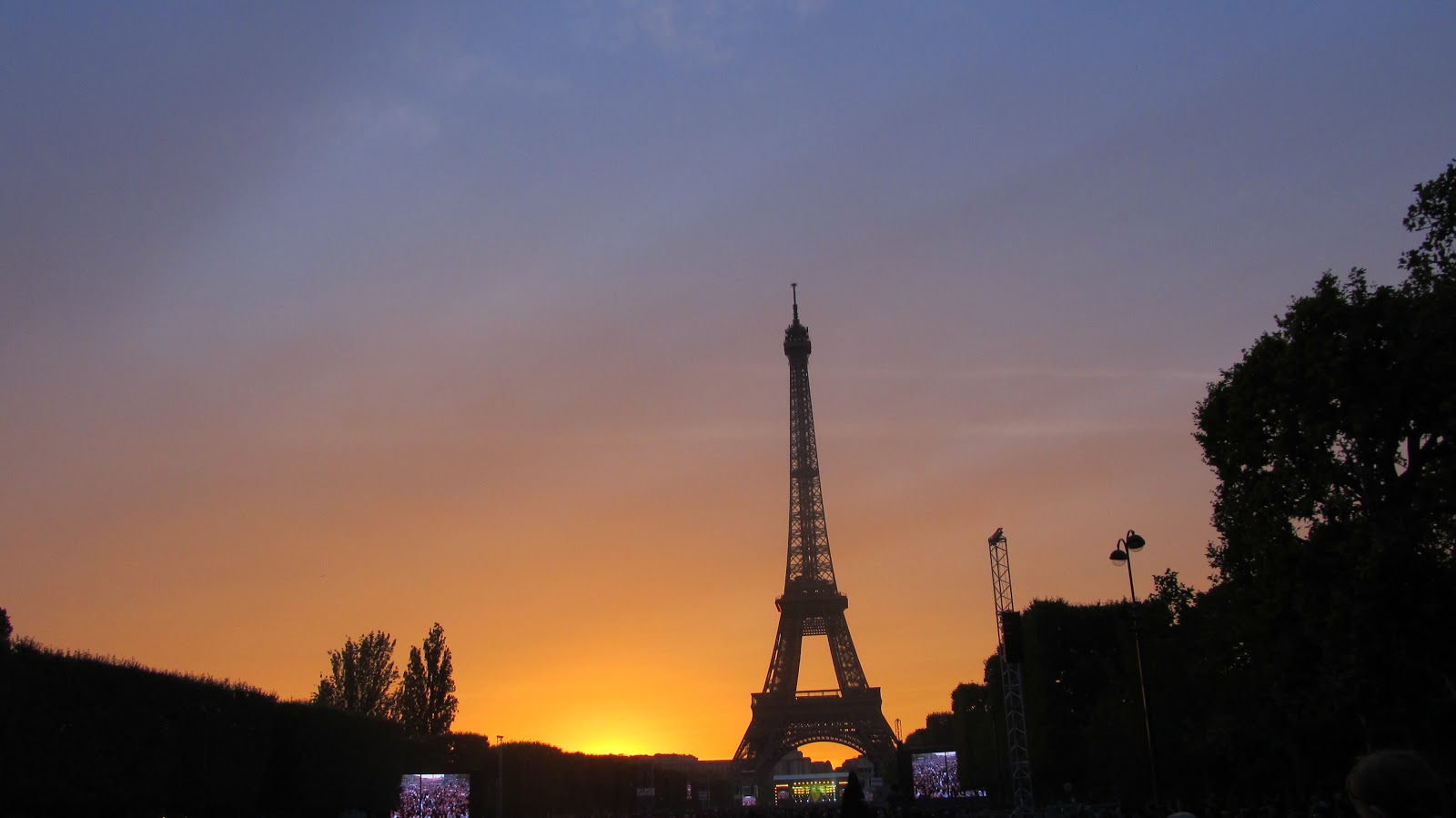
I had hoped the field would clear a bit as the sky darkened and the concert ended, but it seemed that most people were there for the fireworks display just as we were. Christine and the guys from the hostel had arrived partway through the concert and every once in a while we would stand up and sing along to an American song, and especially to Let the Sunshine In, which was in French on the verses and back to its original English on the chorus. We waited as the sun sank lower and lower, giving an increasingly beautiful view of the tower and the sunset, until it was dark, the concert ended, the only lights around us the huge view screens that had been set up. Eventually these went out too and we stood and stared, impatient for the first boom.

The announcement of the fireworks show was in French and then in English, making my garbled translation for my friends a little useless. It was a show set to famous songs from musicals and from the opening statement of the overture to Candide to whatever amazing song they picked to end the show with, I was amazed. I Could Have Danced All Night rang through my head even as they moved on to Singing in the Rain, Joanna from Sweeney Todd, and to the loudest cheers, Temps de Cathedrali, from Notre Dame de Paris. I sang along to every song I knew, which was fine because my mouth would have been open anyway, staring at the single most beautiful fireworks display I had ever seen or imagined. There were claps and cheers and a huge swelling of applause at the end, and we finally smelled the sulfur from the used firecrackers as the stood and waited for the crowd to thin out, arguing over our favorite song  and discussing the merits of the show.

The walk back was taken leisurely, knowing that we should probably head for a metro stop a few stops away from the one we had taken to get us close to the Eiffel Tower. At one point we crossed a bridge over the Seine and just as I had stopped talking and gawked at the Eiffel Tower the first time I saw it, I stopped and then squeaked and ran to the stone rail of the bridge, looking out over the river I had heard about, had read about, had seen in pictures and drawings but never with my own eyes observed. Just as I had had difficulty believing that I was in Rome seeing the Colosseum, so now I had a few moments of amazed wonderment at the fact that I was actually in Paris.

All of that aside, we decided it was time to get on the metro. We walked to the nearest stop we could find and flowed with the crowd down to the platform. We let one train pass, thinking that it'll surely be less crowded on the next. It wasn't, but we waded the river of people leaving the platform and got closer to the doors. The next train, we got closer. The next, one of us got on, pushed by the now-crushing crowd behind us almost desparate to get on the train. We waved as he looked concerned back at us. The next train we vowed to get on, but allowed a small family to be pushed on together as opposed to any of the four of us left. The next train, one of us managed to get on again. The final three of us pushed our way farther up the platform and got on the next train comparatively easily, pushed up again against the wall of humanity that the inside of the metro had become.

We began our walk to the next train to which we were changing when one of us heard from another person on the platform that this next train was the last one of the evening. I'm not entirely sure why the last train in Paris struck such fear into our hearts, but it did, and we began to run to the platform. We bolted up the stairs, taking them two at a time, and one of the guys from the hostel and I jumped on the train with seconds to spare. The buzzer sounded and we turned to see Christine at the top of the stairs. She heard the sound and, knowing from the signs in French and in English that three seconds would elapse between the sounding of the buzzer and the shutting of the metro door, she sprinted from the top step to the cart. She swung onto the metro just as the doors closed, hitting the guy from the hostel on the back as he attempted to block the doorway.

We three looked around and laughed nervously, panting a little with our efforts and I said, "Let's never do that again." In fact, I believe we pinky-swore to never do that again, though Christine later said, "Why not? That was kinda fun."

Which, in fact, was true.

Fin.

Aux Champs-Elysees

Thanks to my high school French teacher, I can't think of the Champs-Elysees without hearing this song in my head. What is slightly more disturbing is the fact that we actually listened to this version in class. Ah, my life.

She also had all of us memorize the countries in Europe and which ones were in the European Union and the monuments of Paris. Have I ever mentioned this before? I mean, this might be the only reason that I know that Portugal is in Europe because, due to an entire lack of geographical and a minimal historic education, I spent most of my adolescent life thinking it was in South America. And I was voted most intelligent in my senior class in high school. Hmm American education.

So, in a pictorial homage to the things I learned in high school, here are a few pictures of the Champs-Elysees to go along with the song. Because I was determined to.

Aux Champs-Elysées, (on the Champs-Elysees)


aux Champs-Elysées, (on the Champs-Elysees)


Au soleil, (in the sun)


sous la pluie, (in the rain)


à midi (at noon)


ou à minuit (or at midnight)

OK, not on the Champs-Elysees but I was there at midnight! I just didn't take any pictures.
Il y a tout ce que vous voulez aux Champs-Elysée (Everything you want is on the Champs-Elysees, a line that I could never remember)
But here's Notre Dame, proving that the lyrics of the song are inherently flawed, because I cannot find it on the Champs-Elysees, whether in the sun or rain or at noon or midnight.
Best wishes getting that oh-so catchy tune out of your head!

Monday, August 1, 2011

Paris Partie Un

Editor's Note: I started thinking about what I was going to say about Paris almost as soon as I left the city. So even though my post about Avignon references Glasgow, this was actually written in London. In an attempt to preserve continuity, I have actually created a lack of continuity. Can you ever forgive me? No? Ah well. Such is life.


Oh mon dieu.

Paris.

To give you an indication of my love for this city, allow me to inform you that it rained most days, I walked around with soaking wet socks in the cold and I had upwards of fifty euro stolen from me and I can still count Paris among my favorite, if not my absolute favorite palces in Europe. (I can say this without a guilty conscience as I write it in London because the UK, as we all know, is not part of Europe. [Sarcasm, sarcasm!])

I've thought a bit about how best to write about Paris. Should I detail each day, should I flow between a series of stories placed across the visit, should I merely wow you with pictures and tell my stories through captions? I decided yesterday, walking down the Mall from Buckingham Palace, that I would 1) express my love for this beautiful city, 2) regale you with the tale of Bastille Day and, 3) give you a feel for the rest of the trip by enumerating my metro passes on my last full day. And, as it's quite a walk back to my hostel, I had a decent amount of time to decide that this is, in fact, my best course of action.

So, my love for Paris translated into a top ten list for you:
1) Notre-Dame-de-Paris

2) The Eiffel Tower

3) Men in Military Uniforms Singing

4) Montmartre

5) Baguettes (sorry, no picture- but we all know what a baguette looks like. Here's a video, if you don't. Skip to 0:47 if you don't enjoy Flight of the Conchords to get the joke)
6) The Seine

7) The Champs Elysees

8) Pont Neuf/Pont au Change/The walk by the Seine around Notre Dame (no picture again! French the Llama!)
9) La Madeline

10) It's a toss up between Notre Dame's gargoyles and Sainte Chapelle


Yes, in fact, most of my love for Paris cetners around Notre Dame: walking around on Pont Neuf, along the Pont au Change, leaving a lock on the Pont Notre Dame, glancing at the Seine between book vendors on a walk by the Isle de la Cite, surveying the scene from the top of Notre Dame, remembering phrases and ideas from the book that led to movies and musicals. More about that later. But I also loved wandering the streets of Paris, walking with the crowds to a concert before Bastille Day, seeing the windmills in Montmartre, walking by the graves in Pere Lachaise. Paris brings me to a city I know from high school French lessons, from the writings of Victor Hugo, from the history I've learned and the movies I've seen. A week is not enough to see everything, so I will be back. Everyone needs an excuse to visit Paris again.