This next church is one that I actually really researched and was excited to see. It was built as a Lutheran church dedicated to the Holy Trinity, but then the Catholics won the
Battle of White Mountain during the Thirty Years' War and the church was given to the Catholics by the emperor in 1620. It's named Our Lady of Victory after that victory. I thought it'd be fascinating to see if the architecture was any different between Protestant and Catholic churches at this time, and to see if the inside was laid out differently than the other churches I had looked at.
In my planning for Prague, I had placed it alongside Prague Cathedral, thinking that I would have plenty of time that day to go looking for other places. As I got more involved in directions and looking around Prague, I realized I had no idea where it was and I got a little disheartened. Maybe I wouldn't see it at all.
Christine and I were exploring, looking for a good place for dinner, when we walked by a building that caught my attention.
 |
| Clearly, my attention is easily captured. |
I wonder what that is, I said aloud and Christine gave me a look that I've gotten used to seeing any time I ask her, a person who has seen this city for the exact same amount of time that I have, what something is. I bet two dollars it was a church and internally I thought, wouldn't it be funny if this was Our Lady of Victory and it was just here the whole time?
It was.
I was so delighted to know where the place was when I went back the next day that I hadn't even bothered to check the opening times of the church. I remembered it being free to view, since so many pilgrims would come to see the Infant of Prague, a statue of baby Jesus that originally came from Spain and, legendarily, St. Teresa of Avila. I bounded up the stone steps and took a second to compose myself at the door, noticing the sign requiring that I be silent. I pushed open the heavy wooden door and...
walked right into a communion mass. It was a great opportunity for me, because I got to see the church in action, but also extraordinarily embarrasing for me, because I walked in in the middle of mass. Of course, I wasn't the only one- there were a hefty number of people with cameras around their necks chilling in the back. Since I was wearing a dress that day, I decided to fake like I was just late. I sunk down into a back pew and listened to the service (in Czech). I stood when everyone else stood and mumbled something when everyone else responded. After the service, I walked over to a side station where they had copies of a missionary magazine that I perused in order to look like less of a tourist while I waited for the crowd to clear and processed the service.
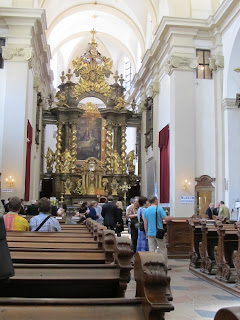 |
| It never ceases to amaze me how people are just, you know, chilling in a church I came halfway round the world to visit. |
The thing that stuck out to me most was how far away the priests were. I could see them lifting the bread and the cup for communion, but I have no idea what their faces look like. They also came down out of the chancel to give communion to the people, but went back for the end of the service. After the benediction, they precessed out the side and the congregation stuck around, greeting each other and chatting while a nun came to reset the altar after the service. It was like the priests carried out a function- they gave you your communion, they blessed you on the way out. They made the space function.
With the service over, people went feely to the altar on the right side of the church. There was a general wave of people, all waiting to stand or kneel before the Infant of Prague.
 |
| He avoided any better pictures that I could have taken. |
Now, I know that I've got to stop walking in the Catholic churches like a Methodist, but I just cannot yet understand how such an altar came to be. I can tell you the story- the Infant came to be at the church after being handed down from mother to daughter as a wedding gift when the final daughter only had sons. She gave the wax statue to the church with the prayer that the statue would bless the church. Years later, after war had wracked the city and the church, a monk found the statue sitting abandoned in a pile, broken and without any hands, and heard the statue say something like, "Give me my hands and I will bless you." So the monk did and the statue has. The church has witnessed miracles and the plaques of the wall are all outpourings of thanks for the good things that have happened in people's lives since praying for the Infant to help them.
 |
| This is just one side of the altar. |
Like the distant priests and the ornate buildings, the Infant of Prague is foreign to me. A church like this, a statue like that, these are things that you visit and look at and ponder, not somewhere you build a life and a fellowship. It's very different from the early church, meeting in houses to survive as a community, or even from many churches in America today, so focused on small groups and personal faith. Then again, I'm fascinated by this little baby Jesus, dressed up and enshrined. And who am I to remark at all about the validity of people's beliefs? I myself believe that a common man was the Son of God and rose from the dead over two thousand years ago, leaving a community of believers with a mission and two milleniums of an unfulfiled promise of return. If nothing else, the Infant works as a focus of devotion in the main nave of the church.

I walked around back to check out the museum and the gift shop and got distracted by the sacistry on the way back. I walked by confessional booths and an altar and found myself in a room with glass cases holding mini-figurines of other statues of the Infant Jesus around the world. There are so many, in so many different styles, from all over the place. I think I was in front of the South American cabinet when a monk approached me. He asked if I was from Brazil, which absolutely surprised me, but which I will take as a compliment. After explaining that I was from the US, he proceeded to tell me all about visiting Boston and New York and I think DC, though I'm rather unsure about the whole conversation. Then he talked about the church's mission in the Central African Republic, taking me over to the pictures he had on the wall. "I leave June 16th. You come?"
"Oh. no, I am traveling. I can't be there on June 16th."
"No, no, Americans, you are elastic. You come, June 16th. See, here, I built this. These people, they know me. You will be known here, you will be famous here. Not like in America. Well, I don't know, you may be famous in America. But here, you will be noticed."
I laughed and thanked him and told him not this time. "Ah, if you are sure. Still, you can tell people that you were invited to go. An invitation. That is something. Good-bye, bye-bye, bye-bye," he said, waving and walking back to the case of the mini-statues.
I walked out of the church, feeling like I should stop and at least cross myself before walking past the Infant, but the room was crowded. I thumbed through the pages of the missionary magazine I still held in my hands. Water for people who need it. Gifts to the world around. An invitation. Something indeed.


