Showing posts with label Cathedral. Show all posts

Monday, August 22, 2011

Glasgow Cathedral

The cathedral in Glasgow is dedicated to St. Mungo who is said to have been buried there. Anybody else think of St. Mungo's Hospital for Magical Maladies and Injuries? Good.
Pictured: Not a magical hospital in London

It's actually a pretty well preserved medieval cathedral, something that tended to be torn down in Reformations and the rejection of Catholicism. I can never decide how interesting I find the history of the Protestant Reformation with all its different sects ending up allowing for the thousands of versions of Christianity we have today. I mean, if we had cards, I'd be a card carrying United Methodist, but that's mostly because I'm good at joining organizations and the United Methodist Church in the states is an organized monster indeed. But more on all of this later. The cathedral in Glasgow is a Presbyterian, Church of Scotland place. It was popular during the Reformation to de-roof churches but this medieval cathedral survived and, though desecrated during the Reformation, the people of Glasgow willing paid for its repair.

And so I walked around inside with some kind of appreciation. Sure, the outside was covered with scaffolding, but the inside preserved the quire (choir) screen,
The thing that looks like a wall. Yup, that's a screen.
 separating the open nave from the pewed choir, and even if the stained glass windows were new, they kept up with the traditions of the windows, one belonging to the guilds of Glasgow, another to a wealthy family, each eager to leave a mark on such an important holy place. Again, I enjoyed the English on the walls, from being able to understand that this list of names was a list of those killed in a war and this list of names was a list of honored bishops of the cathedral. I loved picking out Bible verses and stories I knew from the words in the windows and floors. I love that a prayer for a guided path encircled the column in the sacristy and that Jesus' injunction to care for the sick, hungry, thirsty and imprisoned carried the theme of the windows in that same space.


I walked down to the lower church to see the tomb of St. Mungo and caught the end of a tour of the cathedral, pointing out an older Gothic column preserved in its decoration


and a chapel with brilliantly white walls used for weddings. I left the cathedral as they were setting up for a wedding in the upstairs church, giving space for a new life to begin while I walked slowly around the lives that had been ended, reposing on a nearby hill.

The Necropolis in Glasgow is modeled after Pere Lachaise and is from a time when the fortunes of the British Empire smiled on Glasgow as the second most important city in Britain. Names that I don't know of rich people who died long ago and not so long ago adorned tombstone after tombstone. A high monument to John Knox and other reformers sat on top of the hill with the best view of the cathedral and Glasgow and I smiled as a little boy ran up to it and turned to ask his father if it was a king on top of the high pedestal.

Right around the corner from the cathedral is St. Mungo's Museum of Religious Life and Art. It's got plenty of good stuff in there from the five major religions and I spent a couple of hours reading every plaque and thinking over every exhibit. I watched the wedding party arrive and leave from a second story window, keeping my laughter to myself as a group of older German ladies stepped in front of the window and cooed at the small boy in a kilt I had been amused by an hour earlier.

All of this is swirling around in my head, all these bits of religion that I've encountered in one day. On the one hand, you have an extremely familiar form of church for me sitting right out there, a ceremonial church designed for sacraments, inspiration and words of authority. Then there's a graveyard, familiar in its unfamiliarity with a monument to men that I recognize briefly but realize I could not tell their story. And now, here I sit, among Buddhas, copies of the Qu'ran, dancing skeletons and Shiva as the Lord of the Dance. Plenty of people think that if you're a religious studies major, you're on your way to seminary and that you're focused on their religion and a history of their church.

On my right I have a building to remind me of why they think that and on my left I'm surrounded with proof to the contrary.

Sunday, July 24, 2011

Seville Cathedral

Can I tell you a secret?

I've already seen the cathedral in Seville.

It's kinda the reason I went on this trip.

Whew, that's a relief. I'm glad we got that out there. See, I've been a world traveler since the 8th grade. I went with a group from Suzuki School of the Arts in Hickory where I took flute lessons to Germany, Austria and Switzerland over spring break in my last year in high school. Then, in the summer after my junior year of high school, I went with Crossflame Youth Choir, the choir from my church in Hickory, to Scotland. I played flute then too. And lastly, I went with Suzuki one more time over spring break senior year to visit Spain.

On our trip in Spain, the planned visit to Seville turned out to be more of a pain than expected- about three hours in the coach for a day trip to the town. But I had read about Seville in a footnote about a Shakespearean joke during my English project comparing three Shakespearean sets of lovers and I was determined to visit. I went into the cathedral with a lady from my church and I walked around totally confused. There were all these side chapels with these metal fences in between me and them, and then the altar was in this box by itself, in front of a crazy carved wall. There were four organs and this huge box in the middle of the cathedral, also blocked off. It made it so that any lay person attending a service here wouldn't be able to see anything. And where was the pulpit? Where did the choir sit? There wasn't a choir loft. I mean, it was big and pretty and I loved moving from chapel to chapel and looking at the art, but overall, I left confused. We climbed the bell tower and I saw a wonderful view of the city and was honestly quite in love with the space again.  (I was going to show you pictures from then because I didn't make it up to the top of the bell tower this time, but I shudder at the quality of pictures back then compared to now. So sorry, you're out of luck on this one.)

Now, coming back to Spain, I was quite excited to see Seville again. I'd have loved to see Segovia again with its acqueduct, and Cordoba would have made a good story with its converted mosques and Moorish influence, but I was quite content to walk back into this cathedral that started my questioning about sacred architecture.

I walked back in just as confused as always. After all, you have this huge space, the third largest in Europe by area but the largest by volume, soaring up from columns all around you, and then you plop this big box down in the middle of it.
That's not the altar. And I'm sorry that the whole cathedral appears yellow...

That big box, by the way, is the architectural choir. Often, you have clergy sitting in there, or choristers. It's a bit of a trademark of Spanish cathedrals to have an architecturally distinct choir. The choir stalls in there are from the 15th century.

 And just like I thought, all the lay people coming to the service have to sit either in this tiny space between the choir and the chancel, or out in the wings, being unable to see anything. It reinforces the power of the clergy and the wealthy.

And this cathedral is wealthy. It was built on the spot of the Almohad Mosque with the gold and jewels of the recent Reconquest, the taking of the Iberian penisula back from the Moors who had invaded. The large orange grove and the bell tower are the remnants of the mosque.


Ways I identify Moorish influence: Does it look like Aladdin could have been here? (My Islamic Civ prof is shaking his head at me.)


The bell tower used to be a minaret. The treasury has plenty of golden things at which to look.
Above: Examples of Shiny Things

and that busy wall behind the altar is actually the world's largest altar piece, made up of 45 scenes from the life of Christ and covered in gold. The whole place fairly shines.


I'm real bad at identifying scenes when distracted by the shiny.

And so I wandered around again, looking into side chapel after side chapel. I paused in front of the tomb of Christopher Columbus, brought back from its original home in Havannah in 1902 after Cuba gained independence from the US after being taken from Spain in the Spanish-American War.

 I also stopped again and looked at this picture of a giant that has never ceased to baffle me,

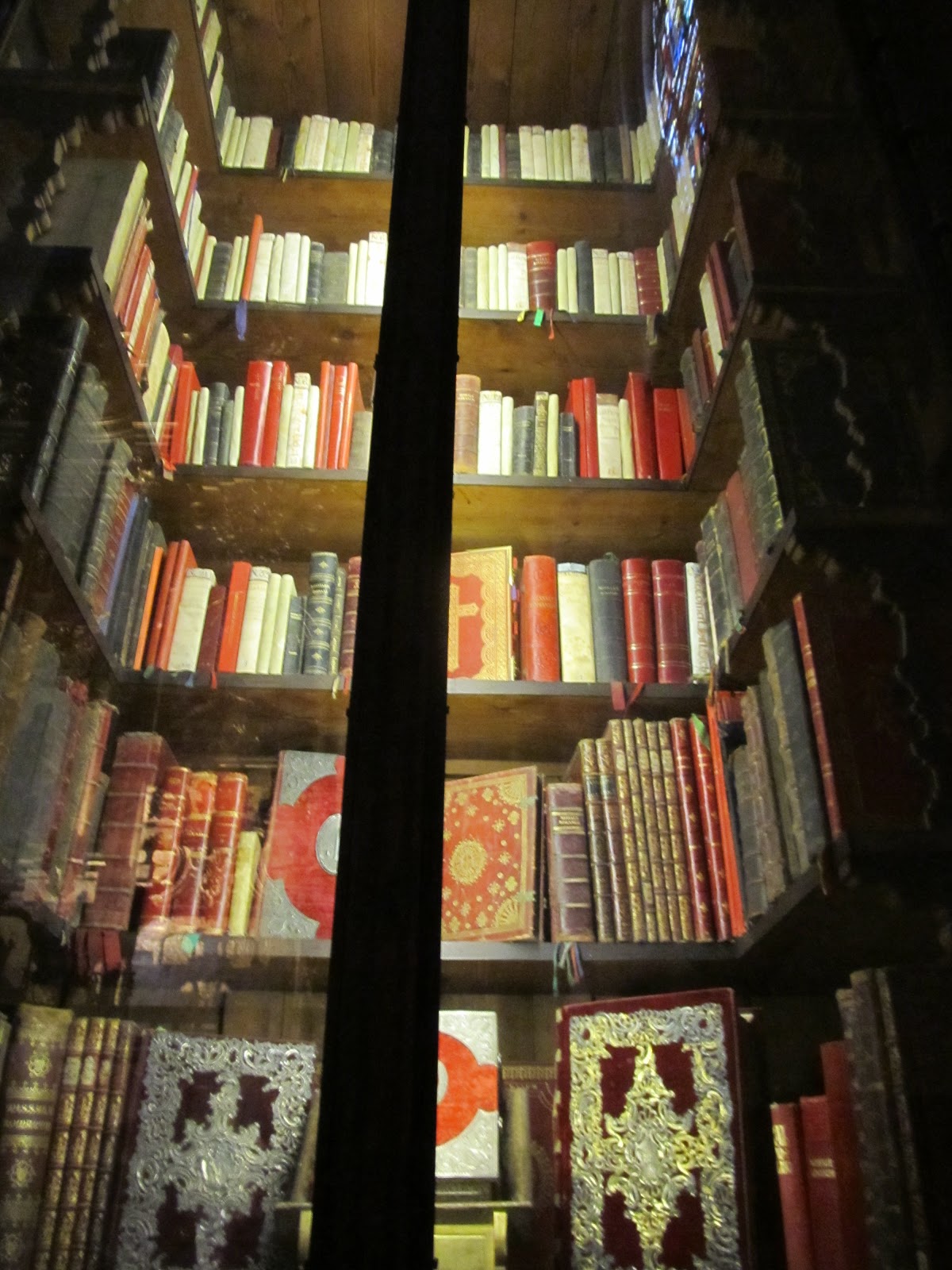
 and walked in to see a bookcase in one of the chapels.
The only books I've seen in a cathedral that aren't for sale.

One evening I came back for mass. There was a wedding on the other side of the church, but it's such a large space, a quiet mass in one of the chapels couldn't mess with the ceremonies going on in other places. During the service I let my eyes wander, once again being stuck in a service in a language I didn't understand. First I let my mind wander up to the top of the chapel, where a real bird flew back and forth in front of the painted dove. Next I followed the old Spanish ladies and their fans with my eyes, standing when they stood and kneeling when they knelt. One of the daughters of the older ladies came up and read the scripture before the sermon. Even as she walked back to her seat, I watched her mother's fan sweep back and forth, back and forth, bringing a little bit of cool in this building that still reflected the heat outside. The air was thick with the ceremonial incense by the end of the service. I felt oppressed by the sweet smell, delighted to go outside and away from the smoke by the end of it.

Cathedrals like this were built for show, to tell the world how the people who had the building built were blessed. I feel out of place here, in a building built for the division of classes of people. At the same time, it's beautiful and impressive, holding the history of a city and a country in its old walls and in its new patrons. While it will never be my favorite cathedral, I'm quite glad I got the chance to see Sevilla again.

Sunday, June 26, 2011

Florence Duomo

The cathedral in Florence is huge.

One of my selling points for my proposal for this whole thing was that you simply can't get an idea of what being in these spaces is like from a book. My primary example of this was the size of most of these cathedrals- I can tell you that the building is 502 feet long (like a football field and a half), 124 feet wide, 295 feet wide at the transept (which is almost a football field- sorry, I have no other good conception of distance [silly marching band]) and 75 feet tall... in the nave of the cathedral. It's 375 to the top of the dome.

I just...

I can't...

Like, what even? 
It's just massive. It's impressively big. Which is part of the reason why it was begun in the first place.

The Duomo di Firenze (or the Cattedrale Santa Maria del Fiore, St. Mary of the Flower [the flower being the lily, the symbol of Florence]) was actually built after the cathedral in Pisa and a couple of other less-well-known cathedrals around the area. It was built with public funds and set up as a state church in a response to these churches. They started construction in 1296 and finished the nave about a hundred years later (there were plagues and things holding up the project) and the dome in 1436. They pulled out all the local artist stops, which, considering the local artists were people like Donatello, is pretty awesome. Though, I always feel obligated to point out this graph when I talk about Donatello. The end product was the largest dome in the world until modern times. It's even bigger than the dome in St. Peter's Basilica in Rome, and was, in fact, a model for domes after it.

It's an impressive building. The exterior is white, green and red marble (mostly white) and it's part of this complex including the baptistery across the way.

It dominates the view of the city from the Piazzale Michelangelo, about a mile and a half away. Climbing up the dome was the worst climb I've ever done, but the view from the top was absolutely gorgeous, so, still, my vote falls in with actually doing dome climbs.
I may have already used this one, but it's so pretty. Soooo preeetttyyyy.

At the same time, you know, with all the impressiveness, it didn't strike me as a particularly holy place. There's an excavation downstairs, which is cool, but right beside it is the gift shop. The gift shop. Call me old fashioned, but I don't think you should be selling things in a church. Outside the walls, in an ajoining building, sure. But actually in the church? Hmmm. Though, in the gift shop's defense, it is downstairs.

And see, the thing is, with these huge buildings, you have these side chapels (the top and arms of the cross, since it's normally laid out in a cruciform plan) and that's normally where mass is held. That huge nave? It's used for the bigger mass ceremonies, I presume like Christmas and Easter, but most of the time, it's only filled with tourists.

And I hate tourists.

Like, I really hate tourists in churches.

I mean, I realize that I act like one, but I generally acknowlege the purpose of the building, you know, as a place dedicated in name if not in practice for the worship of the God of the world's largest monotheistic religion, a gathering place for the faithful, a place of spiritual significance for people. But the person complaining loudly on their way out the door that they can't view a chapel because mass is about to be held in there or the group coming to a consensus that this visit was a waste of their time or the tourist with their camera who steps in front of a person praying in the pews to get a better picture of who knows which window Donatello designed, all these people are missing the point of the building.

Though if they were taking this picture I might be more understanding.

You know, maybe they're not. Maybe all these places I visit are just tourist traps now, designed to intimidate and remind people of the power of the bishops and the cardinals and the pope and the people associated with them. The Duomo has plenty of pictures and statues of the nobles who helped to fund its construction. And it does have a gift shop in its basement.

But I'm a bit opposed to this kind of cynicism. Because I remember that first moment of wonder as I stepped into the large, empty gothic nave.

And I like wonder.

Wednesday, June 15, 2011

Stephansdom

St. Stephen's Cathedral is that church in Vienna. It's the metro stop you get off at when you want to go into the old city and mostly everything fans out from the square in front of the cathedral.
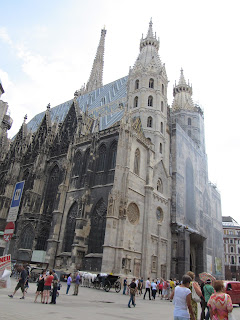
Kinda intimidating, actually.

I had three people tell me to go there, one by name because you simply have to visit Stephansdom if you're visiting churches in Vienna, one because the outside was amazing, even though it's partially (perpetually) under construction and one because they have these colored filters in front of the windows so when the sun comes in, it looks like a laser show in a gothic cathedral. All of these seem like valid reasons to check out the building.

There are so many churches in Vienna. There's Maria vom Siege, Our Lady of Victory, right down the road from my hostel. There's Peterskirche, but more on that later. There's the big church in Karlzplatz. There are dozens of other churches not big enough to be landmarks on a map, but they're still around, quietly awaiting the patronage of churchgoers and tourists alike. There are even churches without impressive buildings. I think there's a Korean church also down the road from my hostel, marked with a cross sticking out into the street and there's the English Speaking United Methodist Church in Vienna that has very detailed directions on its website because it's easy to miss. I almost feel bad for spending a whole week here and only really looking at two churches.

So if there are so many options for going to church, why is Stephansdom the church in Vienna? The audioguide says it's a symbol for Vienna and a symbol for Austria. It's also quick to point out Mozart's involvement in the church (he was married there, christened two of his children there and his funeral service was held there). And I have to say, it is a pretty church. The outside is adorned by what must be thousands of stone curls along with the traditional gargoyles and scenes from the life of Christ.
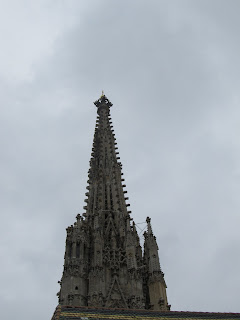
These are just the curls on the tower. You should see the rest of it. 

 Inside is also beautiful, light show notwithstanding. There's your regular slew of statues of patron saints, Mary and the apostles, and of course, Jesus himself. The stained glass windows behind the main altar are impressive, along with the organ(s).
Organ win.
Besides all that, the south tower contains the second largest bell in the world which you can (pay money to) ride the elevator up and see. It also gives you a pretty good view of Vienna.

I first went to Stephansdom on Ascention Day. Note to everyone- Catholic holidays, like Ascention Day, are bank holidays in Austria so most of the shops are closed, with the exception of the souvenir shops. The museums were open, I guess, but besides that, there's not much else to do besides go look at churches.

Ascension Day is the day, forty days after Easter, when Christ left the disciples again and ascended into heaven. The two Sundays from that is Pentecost, the giving of the Holy Spirit to the first Christians and the birth of the Church but I guess on Ascension Day, we focus on the things that have left us, rather than the things that were given us.  You could smell the melting wax from hundreds of candles the second you stepped into the cathedral. And that was beautiful enough in itself- through the crowds of people with their cameras out, focused on capturing the colors on that wall or the picture above that altar, you could see a few making their way slowly to the side altar to offer a prayer before they lit a candle, sending lost spirits up and away.
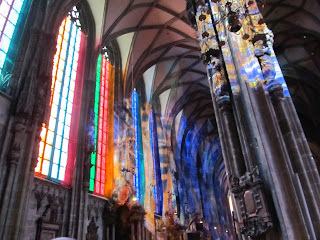
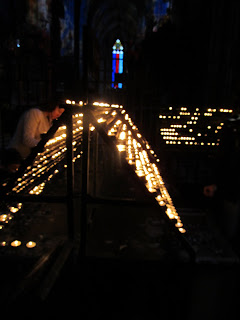
But then there were these tours going around everywhere and all these little interactive information posts that cost 2 euros to operate and people jostling people outside the metal screen that separated the narthex from the nave and I think I bought an audiogiude just for the chance to step away from them all. I sat in the nave for a few minutes, then walked around, listening to the story of the baptisimal font in St. Catherine's chapel, the Madonna whose colors have been turned black by the smoke of ages of devotional candles lit beside it, the old organ and the new organ, the destruction of the cathedral during a fire in World War II and the beginning of the ever contintuing construction after the war.

I sat in front of the chancel and high altar for a few minutes, watching a family that had come in pray. Then an older man walked right up into the chancel, past the altar table and up behind the choir, where a screen, part of the colorshow, separated us from the altarpiece and statues. This distracted one of the young men in the family from his prayers and he watched the lady who had come in with the man as she told him, I assume, that she didn't think he was supposed to go up there. He waved her off and eventually she walked up into the chancel too, causing the young man in the pew to look around concernedly. Within a few moments, he sat back in relief as one of the staff members of the cathedral shooed the tourists out of the chancel, answering their protests by insisting, "It's for the priests!" as he shut the chancel rail. The old man threw his hands up in the air in frustration, then gestured to the chancel rail that had been left open. The staff member just shook his head and said again, "For the priests!"

The audioguide takes you around the nave of the church, with a brief stop outside one of the side chapels. Stephansdom is a hall church, with two rows of columns separating the nave from the side aisles with equal celilings. You can sit in front of one of the altars in the nave and listen to the guide as it points out where the organ used to be and where the choir used to stand. The master builder put a carving of himself into the wall under where the organ stood, supporting the weight of the instrument.


It's right close to the entrance to the crypt, which I had planned on visitng, before the staff started to set up for a service later that evening. With all the people still inside, I figured I'd do them a favor and get out of the way, knowing that it can't be easy to maintain a functioning church when people are just standing around, gawking at everything. A loud crowd of teenagers passed by as I stood to go and staff member walked by and said, "Quiet! You are in church!"

Even on Sunday morning I think the staff could have issued the same warning. I was going to go to the English speaking church, but then again, how often do you get to go to church in a cathedral? And besides, I'll get to hear English every Sunday soon enough. So I walked in and I bypassed all the people standing around and gawking and walked into the main nave, talking a seat near the transept. Eventually the seats around me filled and more and more people walked into the nave, filling in the pews, the chairs they had sat out in addition to the pews and finally standing in the middle of the transept. I watched the families walk around, the new parents strolling around their babies, the youth in suits shaking hands with everyone, the older couples shuffling down the aisles, taking a seat whenever someone younger hopped up to let them have a place. It was a pretty vibrant congregation, full of well-to-do people who knew each other and greeted one another by name.

The nave was so full a member of the staff had to get people to move from the middle of the transept so the acolytes and priests could process in. I thought it was funny- we had all hopped up at the sound of this little bell announcing the beginning of the service but people hadn't thought to look around for the entrance of the clergy. I found out partway through the service that it was Confirmation Sunday (or something like that- there might be another rite I'm missing, the whole not being catholic thing) so many of the people filling the transept were family members watching their young relatives being ushered into the life of the church. Their concern was focused on anything other than the ceremonial procedures of the service.

It always amazes me how wired these old buildings can be. There were TV screens for people in the back so they could see what was going on in the service and there were microphones for the musicians, priests and anyone who came up to the lecturn, which was a surprisingly large number of lay members. The service started out with the organ filling the room, as I expected, but the rest of the music was provided by 1) a monk on the accordian accompianying 2) the music leader on guitar showing 3)two oboes, a flute, a clarinet, 4) a tambourine player and 5) four female vocalists on mics. Plus the head priest dude. They always have to sing into their microphone, though, so I guess it's expected that you have to be more than tone-deaf to lead a service.

An hour and a half later, the band played its last song, the priests processed out and the organist played a short postlude after the confirmands posed for pictures. It felt like a pretty standard service, albeit in German and with the weird standing and kneeling and crossing yourself that I swear I'm going to master before I leave the continent. People stayed around in the nave even after the organist finished, talking to each other and taking pictures with their families.

I, however, fought my way through the flood of tourists waiting on the other side of the metal bars that separated the holy from the secular and strode into the sunlight outside of the cathedral.

Thursday, June 9, 2011

Berliner Dom

I wasn't originally going to go inside of the Berlin Cathedral. It's an impressive building, sure, and I loved taking pictures of it and just sitting in front of it, but the man behind the desk at the hostel had assured me that it was just like any other cathedral. He suggested several other places to go besides. It wasn't until I saw the people walking around the top of the dome that I decided that I needed to go in. It wasn't very expensive either, plus seeing the inside now freed up my Sunday morning as I had planned to go to service in this "Protestant St. Peter's."

Just like any other cathedral, the Berliner Dom has a lot of history. The first structure on this site was a chapel dedicated to St. Erasmus (who wrote Praise of Folly, which I wrote a paper on in my only English class in college, and made a copy of the Bible that scholars used for centuries, which I read about in my only book on New Testament textual criticism) in (wait for it...) 1465. 1465. That's a couple of decades before Columbus sailed over to America. Just to throw that into perspective there. Then, about three hundred years after that, they tore the chapel down to build a new cathedral in 1747. That cathedral was renovated in 1822 in the neoclassical style (to celebrate Prussia's uniting the Lutheran and Reformed communities). Next, Emperor Wilhelm II tore down that cathedral to build a new one in the baroque and renaissance styles that was finished in 1905, which was bombed during World War II and has since been renovated to show a simpler style, re-opening in 1993. And if you think that's a ridiculous amount of history, you should see the cathedral museum on the way up to the top of the dome. Ridiculous.

So the outside's deinitely impressive, with all these angels and then there are the fathers of the Protestant church (there's a lot of Luther) and there's Jesus, welcoming you in, and these gold inlay signs... it's a sight to see.


Inside, it's what I've come to expect from the older Catholic cathedrals I've visited- ornamentation, a decorated pulpit not in the center of the chancel, a crypt and a lot of biblical people looking down at you. Instead of the Latin or Greek church fathers, though, you have Protestant Reformers staring down at you. It's a little bit of a different experience.


Why hello there.


Whenever people ask me what brings me to whichever city I happen to be in, I say travel unless I want to get into a discussion about religion and the church. There are many questions tied up in studying sacred architecture. I'm always afriad of Why do we need cathedrals? I'm always tempted to brush it aside as a power and pride thing, ostensibly insiting that people are trying to display the glory of God in a building, the same way Handel or Beethoven would try to display it in a composition. It's easier to do when it's a Catholic church because I'm not Catholic. It almost makes me curl up in a ball of ignorance and guilt when I think that I had assumed that Protestants of any kind wouldn't spend their time building these ornate buildings. And yet here we are, Luther and Calvin glaring down at me from the heights of the cathedral.

You might think I'm being dramatic, but really. They're staring. It's impolite. 
Maybe to escape it all, I climbed up the stairs, my original purpose in buying a ticket. It's not a bad climb, though it was lengthy. I loved the view of Berlin from the top, though, so I'd consider it worth the time and effort. From there you could see the spires of other churches, the tops of other buildings, distant smoke stacks, tiny ant people in the park. From one side, an angel appeared to conduct a band on the bridge far below. From another, the angel sang out proclamations to the lady sitting in the middle of the giant heart I hadn't seen before.


Climbing back down led to staircase after staircase and I ended up in the crypt, which, ironically, is right by the bathrooms. I dunno, I just feel like we shouldn't be waving the dullness of everyday living, breathing, existence in the face of our dead. I also feel like you shouldn't have a bathroom right beside a crypt of the honored dead, like kings and queens and war heroes. I mean, what kind of message does that send, especially to vindictive ghosts?

I liked the crypt, though. It was quiet and respectful. It's easy to mourn someone else's loss. I paused for a long time in front of the tiny caskets and pondered over the paired tombs of husbands and wives. The best part of the crypt, though, was its focus on promises. Following the main path will lead you from the entrance to either the exit, the tomb of an emperor, or a marble statue of a young man sitting on a marble bench in front of a cross draped with a white cloth.

On the bench beside the young man were the words Er ist nich hier, Er ist auferstanden. He is not here. He is risen.

I like it when I leave a church pensive. I like that the building has given me something to think about or turn over in my head. It gives me different ideas about the structure and purpose of a church, though, when the most meaningful places were the metal walkway high above the sanctuary and the cold crypt far below it.

St. Hedwig's Cathedral

St. Hedwig's was a serendipitous mistake on a sunny afternoon in Berlin. We had sat in front of the much larger, much more impressive Berliner Dom basking in the peaceful rest only soft grass in the sun can provide before walking around and exploring the other fancy looking buildings around. We ended up in a plaza where the cathedral was slightly tucked away behind the construction work on another building. Admittedly, the domed building with its white columns doesn't scream cathedral like you expect in Europe.


Inside, though, you get the story of the cathedral. It's the seat of the archibishop in Berlin and the church that was built on this spot in the 18th century was the first Catholic church allowed in Prussia after the Protestant Reformation. Like many other churches in Berlin, St. Hedwig's sustained damage during the war, burning in an air raid in 1943. The structure seen today was constructed in 1952-1963 and it doesn't pay tribute to any previous styles of building. There's a skylight at the top and windows in the walls, but no pictures in the stained glass and no candeliers for lighting- just these odd orbs of light on strings hanging down from the ceiling. The altar is in the center of the room, surrounded by pews and the additional chapels are down a staircase right in front of the altar.


Downstairs, they have a chapel for St. Hedwig, of course- her relics are kept here in the cathedral that honors her name. St. Hedwig has little or nothing to do with the more famous (I think) snowy white owl, but she did go barefoot in the winter and donate to the poor a lot, so she's solid in my book. There remains of Bernhard Lichtenberg are in the crypt as well. Father Litchenberg was persecuted by the government after praying for Jewish families in the aftermath of Kristallnacht. The chapels are good and quiet, each with a different purpose and atmosphere. On the whole, though, the entire cathedral was rather deserted. I don't think St. Hedwig's is on a list of cathedrals to visit in Berlin.

Upstairs, there was a little nook that had a statue of Mary and two candelabras, full of votive candles.

I lit mine for the women in the park in front of the Berliner Dom, who each told a different story of a different country's unrest or tragedy that brought them to the streets of Berlin. One of them had wandered over to St. Hedwig's and sat just outside of the door, rocking her baby. I know that handing them a euro coin won't make their lives any better, but one of the reasons I still believe in the church is that it still does good deeds. Maybe the euro I put in for my candle will sneak into a fund for the people on the streets of Berlin.


The smoke didn't drift up to the bulbs they had for lighting in the sanctuary, but they caught my eye anyway. Looking around the room, you'd almost forget that this cathedral belonged to a religion millenias old. I thought of the places the women had claimed to be from. Libya. Egypt. Afghanistan. A modern church for modern problems, centuries old.