Showing posts with label Domes. Show all posts

Sunday, July 17, 2011

St. Peter's Basilica

Editor's Note: You're stuck with some unfortunate reflections of a personal nature in addition to the expected expounding of history and ideas. Feel free to disagree and correct as needed. Much thanks.

An indulgence is a pardon from time in purgatory, time which is required by God's justice, even though the guilt of the sin is forgiven by God's grace. Indulgences are given by the pope or by bishops or others given authority by the pope, who gets his authority as the successor of St. Peter, to whom Christ gave the keys to the kingdom and the power to bind things on earth that will be bound in heaven. They're given with the caveat that the parishioner who recieves the indulgence does some good work or an act of piety, like going on a pilgrimage or giving to the poor or the building of something for the public good, like, say, a bridge or a church.

It's odd then, to think that in the 16th century, one could use this privilege of the church to simply buy one's way out of purgatory. It strikes me as odd that the people who have the best access to scriptures that speak against greed and the hoarding of fine things and that the religion whose founder turned over seller's tables in the temple because the sellers were abusing a sacred space should then sell a faster ticket to heaven like a museum sells a tour pass that lets you bypass the lines outside. I remember when I first heard about indulgences, unclearly explained by my 10th grade world history student teacher in a rare moment of actual historical instruction. I was amazed that such a thing actually happened. I mean, the issue is always a little more subtle than you have time to cover in class, but to me it sounded like a money-making scheme, something a villian in a noel would do, something entirely unsuited to the church. It just seemed wrong. And what did they need all that money for anyway?

Oh. To build a church. This church, in fact.

Now, I'm not the only one who though there was something off about all this. The sanctioned selling of indulgences to build St. Peter's Basilica as you see it now is one of the things that set Martin Luther off on his 95 Thesis, started the Protestant Reformation and changed the face of Christianity as it was known. Even the Catholic Church itself wasn't left out of this change: the Protestant Reformation started a Counter Reformation that can be seen in the architecture of the time- churches were built to display more wonder and awe, to remind people of the amazing and astounding nature of the God to whom they came to pay homage, to worship. It was a great time of change in the world, with the Renaissance and all sorts of humanist ideas flying around among this era of debate and rupture in the Church.

Knowing all of this should have made walking into St. Peter's a more solemn, momentous moment, one full of conflict about visiting a place with such historical and cultural significance. Or so you'd think. But Sarai and I came down rather suddenly from the climb up to the cupola (definitely worth your while) and stumbled our way into a side door, spilling accidentally and abruptly out into the nave to stand astonished at this massive, beautiful, awesome space.

The nave at St. Peter's can fit most other churches in the world inside of it. It's bigger than the Florence Duomo with its inexpressible size and even if I tried to amaze you with the height and length and width of the church, you would not feel the awe that this space inspires. I made Sarai give me a couple of minutes to walk around by myself because this kind of amazement is not something that I'm particularly good at sharing with other people.

Hold on, let me give you some pictures for a second and some facts in the captions and then we can reconvene to talk about this place.
Michelangelo's Dome, whose top is 448 feet from the floor 


A statue in the nave. That little angel, you know, the one chilling at the bottom? TALLER THAN  A REGULAR HUMAN. 

Baldachin over the papal altar by Bernini. It's the height of a 7 story building.


The orange glow in my picture of the nave was this window. It was two American football fields away from where I took the picture. The dove itself is 6 feet tall.

Now, St. Peter's isn't the cathedral in Rome. I know, you're disappointed, your life is a lie, etc. The cathedral is, as previously mentioned, the seat of the bishop, in this case, the bishop of Rome, or the pope. And the pope's chair in Rome is San Giovanni in Laterano. St. Peter's is just a basilica, or a papal basilica since the pope tends to celebrate mass here when he's around, and a basilica is a church that is given that status because it contains some kind of relic. In this case, it's the tomb of this guy, St. Peter, whom you might have heard of as one of Jesus' closest friends and the first pope, you know, something like that. (I use sarcasm here because I have difficulty dealing with the importance of this spot.) Peter was martyred by that great guy Nero in AD 64, crucified upside down because he didn't think he was worthy to die in the same manner as his Lord, and buried right under where the altar stands in this church.

I was going to tell you about the history of building the church, starting out with the shrine over the burial site of St. Peter, which was originally marked with just a red rock, to the building of Old St. Peter's, started by Constantine, to the original plan for the church, but I figure you can read the wikipedia article just as well as I can. What stuck out to me, though, is when Michelangelo (man, he's just turning out to be my recent favorite of the ninja turtles) took over the design from Bramante & co, he said that he did it to the glory of God and to the honor of the apostle. Over the course of this trip, I've spent a lot of time thinking about why we have these huge churches, why there are these cathedrals. It's not a question I can answer, but I like what Michelangelo said. And if God truly needed a church to explain His glory to the world, though, I would point to this one.


You have saints lining the nave and side chapels with a couple of popes in tombs, so many sculptures to draw the eyes up to the distant ceiling. You can stand at the back and feel the expanse of the church without knowing the height of the distant construction over the papal altar. As you approach it, the canopy looms larger, just barely misaligned with Michelangelo's dome still higher above, truer to the burial place of the saint. There are the accouterments of a church dedicated to such a large fixture in Christianity- a statue of Peter with his curly hair, sitting where his feet can be worn smooth by approaching pilgrims,


 the Cathedra Petri or the throne of St. Peter, encased in bronze and enshrined above the altar in the main apse,

and two meter high letters declaring Peter the rock on which Christ will build the church as you look up towards the dome.

 At the same time, there's a wonderful peaceful dove window above the chair, supported by four church fathers, including two from the Greek tradition. The original plan was a Greek cross with even arms, until the nave was expanded to make a Latin cross. The current design still pays homage to that idea.

The thing is, you've got all of us walking around, made insignificant by the size of this church. You've got people climbing up to the dome- we watched part of a mass being performed in one of the side chapels in the transept from a safe distance on our climb up. You've got people crowding around the Pieta, which is such a wonderful, beautiful piece of sculpture that I had difficulty tearing my eyes from, hidden behind a bullet-proof glass divider.

And all of us, in all this space, what are we doing? You there, with the camera and guide book, do you know the great artists that designed this church? You, walking hand in hand with your mother, do you know who St. Peter was? You, sitting in the chairs in the back of the chapel, do you understand how many people have been here, how many have prayed here? How many popes, leaders of the largest group of followers of Christ on the planet, have been in this very same room as all of us, massive though this room is?

I cannot own this church. I cannot make it mine. I can listen to the telling and retelling of the stories of Peter and I can make the apostle a favorite character in my own understanding of the Gospel. I can love the Pieta and carry the image of the young Mary holding the dead Jesus in my heart and make it an outcry of my own mourning. And I can wonder and marvel at the saints up and down the nave and the dome and the ceiling, so far away, but I cannot own anything except that wonder. This space, this church, could never be a place that I worship the God I understand. It's too big, it's too distant, it's un-understandable for me.

But I can own the feeling of seeing the inside of this place for the first time, that kind of running excitement discovery that steps back when it realizes that this is not a conquerable landscape. (God, what a metaphor for You in my life.) I want to preserve that feeling forever, remembering the few seconds of my life when the things I know about a place didn't matter. Just being there was enough.

Friday, July 15, 2011

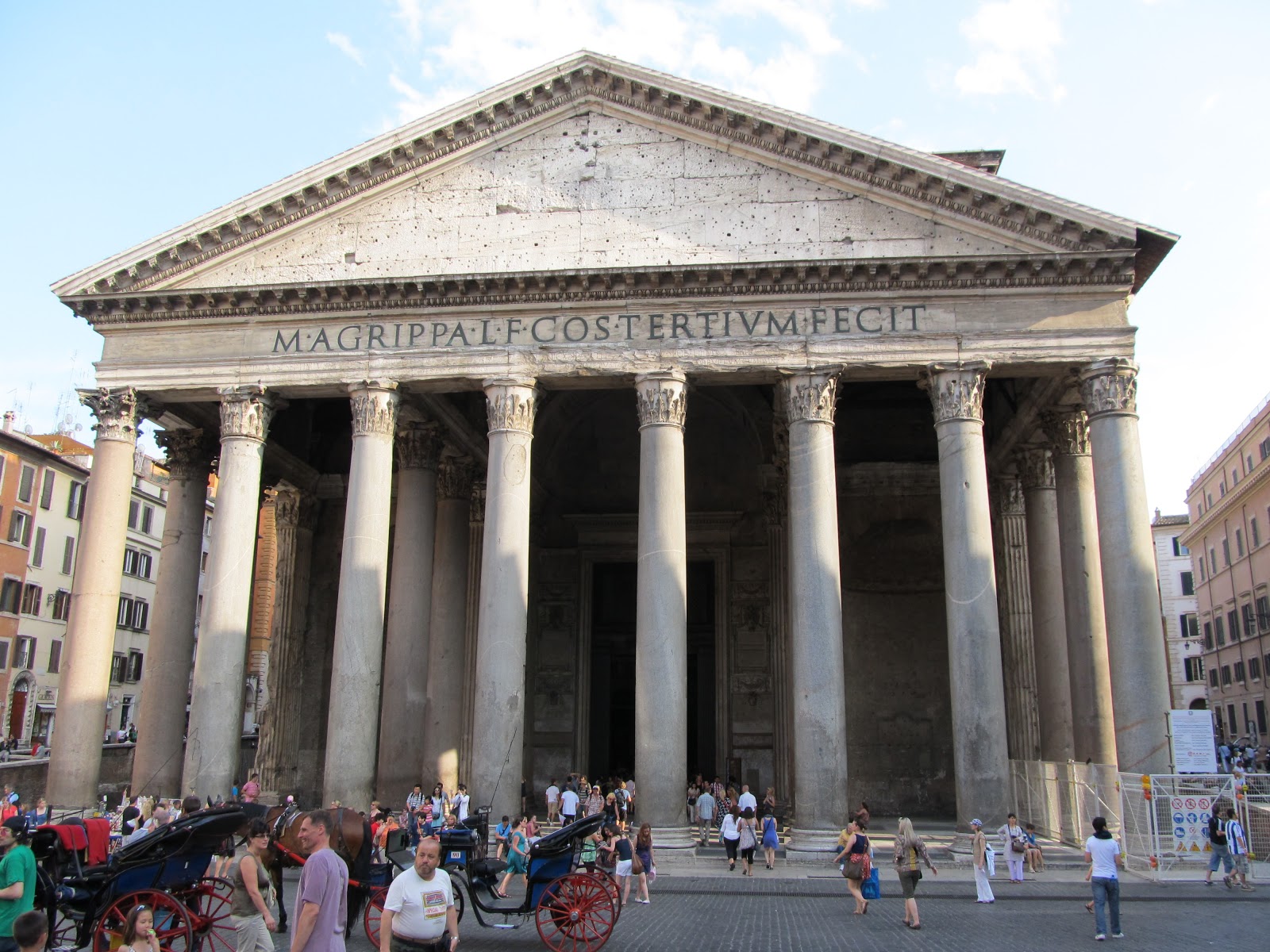
Pantheon

The Pantheon is actually the only building from ancient Rome that's been in continual use since its construction. [Citation: Rick Steves, and I have no idea where he gets his stuff from, so that could be a lie.] It was originally build by Marcus Agrippa in 27 BC, but the one we see today was rebuilt by Hadrian, one of my favorite emperors, in 120 AD. Its dome, which is 142 feet from floor to ceiling, was a model for the dome in Florence (which I've seen), St. Peter's (which I've also seen), and our capitol building (which I would be ashamed if I hadn't seen). From, the outside, it has impressive columns and huge gilded letters that say, Marcus Agrippa built this. He didn't, of course, but Hadrian wanted to preserve the prestige, I guess. From the inside, a single skylight lets down the only illumination the room gets, sending beams of sun from the sky to the corners of the room from the oculus.

Now, this building may have been in use so long that it's sunk a couple of inches below all the streets of Rome outside, but it hasn't always had the same use. The Pantheon was a temple to all the gods and the nooks that now hold statues to Mary and the saints used to hold altars for various gods, with the altar to Jupiter, the big shot of the Roman gods, at the place where the main altar now stands. It actually stayed in use as a temple for a couple of centuries- it wasn't converted to a church until 609.

I would love to say that there's an air of the ancient in the Pantheon, that it has preserved all the history of the other temples that have since fallen into ruins in the forum, bearing witness to the once powerful Roman gods. But since the oculus lets in rain as well as light, the floor gets redone every once in a while, and the statues are all kept clean and new looking. Much more modern people are entombed there- Raphael sits in a recess beside his Madonna and Child that he designed for his tomb, and some of Italy's most recent kings while away the hours of eternity there as well. That, combined with the announcement for Silence, please, in a variety of languages over the loudspeaker every few minutes, generally kills the ambiance of the ancient.


Raphael's tomb. The man had taste.
I'm not saying that it's not a wonderful sacred place. It's just one of those sacred spaces that seem a little less sacred because of the number of people in it treating it like a museum, or maybe a glorified bench. People approached the altar and sat down in the pews in front of it only to pull out a map or a guildebook and plan the next stage of their journey. Some talked over the announcement for silence, please. There was a veritable line of people in front of the altar, waiting to have their picture taken.

And how would you use this as a church, anyway? Is there a place for a sacistry around the back? There's no organ, no choir, though I've found that masses don't require songs. I'm so used to the processional space afforded by a longitudinal church with its rows of pews and columns, I'm not even sure where a priest would come in or go from here. It's more like a chapel than a church, made primarily for private devotion, of which there was not much while I was there.

I paused for a while in front of Raphael's tomb because it was lovely and because I admire the painter. I paused for a while in front of a few of the statues beacuse they caught my eye more than because I had a reason to pray in front of them. But really, I would have felt more comfortable sitting outside and leaning against one of the columns, much more familiar to me, out in the plain air and away from these imposing figures ignored by the people who ran from place to place snapping shots with their cameras.

Why do we visit churches anyway?

Sunday, June 26, 2011

Florence Duomo

The cathedral in Florence is huge.

One of my selling points for my proposal for this whole thing was that you simply can't get an idea of what being in these spaces is like from a book. My primary example of this was the size of most of these cathedrals- I can tell you that the building is 502 feet long (like a football field and a half), 124 feet wide, 295 feet wide at the transept (which is almost a football field- sorry, I have no other good conception of distance [silly marching band]) and 75 feet tall... in the nave of the cathedral. It's 375 to the top of the dome.

I just...

I can't...

Like, what even? 
It's just massive. It's impressively big. Which is part of the reason why it was begun in the first place.

The Duomo di Firenze (or the Cattedrale Santa Maria del Fiore, St. Mary of the Flower [the flower being the lily, the symbol of Florence]) was actually built after the cathedral in Pisa and a couple of other less-well-known cathedrals around the area. It was built with public funds and set up as a state church in a response to these churches. They started construction in 1296 and finished the nave about a hundred years later (there were plagues and things holding up the project) and the dome in 1436. They pulled out all the local artist stops, which, considering the local artists were people like Donatello, is pretty awesome. Though, I always feel obligated to point out this graph when I talk about Donatello. The end product was the largest dome in the world until modern times. It's even bigger than the dome in St. Peter's Basilica in Rome, and was, in fact, a model for domes after it.

It's an impressive building. The exterior is white, green and red marble (mostly white) and it's part of this complex including the baptistery across the way.

It dominates the view of the city from the Piazzale Michelangelo, about a mile and a half away. Climbing up the dome was the worst climb I've ever done, but the view from the top was absolutely gorgeous, so, still, my vote falls in with actually doing dome climbs.
I may have already used this one, but it's so pretty. Soooo preeetttyyyy.

At the same time, you know, with all the impressiveness, it didn't strike me as a particularly holy place. There's an excavation downstairs, which is cool, but right beside it is the gift shop. The gift shop. Call me old fashioned, but I don't think you should be selling things in a church. Outside the walls, in an ajoining building, sure. But actually in the church? Hmmm. Though, in the gift shop's defense, it is downstairs.

And see, the thing is, with these huge buildings, you have these side chapels (the top and arms of the cross, since it's normally laid out in a cruciform plan) and that's normally where mass is held. That huge nave? It's used for the bigger mass ceremonies, I presume like Christmas and Easter, but most of the time, it's only filled with tourists.

And I hate tourists.

Like, I really hate tourists in churches.

I mean, I realize that I act like one, but I generally acknowlege the purpose of the building, you know, as a place dedicated in name if not in practice for the worship of the God of the world's largest monotheistic religion, a gathering place for the faithful, a place of spiritual significance for people. But the person complaining loudly on their way out the door that they can't view a chapel because mass is about to be held in there or the group coming to a consensus that this visit was a waste of their time or the tourist with their camera who steps in front of a person praying in the pews to get a better picture of who knows which window Donatello designed, all these people are missing the point of the building.

Though if they were taking this picture I might be more understanding.

You know, maybe they're not. Maybe all these places I visit are just tourist traps now, designed to intimidate and remind people of the power of the bishops and the cardinals and the pope and the people associated with them. The Duomo has plenty of pictures and statues of the nobles who helped to fund its construction. And it does have a gift shop in its basement.

But I'm a bit opposed to this kind of cynicism. Because I remember that first moment of wonder as I stepped into the large, empty gothic nave.

And I like wonder.

Saturday, June 25, 2011

Florence

On our first day in Florence, we were so entranced with the view from our campground that we didn't even leave the porch of the common area. I wrote and thought and in general enjoyed life and the cool air blowing off of the end of the Appenines in the distance.

On the second night in Florence, we walked over from our hostel to the Piazza Michelangelo to watch the sunset. There's a big copy of Michelangelo's David up there and so, along with what must have been half the tourist population of Florence, we watched the lovely sun sink into the bank of clouds just above the river. It was kinda crazy beautiful.


The next day, we spent time in the city, walking across that big famous bridge and finding our way to that one square, where we decided to meet up again. I headed over to the Duomo, climbed the dome unintentionally (the signs aren't particularly clear),

This: Unintentional.
This: The perk of unintentional excursions.

 got lost on my way back, found Santa Croce,
It's got a big tower, like the place I was looking for.

which was on my list to visit, and then proceeded to sit around for an hour listening to a man playing movies themes on guitar (The Godfather is popular over here) before another woman waiting on a friend informed me it was after 8. I was supposed to meet Christine at a quarter to six.

I hiked back up these stairs
They haunt my dreams.

 and found Christine at the campground (no, really, cellphones are wonderful things) and enjoyed talking to the people around the place. Campgrounds are a little different from any other place we've stayed. There's a lot more families in motor homes, a lot of people spending a long time enjoying the view rather than running on to see the next big thing. Florence is a city of the Renaissance. Painters, thinkers, scientists all came from or to here, beginning or continuing changes we still feel today. The science museum here is named after Galileo, who (I think) did some of his initial experiments with telescopes from here. And yet it is not a city that forces its history on you or demands that you fill up your itinerary or your evenings. I loved it.

On Sunday, I went to St. James Episcopal Church, the American church in Florence, because it was Pentecost and I desperately wanted someone who spoke in my own language. It was the beginning of week three and, if you hadn't heard, there's this rule of the threes- apparently, at three weeks and three months and three years, you get this crazy sadness or homesickness or something, Silly superstitions aside, I really needed to hear a Protestant church service in English. The only thing that could have done my heart more good would have been a Methodist hymn sing, but those are as hard to come by over here as Sundrop.

Sunday afternoon, Christine and I went exploring again, to attempt to find the museum that the real David's housed in to make a reservation. I gave Christine the map and we found our way to where we were supposed to be, stopping in this eerily deserted square first. After resting for a few moments, watching the pigeons attack the man on the horse, we decided to look around. It was a warmer day, so shorts and a tank top were called for. There was a children's hospital or maybe a museum that was confusing off to one side, and then a basilica on another. The basilica was having an all-day Pentecost prayer vigil, but I'm quiet and respectful and I figured sticking my head in wouldn't hurt anything. This little old lady stopped us just inside the door, though, pointing at our legs and our shoulders and lecturing us in Italian. We whispered that we were going and she kept on talking. I caught a glance of a ceiling like the one in Venice before we left.

I've never been thrown out of a church before. It's a new experience. God must really hate my knees. (PS, I definitely understand that I was inappropraitely dressed per cultural norms and that I should be more respectful when I enter another person's sanctuary and that my last comment is slightly uncalled for. Then again, I was just thrown out of a church. Go ahead and blame me.)

Still, wandering around and finding the museum closed (and closed on the second and fourth Mondays of the month. Sensical? No.) and wandering back was a good way to clear the air and remind myself of the beauty of this city. Maybe I loved resting here too much. There's definitely more to see than I saw, but I don't know that I'd trade one morning for another site to see and memorize for later description.

Our time in Florence ended with a surprise trip to Pisa, which was quite nice. It's wonderful to meet people and travel with them on their pre-planned adventures, and this was such an adventure as to merit its own post. On Tuesday, we took an afternoon train to Rome, piling once again onto a bus that careened along streets full of Italian drivers and motorcyclists, who like to think that they can drive anywhere they wish. This is partially true and totally frightening on a bus. On our way to our hostel, I was distracted by an old man whistling to himself and then a cheerful English speaking group singing together on the bus. Now, with the air full of people busy with their lives, it's easy to see how people got stuff done in the 16th century.

Can't get too comfortable with magic, afterall.