I'm a little saddened to think that trains will have less magic for me after this trip.
After all, I've spent a substantial amount of time jumping from city to city on trains, watching the countryside sweep by as I sit stationary, doing my best to be more philosophical about the whole ordeal than thinking of Chocolate Frogs, Dementors and Scabbers. I've even spent the night on a train, in the rather cramped space of the middle bunk in a 6 bunk sleeper. I think I would slept better in a seat.
I just couldn't get to sleep, first watching Austria slip by, then staring intently overhead to watch the first stars come out. I was convinced I was going to see wonderful stars this night, since trains clearly travel through the country, where there are no city lights to block out the nightsky. I got frustrated with my space and the late setting sun and so eventually I quit straining and rolled over, ready to let my eyes rest for an extended period of time.
Something woke me up hours later. It was much darker in the cabin- maybe they had dimmed the lights in the hall. I rolled onto my back because the arm I had been sleeping on was tingling, asleep, and opened my eyes to look around.
Holy. Everything.
You could see the Milky Way. There were so many stars. I lay back and stared at the wonder of it all, unsure of my bearings in an unfamiliar slice of the sky. Have you ever seen it, a darkened sky on a clear night, with no human light to drown out what must be the divine light reaching us from so far away? Do you know what our galaxy looks like from our home, the permanent cloud in the sky that so many legends have been told about? Have you ever seen so many stars that the sky doesn't become a simple connect the dots but instead offers you shading, a billion brilliant lights twinkling more spectacularly than any photograph or word can capture? Have you seen it?
I remember each and every time I've seen a sky like this. Twice, before I could point out a single full constellation, I lay underneath a sky like this. Once, I stood outside a huge telescope, pointing a smaller optical instrument at the newly risen Juptier, looking at its cloud bands and moons. You could see the galaxy rising up like steam from Sagittarius and even though I laughed at the teapot idea then, I sat amazed at the stories that had been told about these dots in the black above us.
Once, I lay on a mountain side with some of the best people I've ever met, watching shooting stars fly against the black. This is one of my favorite memories, one I hide away and glance at only when the real stars begin to compare to the ones I saw on that night. Even though it was summer, we lay under blankets to guard against the cold of a sunless sky, and prayed. I prayed for the brokeness I'd seen in people, in lives, in all these problems around us, staring into a sky so untouched by it all. I can believe it, you know, when I'm looking at the stars, that there's something bigger than all the things that tie us to this tiny little planet. It's awesome and awful, to look and think of these objects so distant from us, yet powerful enough to remind us nightly of their existence. They're a beautiful, beautiful reminder of the things in the universe that we can't own, can't touch, can't steal, can't ruin. We can only block them out, forget to be reminded, stop our children from seeing the grandeur of the sky they've inherited.
I used to think knowing the constellation stories would ruin the sky for me. If I knew the pictures others had seen, I would lose the ability to see my own stories up there. But as I lay on the train and watch the sky change as we rounded a corner, I picked out the Bigger Dipper and then the rest of Ursa Major, then Ursa Minor, then Draco. I waited for the sky to turn again to better see Lyra or Aquilla or Cygnus.
For thousands of years, people have seen these stars. People from every culture have told stories about the things they see in the sky above them, the stars being so constant a company of companions as to become ordinary. For thousands more, a sky like this will hide behind our clouds of light, blocking us from this universal sharing. We'll forget. And we'll be quite surprised when we see it again. Amazed. Awed.
And so, in a way, the nighttime sky, this plethora of stars against the black, is like the Church. The real Church, the functioning Body of Christ that the early followers of Jesus heard about from a converted Jew named Paul. For many years, there were stories told, dots connected among the truths we knew. Learning continued, and other people saw the dots connected in a different way, but the tradition of the learning grew and the studying continued. Then we allowed it to become clouded by the things we've created, and so we've blocked out the things that might be shared by all, the good and wonderful things that remind us of our place in all the bigness that is out there. And it amazes us when we see it again, when we see the Church actually working among the churches.
But it doesn't much matter which stories you learned from the sky. I don't think any one grouping of stars is any more correct than another. It's all we've got, really, the ways we reflect ourselves in the black. And I don't feel so afraid anymore about knowing more about the stories people told. I knew where I was going in the sky as I found my familiar constellations, but I was still left to wonder about the many more hiding amist the black. There's so many things left to learn, so many stories to tell, to teach, to share.
The Church in the Sky.

A pile of rocks ceases to be a rock when somebody contemplates it with the idea of a cathedral in mind. -Antoine de Saint-Exupery
Showing posts with label Vienna. Show all posts
Showing posts with label Vienna. Show all posts
Wednesday, June 15, 2011

Peterskirche
You get to learn the dates of many feasts of the Catholic Church when you visit places in Europe. For example, our first day looking around Vienna happened to coincide with the 40th day after Easter, the day of the Ascension. Many of the shops were closed, though the churches were open, but there's only a select few of us that think that churches are interesting enough to make up an entire day's occupation. We're the same group of people who will go google the stories of the saints when we learn to whom each altar in the church is dedicated.
But a whole day of trying to find something to do in a city in another country where they don't speak English, where you can't figure out why nothing is open and where you are having extraordinary difficulty deciding what to do for lunch and/or dinner (you're not quite sure what time it is either) on top of travelling to so many different places can do something crazy to a person. You can become quite unreasonably angry with your friend and leave her on the metro back to the hostel while you hop the next train back into the city to sulk.
It was in this rather disquieted state of mind that I magically found my way to St. Peter's Church or Peterskirche in German. I had walked by this church before the last time I was in Vienna, I was sure, and even though I had determined earlier that day that I was going to focus on Stephansdom while I was in Vienna, the bells were ringing the evening mass as I walked by and I figured it couldn't hurt me to go to church. I would just sit down somewhere and write mean things otherwise.

Peterskirche is not a big church. It's baroque and it's impressive with its decoration, but it had already quite filled up by the time I walked in. I had to sit in a chair beside the raised pews with no kneeling rail. This mean that during mass, when I generally play a game of monkey-see, monkey-do with the knowledgable people around me, I couldn't imitate their kneeling. It was still good though, to listen to the congregation chant their way through mass and to contemplate things as I looked around the room, wondering what in the world the sermon could be about.
The confessional booths were open and I had never seen one of these things in action before. The ones in Peterskirche were also new to me because they had these little side nooks that you kneeled at and then whispered yours sins to the priest. Man, I want more privacy than that. If I have to say everything I've done wrong since my last confession, I don't want any chance of that mess getting around (that's what she said... and now I would have even longer of a list). But the booths are distant enough from the main nave, I guess, taking up some wall space in some of the side altars, so I just watched as a mini-priest in the making, a proud middle school boy, made his way over to the booth early on in the service to get those sins off his chest before taking communion. A little line formed, mostly men, though the boy's mother also went over to the booth (is it allowed to go both ways? I feel like moms should be able to get some information from the priest. They're all in cahoots anyway). It's a character study, watching their faces change as they approach confession and after they leave it. And hey, body language was the only thing that was making sense to me at the time.
After mass, the church cleared out but I couldn't bring myself to leave. I mean, I didn't particularly want to look around, because I was still mad and sad and stuff, but the people who stayed to pray had me glued to my seat. OK, this is kinda a lie and this is where I make my decision. Sometimes you just get tired of secularizing everything.
I believe in God. I believe God does mighty and wonderful things in the world today, sometimes through the Church and sometimes not. I believe God hears me when I pray and I believe that He doesn't judge me on the way that my prayers get to Him, so even though I feel a little insolent doing it in one of these fancy churches with enough decorations on the ceiling to scare anyone away from staring intensely at it, I will stare intensely at the ceiling because that's the easiest way for me to focus my attention on the task at hand, and I have found that I can pray for the hour and a half between mass and the evening organ concert and barely notice my butt going numb from the tiny wooden pew that I absconded post-mass.

Because sometimes, God needs to hear it. God needs to hear my confusions and my frustrations as much as He needs to hear my joys and my praises. God needs to hear my confessions and my failings as much as He needs to remind me of my blessings and my suceedings. God needs to hear when I am worried about the Church and He needs to hear what I have to say in praise of the Church. And I couldn't think of a better place to do this than the one I currently inhabited. It also doesn't hurt to send up a prayer or two for people you may or may not have left on metro trains, even though we're both capable adults and the metro stop is stupid close to the hostel. You know, just in case.
Then I let myself get distracted by the room. I'm getting to like the stories churches tell. I like recognizing the altars (St. John of Nepomuk, St. Barbara, St. Michael, St. Anthony).

I like looking at the different ways people choose to portray Biblical figures.

Of course, there's always people in the room. It's impossible not to be slightly miffed by the tourists that forget that you're in a church, that click two photos of the interior and talk too loudly to the people around them before moving on, but this can be countered if, say, a caring husband leaves his pregnant wife waiting patiently at the pews while he goes to fetch a priest to talk about a christening ceremony for the little not-yet-born human that will soon occupy all of their time. Then you can watch as one of the other priests, quicker at changing, comes over to talk to the pregnant wife like they're old family friends and watch the way she reacts, all comfort and smiles and quietly told stories, respectful but happy in the space she's in. You can sit back as the husband comes back, priest in tow, completely focused on getting back to his wife, smiling at her as he approaches. This little scene can give you a good bit of encouragement for the Church, if a place like this, so full of shiny things that they're willing to give you a printed guide at the door to help you sort it out, can still be bothered to do the simple care of a congregation. It can make you smile as you go back to your prayers.
I thumbed through the pamphlet on the objects in the room as I waited the extra half hour for the organ concert to start. The free concert, by the way, was something kinda crazy beautiful. They had singers as well, and they did Ave Maria, which I had done with my youth choir back home and dearly loved and my heart soared for a song I understood. All in all, it was beautiful. But before I got distracted by that, I was distracted by the top paragraph on the back of the pamphlet. "Before leaving, do look again at the painting aboce the main altar.

This work of art (by M. Altomonte) portrays the healing of the lame man by St. Peter and St. John at the Beautiful Gate in Jerusalem. Before you leave the church you might pray for the unity of all Christians. St. Peter's has worked for this goal since 400 AD."
See, the Ascention is when Christ left us all to deal with each other, you know, Love one another as I have loved you, etc. 400 years later, this church began its work trying to make that kind of unity true. It's all good, though. I can't think of a better place to celebrate the beginning of the churches' time together.
 |
| Ooo ooo, I know this one! St. John of Nepomuk! I don't even have to look up how to spell Nepomuk anymore! |
But a whole day of trying to find something to do in a city in another country where they don't speak English, where you can't figure out why nothing is open and where you are having extraordinary difficulty deciding what to do for lunch and/or dinner (you're not quite sure what time it is either) on top of travelling to so many different places can do something crazy to a person. You can become quite unreasonably angry with your friend and leave her on the metro back to the hostel while you hop the next train back into the city to sulk.
It was in this rather disquieted state of mind that I magically found my way to St. Peter's Church or Peterskirche in German. I had walked by this church before the last time I was in Vienna, I was sure, and even though I had determined earlier that day that I was going to focus on Stephansdom while I was in Vienna, the bells were ringing the evening mass as I walked by and I figured it couldn't hurt me to go to church. I would just sit down somewhere and write mean things otherwise.

Peterskirche is not a big church. It's baroque and it's impressive with its decoration, but it had already quite filled up by the time I walked in. I had to sit in a chair beside the raised pews with no kneeling rail. This mean that during mass, when I generally play a game of monkey-see, monkey-do with the knowledgable people around me, I couldn't imitate their kneeling. It was still good though, to listen to the congregation chant their way through mass and to contemplate things as I looked around the room, wondering what in the world the sermon could be about.
The confessional booths were open and I had never seen one of these things in action before. The ones in Peterskirche were also new to me because they had these little side nooks that you kneeled at and then whispered yours sins to the priest. Man, I want more privacy than that. If I have to say everything I've done wrong since my last confession, I don't want any chance of that mess getting around (that's what she said... and now I would have even longer of a list). But the booths are distant enough from the main nave, I guess, taking up some wall space in some of the side altars, so I just watched as a mini-priest in the making, a proud middle school boy, made his way over to the booth early on in the service to get those sins off his chest before taking communion. A little line formed, mostly men, though the boy's mother also went over to the booth (is it allowed to go both ways? I feel like moms should be able to get some information from the priest. They're all in cahoots anyway). It's a character study, watching their faces change as they approach confession and after they leave it. And hey, body language was the only thing that was making sense to me at the time.
After mass, the church cleared out but I couldn't bring myself to leave. I mean, I didn't particularly want to look around, because I was still mad and sad and stuff, but the people who stayed to pray had me glued to my seat. OK, this is kinda a lie and this is where I make my decision. Sometimes you just get tired of secularizing everything.
I believe in God. I believe God does mighty and wonderful things in the world today, sometimes through the Church and sometimes not. I believe God hears me when I pray and I believe that He doesn't judge me on the way that my prayers get to Him, so even though I feel a little insolent doing it in one of these fancy churches with enough decorations on the ceiling to scare anyone away from staring intensely at it, I will stare intensely at the ceiling because that's the easiest way for me to focus my attention on the task at hand, and I have found that I can pray for the hour and a half between mass and the evening organ concert and barely notice my butt going numb from the tiny wooden pew that I absconded post-mass.

Because sometimes, God needs to hear it. God needs to hear my confusions and my frustrations as much as He needs to hear my joys and my praises. God needs to hear my confessions and my failings as much as He needs to remind me of my blessings and my suceedings. God needs to hear when I am worried about the Church and He needs to hear what I have to say in praise of the Church. And I couldn't think of a better place to do this than the one I currently inhabited. It also doesn't hurt to send up a prayer or two for people you may or may not have left on metro trains, even though we're both capable adults and the metro stop is stupid close to the hostel. You know, just in case.
Then I let myself get distracted by the room. I'm getting to like the stories churches tell. I like recognizing the altars (St. John of Nepomuk, St. Barbara, St. Michael, St. Anthony).

I like looking at the different ways people choose to portray Biblical figures.

 |
| OK, so I don't really know who this is, but isn't that the coolest effect ever?! |
Of course, there's always people in the room. It's impossible not to be slightly miffed by the tourists that forget that you're in a church, that click two photos of the interior and talk too loudly to the people around them before moving on, but this can be countered if, say, a caring husband leaves his pregnant wife waiting patiently at the pews while he goes to fetch a priest to talk about a christening ceremony for the little not-yet-born human that will soon occupy all of their time. Then you can watch as one of the other priests, quicker at changing, comes over to talk to the pregnant wife like they're old family friends and watch the way she reacts, all comfort and smiles and quietly told stories, respectful but happy in the space she's in. You can sit back as the husband comes back, priest in tow, completely focused on getting back to his wife, smiling at her as he approaches. This little scene can give you a good bit of encouragement for the Church, if a place like this, so full of shiny things that they're willing to give you a printed guide at the door to help you sort it out, can still be bothered to do the simple care of a congregation. It can make you smile as you go back to your prayers.
I thumbed through the pamphlet on the objects in the room as I waited the extra half hour for the organ concert to start. The free concert, by the way, was something kinda crazy beautiful. They had singers as well, and they did Ave Maria, which I had done with my youth choir back home and dearly loved and my heart soared for a song I understood. All in all, it was beautiful. But before I got distracted by that, I was distracted by the top paragraph on the back of the pamphlet. "Before leaving, do look again at the painting aboce the main altar.

This work of art (by M. Altomonte) portrays the healing of the lame man by St. Peter and St. John at the Beautiful Gate in Jerusalem. Before you leave the church you might pray for the unity of all Christians. St. Peter's has worked for this goal since 400 AD."
See, the Ascention is when Christ left us all to deal with each other, you know, Love one another as I have loved you, etc. 400 years later, this church began its work trying to make that kind of unity true. It's all good, though. I can't think of a better place to celebrate the beginning of the churches' time together.
Stephansdom
St. Stephen's Cathedral is that church in Vienna. It's the metro stop you get off at when you want to go into the old city and mostly everything fans out from the square in front of the cathedral.
I had three people tell me to go there, one by name because you simply have to visit Stephansdom if you're visiting churches in Vienna, one because the outside was amazing, even though it's partially (perpetually) under construction and one because they have these colored filters in front of the windows so when the sun comes in, it looks like a laser show in a gothic cathedral. All of these seem like valid reasons to check out the building.
There are so many churches in Vienna. There's Maria vom Siege, Our Lady of Victory, right down the road from my hostel. There's Peterskirche, but more on that later. There's the big church in Karlzplatz. There are dozens of other churches not big enough to be landmarks on a map, but they're still around, quietly awaiting the patronage of churchgoers and tourists alike. There are even churches without impressive buildings. I think there's a Korean church also down the road from my hostel, marked with a cross sticking out into the street and there's the English Speaking United Methodist Church in Vienna that has very detailed directions on its website because it's easy to miss. I almost feel bad for spending a whole week here and only really looking at two churches.
So if there are so many options for going to church, why is Stephansdom the church in Vienna? The audioguide says it's a symbol for Vienna and a symbol for Austria. It's also quick to point out Mozart's involvement in the church (he was married there, christened two of his children there and his funeral service was held there). And I have to say, it is a pretty church. The outside is adorned by what must be thousands of stone curls along with the traditional gargoyles and scenes from the life of Christ.
Inside is also beautiful, light show notwithstanding. There's your regular slew of statues of patron saints, Mary and the apostles, and of course, Jesus himself. The stained glass windows behind the main altar are impressive, along with the organ(s).
Besides all that, the south tower contains the second largest bell in the world which you can (pay money to) ride the elevator up and see. It also gives you a pretty good view of Vienna.
I first went to Stephansdom on Ascention Day. Note to everyone- Catholic holidays, like Ascention Day, are bank holidays in Austria so most of the shops are closed, with the exception of the souvenir shops. The museums were open, I guess, but besides that, there's not much else to do besides go look at churches.
Ascension Day is the day, forty days after Easter, when Christ left the disciples again and ascended into heaven. The two Sundays from that is Pentecost, the giving of the Holy Spirit to the first Christians and the birth of the Church but I guess on Ascension Day, we focus on the things that have left us, rather than the things that were given us. You could smell the melting wax from hundreds of candles the second you stepped into the cathedral. And that was beautiful enough in itself- through the crowds of people with their cameras out, focused on capturing the colors on that wall or the picture above that altar, you could see a few making their way slowly to the side altar to offer a prayer before they lit a candle, sending lost spirits up and away.
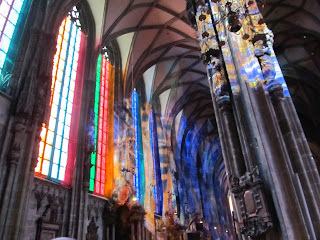
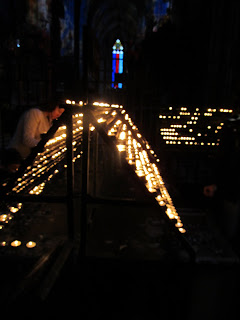
But then there were these tours going around everywhere and all these little interactive information posts that cost 2 euros to operate and people jostling people outside the metal screen that separated the narthex from the nave and I think I bought an audiogiude just for the chance to step away from them all. I sat in the nave for a few minutes, then walked around, listening to the story of the baptisimal font in St. Catherine's chapel, the Madonna whose colors have been turned black by the smoke of ages of devotional candles lit beside it, the old organ and the new organ, the destruction of the cathedral during a fire in World War II and the beginning of the ever contintuing construction after the war.
I sat in front of the chancel and high altar for a few minutes, watching a family that had come in pray. Then an older man walked right up into the chancel, past the altar table and up behind the choir, where a screen, part of the colorshow, separated us from the altarpiece and statues. This distracted one of the young men in the family from his prayers and he watched the lady who had come in with the man as she told him, I assume, that she didn't think he was supposed to go up there. He waved her off and eventually she walked up into the chancel too, causing the young man in the pew to look around concernedly. Within a few moments, he sat back in relief as one of the staff members of the cathedral shooed the tourists out of the chancel, answering their protests by insisting, "It's for the priests!" as he shut the chancel rail. The old man threw his hands up in the air in frustration, then gestured to the chancel rail that had been left open. The staff member just shook his head and said again, "For the priests!"
The audioguide takes you around the nave of the church, with a brief stop outside one of the side chapels. Stephansdom is a hall church, with two rows of columns separating the nave from the side aisles with equal celilings. You can sit in front of one of the altars in the nave and listen to the guide as it points out where the organ used to be and where the choir used to stand. The master builder put a carving of himself into the wall under where the organ stood, supporting the weight of the instrument.

It's right close to the entrance to the crypt, which I had planned on visitng, before the staff started to set up for a service later that evening. With all the people still inside, I figured I'd do them a favor and get out of the way, knowing that it can't be easy to maintain a functioning church when people are just standing around, gawking at everything. A loud crowd of teenagers passed by as I stood to go and staff member walked by and said, "Quiet! You are in church!"
Even on Sunday morning I think the staff could have issued the same warning. I was going to go to the English speaking church, but then again, how often do you get to go to church in a cathedral? And besides, I'll get to hear English every Sunday soon enough. So I walked in and I bypassed all the people standing around and gawking and walked into the main nave, talking a seat near the transept. Eventually the seats around me filled and more and more people walked into the nave, filling in the pews, the chairs they had sat out in addition to the pews and finally standing in the middle of the transept. I watched the families walk around, the new parents strolling around their babies, the youth in suits shaking hands with everyone, the older couples shuffling down the aisles, taking a seat whenever someone younger hopped up to let them have a place. It was a pretty vibrant congregation, full of well-to-do people who knew each other and greeted one another by name.
The nave was so full a member of the staff had to get people to move from the middle of the transept so the acolytes and priests could process in. I thought it was funny- we had all hopped up at the sound of this little bell announcing the beginning of the service but people hadn't thought to look around for the entrance of the clergy. I found out partway through the service that it was Confirmation Sunday (or something like that- there might be another rite I'm missing, the whole not being catholic thing) so many of the people filling the transept were family members watching their young relatives being ushered into the life of the church. Their concern was focused on anything other than the ceremonial procedures of the service.
It always amazes me how wired these old buildings can be. There were TV screens for people in the back so they could see what was going on in the service and there were microphones for the musicians, priests and anyone who came up to the lecturn, which was a surprisingly large number of lay members. The service started out with the organ filling the room, as I expected, but the rest of the music was provided by 1) a monk on the accordian accompianying 2) the music leader on guitar showing 3)two oboes, a flute, a clarinet, 4) a tambourine player and 5) four female vocalists on mics. Plus the head priest dude. They always have to sing into their microphone, though, so I guess it's expected that you have to be more than tone-deaf to lead a service.
An hour and a half later, the band played its last song, the priests processed out and the organist played a short postlude after the confirmands posed for pictures. It felt like a pretty standard service, albeit in German and with the weird standing and kneeling and crossing yourself that I swear I'm going to master before I leave the continent. People stayed around in the nave even after the organist finished, talking to each other and taking pictures with their families.
I, however, fought my way through the flood of tourists waiting on the other side of the metal bars that separated the holy from the secular and strode into the sunlight outside of the cathedral.
 |
| Kinda intimidating, actually. |
I had three people tell me to go there, one by name because you simply have to visit Stephansdom if you're visiting churches in Vienna, one because the outside was amazing, even though it's partially (perpetually) under construction and one because they have these colored filters in front of the windows so when the sun comes in, it looks like a laser show in a gothic cathedral. All of these seem like valid reasons to check out the building.
There are so many churches in Vienna. There's Maria vom Siege, Our Lady of Victory, right down the road from my hostel. There's Peterskirche, but more on that later. There's the big church in Karlzplatz. There are dozens of other churches not big enough to be landmarks on a map, but they're still around, quietly awaiting the patronage of churchgoers and tourists alike. There are even churches without impressive buildings. I think there's a Korean church also down the road from my hostel, marked with a cross sticking out into the street and there's the English Speaking United Methodist Church in Vienna that has very detailed directions on its website because it's easy to miss. I almost feel bad for spending a whole week here and only really looking at two churches.
So if there are so many options for going to church, why is Stephansdom the church in Vienna? The audioguide says it's a symbol for Vienna and a symbol for Austria. It's also quick to point out Mozart's involvement in the church (he was married there, christened two of his children there and his funeral service was held there). And I have to say, it is a pretty church. The outside is adorned by what must be thousands of stone curls along with the traditional gargoyles and scenes from the life of Christ.
 |
| These are just the curls on the tower. You should see the rest of it. |
Inside is also beautiful, light show notwithstanding. There's your regular slew of statues of patron saints, Mary and the apostles, and of course, Jesus himself. The stained glass windows behind the main altar are impressive, along with the organ(s).
 |
| Organ win. |
I first went to Stephansdom on Ascention Day. Note to everyone- Catholic holidays, like Ascention Day, are bank holidays in Austria so most of the shops are closed, with the exception of the souvenir shops. The museums were open, I guess, but besides that, there's not much else to do besides go look at churches.
Ascension Day is the day, forty days after Easter, when Christ left the disciples again and ascended into heaven. The two Sundays from that is Pentecost, the giving of the Holy Spirit to the first Christians and the birth of the Church but I guess on Ascension Day, we focus on the things that have left us, rather than the things that were given us. You could smell the melting wax from hundreds of candles the second you stepped into the cathedral. And that was beautiful enough in itself- through the crowds of people with their cameras out, focused on capturing the colors on that wall or the picture above that altar, you could see a few making their way slowly to the side altar to offer a prayer before they lit a candle, sending lost spirits up and away.


But then there were these tours going around everywhere and all these little interactive information posts that cost 2 euros to operate and people jostling people outside the metal screen that separated the narthex from the nave and I think I bought an audiogiude just for the chance to step away from them all. I sat in the nave for a few minutes, then walked around, listening to the story of the baptisimal font in St. Catherine's chapel, the Madonna whose colors have been turned black by the smoke of ages of devotional candles lit beside it, the old organ and the new organ, the destruction of the cathedral during a fire in World War II and the beginning of the ever contintuing construction after the war.
I sat in front of the chancel and high altar for a few minutes, watching a family that had come in pray. Then an older man walked right up into the chancel, past the altar table and up behind the choir, where a screen, part of the colorshow, separated us from the altarpiece and statues. This distracted one of the young men in the family from his prayers and he watched the lady who had come in with the man as she told him, I assume, that she didn't think he was supposed to go up there. He waved her off and eventually she walked up into the chancel too, causing the young man in the pew to look around concernedly. Within a few moments, he sat back in relief as one of the staff members of the cathedral shooed the tourists out of the chancel, answering their protests by insisting, "It's for the priests!" as he shut the chancel rail. The old man threw his hands up in the air in frustration, then gestured to the chancel rail that had been left open. The staff member just shook his head and said again, "For the priests!"
The audioguide takes you around the nave of the church, with a brief stop outside one of the side chapels. Stephansdom is a hall church, with two rows of columns separating the nave from the side aisles with equal celilings. You can sit in front of one of the altars in the nave and listen to the guide as it points out where the organ used to be and where the choir used to stand. The master builder put a carving of himself into the wall under where the organ stood, supporting the weight of the instrument.

It's right close to the entrance to the crypt, which I had planned on visitng, before the staff started to set up for a service later that evening. With all the people still inside, I figured I'd do them a favor and get out of the way, knowing that it can't be easy to maintain a functioning church when people are just standing around, gawking at everything. A loud crowd of teenagers passed by as I stood to go and staff member walked by and said, "Quiet! You are in church!"
Even on Sunday morning I think the staff could have issued the same warning. I was going to go to the English speaking church, but then again, how often do you get to go to church in a cathedral? And besides, I'll get to hear English every Sunday soon enough. So I walked in and I bypassed all the people standing around and gawking and walked into the main nave, talking a seat near the transept. Eventually the seats around me filled and more and more people walked into the nave, filling in the pews, the chairs they had sat out in addition to the pews and finally standing in the middle of the transept. I watched the families walk around, the new parents strolling around their babies, the youth in suits shaking hands with everyone, the older couples shuffling down the aisles, taking a seat whenever someone younger hopped up to let them have a place. It was a pretty vibrant congregation, full of well-to-do people who knew each other and greeted one another by name.
The nave was so full a member of the staff had to get people to move from the middle of the transept so the acolytes and priests could process in. I thought it was funny- we had all hopped up at the sound of this little bell announcing the beginning of the service but people hadn't thought to look around for the entrance of the clergy. I found out partway through the service that it was Confirmation Sunday (or something like that- there might be another rite I'm missing, the whole not being catholic thing) so many of the people filling the transept were family members watching their young relatives being ushered into the life of the church. Their concern was focused on anything other than the ceremonial procedures of the service.
It always amazes me how wired these old buildings can be. There were TV screens for people in the back so they could see what was going on in the service and there were microphones for the musicians, priests and anyone who came up to the lecturn, which was a surprisingly large number of lay members. The service started out with the organ filling the room, as I expected, but the rest of the music was provided by 1) a monk on the accordian accompianying 2) the music leader on guitar showing 3)two oboes, a flute, a clarinet, 4) a tambourine player and 5) four female vocalists on mics. Plus the head priest dude. They always have to sing into their microphone, though, so I guess it's expected that you have to be more than tone-deaf to lead a service.
An hour and a half later, the band played its last song, the priests processed out and the organist played a short postlude after the confirmands posed for pictures. It felt like a pretty standard service, albeit in German and with the weird standing and kneeling and crossing yourself that I swear I'm going to master before I leave the continent. People stayed around in the nave even after the organist finished, talking to each other and taking pictures with their families.
I, however, fought my way through the flood of tourists waiting on the other side of the metal bars that separated the holy from the secular and strode into the sunlight outside of the cathedral.
Churches in Vienna
When I opened the directions to my hostel, it said, look for the large domed church and we're a street over. I have a good habit of picking hostels with churches nearby. And this made me realize that Vienna is a great city in which to play my favorite game: Let's Find a Church!
There are churches in neighborhoods when you're lost:

Churches on main streets:
Churches that surprise you when you turn a corner with their murals:
Big churches,
Little churches,

Even churches in train stations!

These are just the churches that I snapped pictures of walking around Vienna. I don't have an exact number, but from scanning this list, which doesn't even claim to be complete, I'm going to guess there are over seventy. And there are so many pretty ones to see and I was there for quite a long time (it might have even been six whole days!) and you might be wondering why I'm only writing up posts on two churches, when there are so many more to be visited.
Well, part of it is that travelling really takes it out of you and the other part of it has to do with my interview for this scholarship in the first place. I had this crazy long list of churches I wanted to visit, like maybe 190 or something like that. The interviewers looked at the ambitious list and asked what I would do if I didn't get to all of them? Did I have time planned in to do all the touristy things I'd like to do? I answered with something along the lines of "I like to be busy and I like a challenge and anyway, this is more of a list of goals. I won't be heartbroken if I miss a couple." One of the interviewers suggested getting to know the places better, maybe picking fewer churches and getting to know them better. I said I'd take it into consideration.
Consider the idea considered.
I was a little overwhelmed by the churches in Vienna. I had my list, but I also have a wonderful habit of running into churches that are quite worth the visit. I decided, sitting in St. Stephen's, that I'd focus on this church, really get to know it, and turn that in for this town. Then I ran into St. Peter's and figured I'd have to turn this in as well.
I'm not going to say that I'm going to only pick two churches per city from now on (in fact, I know I can't do that in Rome), but I am going to allow myself to be limited. I loved Vienna and I don't think I'd spend more time in churches, checking off a list. And even though every church has its own impact, some can make that impact in one viewing and some take more. I'm not afraid to take more time.
There are churches in neighborhoods when you're lost:

Churches on main streets:
 |
| Peterskirche |
Churches that surprise you when you turn a corner with their murals:
 |
| Kapuzinerkirche |
 |
| Stephansdom, the cathedral |

Even churches in train stations!

 |
| They're restoring it. |
Well, part of it is that travelling really takes it out of you and the other part of it has to do with my interview for this scholarship in the first place. I had this crazy long list of churches I wanted to visit, like maybe 190 or something like that. The interviewers looked at the ambitious list and asked what I would do if I didn't get to all of them? Did I have time planned in to do all the touristy things I'd like to do? I answered with something along the lines of "I like to be busy and I like a challenge and anyway, this is more of a list of goals. I won't be heartbroken if I miss a couple." One of the interviewers suggested getting to know the places better, maybe picking fewer churches and getting to know them better. I said I'd take it into consideration.
Consider the idea considered.
I was a little overwhelmed by the churches in Vienna. I had my list, but I also have a wonderful habit of running into churches that are quite worth the visit. I decided, sitting in St. Stephen's, that I'd focus on this church, really get to know it, and turn that in for this town. Then I ran into St. Peter's and figured I'd have to turn this in as well.
I'm not going to say that I'm going to only pick two churches per city from now on (in fact, I know I can't do that in Rome), but I am going to allow myself to be limited. I loved Vienna and I don't think I'd spend more time in churches, checking off a list. And even though every church has its own impact, some can make that impact in one viewing and some take more. I'm not afraid to take more time.
Vienna: Straatsoper
An exerpt from the boredom-induced writings that occurred at the Straatsoper before the performance of Salome:
It's funny how absurdly self-conscious I am about writing in public. For example, I'm currently sitting in line outside the Straatsoper in Vienna, surrounded by people my age and people much older, students and actual opera lovers operating on quite a different budget than most, passing the time before they open the doors and let us buy our 3 euro tickets.
There's a man in a fancy coat who speaks English with a proper British accent, who supervises us all, informs us of the specfic technicalities of Line Space Holding, clinging to his paper which, half an hour ago, consumed most of his attention. He paces around now, as the line snakes in from the icreasingly cold rain to our backroom waiting place. People are sleeping, talking, reading, watching. They're absorbed in their lives and, so, I think, I should know that they have no interest in mine. Yet I fear, so I do not write.
_____________
The line has moved from the backroom entrance of the cheap and financially less gifted to the darkened side stair leading to the balcony. Here a severe looking old man who may or may not speak English with a proper British accent watches our actions, us waiters, and we watch him, between fits of boredom, hoping he'll take pity on us and the poor feet of those still standing and let us claim our seats. Well, standing places. We have not paid for chairs.

I haven't a pair of shoes. Long wear and unpleasant aftereffects have made my real shoes currently unwearable and my feet bear the dust of the inside and marks of the rain outside around my pathetic excuse for plastic footwear. Hardly the appropriate shoes for the opera, but beggars may not choose. I may lay down my mantle, though, and buy a new pair of shoes tomorrow.
Ah, old severe gentleman in coat, savior of our standing places! It's odd how, until you open your mouth and prove that you have a literal voice, you are brushed aside. It's interesting how, until you utter an intelligible sentence in the given language of a country, you are conunted idiotic. The additional patrons at the bottom of the stairs walked by us, with our placid, silent, bored faces, and assumed that they knew more that us, sheeple that we are, holding our place in line.
And then old severe man in coat corrected them, with a voice appropriate for his coat, deep and gravely. I wonder if he loves opera, if his adoration for the art drove him to this usher's place, forever outside the performances. Does he enjoy talking to the patrons, as he does now, conversing in slow but not unkind German with the professional occupant of the standing section? Or would he prefer to be able to fill the room with his voice, standing just once in that perfect place on the stage to hear a single note reverberate around the cream walls, dying on the red seats?


 How many violins do you need, though? From my perch, I can see two oboes, four horns if we're lucky, one harp, one tuba and an army of violins. Sorry, six horns, two harps, one tuba and an army of violins. They warm up in a creepy cacophony of bowed and plucked strings, mixing in with the violas and cellos and string bass to create a ponderous amount of noise. When there was just one, he danced with the harp, they practiced light and happy phrases, one bouncing musical ideas off the another. Now each string practices in a different mode against the background bellowing of the tuba. Sometimes you can't help but think they get together backstage and, knowing the audiences expects natural harmonies during an orchestral warm up, pick the erriest sections of the opera to practice while the seats fill and the public waits.
Admittedly, Salome gives them quite a few options to pick, as far as eerie themes go.
My favorites are the moments of anticipation when the orchestra gets quiet and the audience follows suit, awaiting the entrance of the conductor to begin the opera. Here, the indeterminate slashes of red paint on a white backdrop disappear to reveal the real curtain minutes before the performance begins. I'm already on my feet, watching my fellow musicians smile and shake hands, noting when the sixth horn player walks in through a side door, just before the group settles down.
The crowd applauds as the man appears. The orchestra begins and the lights dim. Standing, leaning staring, wondering, listening, the music guides us on.
I love the opera.

It's funny how absurdly self-conscious I am about writing in public. For example, I'm currently sitting in line outside the Straatsoper in Vienna, surrounded by people my age and people much older, students and actual opera lovers operating on quite a different budget than most, passing the time before they open the doors and let us buy our 3 euro tickets.
There's a man in a fancy coat who speaks English with a proper British accent, who supervises us all, informs us of the specfic technicalities of Line Space Holding, clinging to his paper which, half an hour ago, consumed most of his attention. He paces around now, as the line snakes in from the icreasingly cold rain to our backroom waiting place. People are sleeping, talking, reading, watching. They're absorbed in their lives and, so, I think, I should know that they have no interest in mine. Yet I fear, so I do not write.
_____________
The line has moved from the backroom entrance of the cheap and financially less gifted to the darkened side stair leading to the balcony. Here a severe looking old man who may or may not speak English with a proper British accent watches our actions, us waiters, and we watch him, between fits of boredom, hoping he'll take pity on us and the poor feet of those still standing and let us claim our seats. Well, standing places. We have not paid for chairs.

I haven't a pair of shoes. Long wear and unpleasant aftereffects have made my real shoes currently unwearable and my feet bear the dust of the inside and marks of the rain outside around my pathetic excuse for plastic footwear. Hardly the appropriate shoes for the opera, but beggars may not choose. I may lay down my mantle, though, and buy a new pair of shoes tomorrow.
Ah, old severe gentleman in coat, savior of our standing places! It's odd how, until you open your mouth and prove that you have a literal voice, you are brushed aside. It's interesting how, until you utter an intelligible sentence in the given language of a country, you are conunted idiotic. The additional patrons at the bottom of the stairs walked by us, with our placid, silent, bored faces, and assumed that they knew more that us, sheeple that we are, holding our place in line.
And then old severe man in coat corrected them, with a voice appropriate for his coat, deep and gravely. I wonder if he loves opera, if his adoration for the art drove him to this usher's place, forever outside the performances. Does he enjoy talking to the patrons, as he does now, conversing in slow but not unkind German with the professional occupant of the standing section? Or would he prefer to be able to fill the room with his voice, standing just once in that perfect place on the stage to hear a single note reverberate around the cream walls, dying on the red seats?


________________________________________________
 How many violins do you need, though? From my perch, I can see two oboes, four horns if we're lucky, one harp, one tuba and an army of violins. Sorry, six horns, two harps, one tuba and an army of violins. They warm up in a creepy cacophony of bowed and plucked strings, mixing in with the violas and cellos and string bass to create a ponderous amount of noise. When there was just one, he danced with the harp, they practiced light and happy phrases, one bouncing musical ideas off the another. Now each string practices in a different mode against the background bellowing of the tuba. Sometimes you can't help but think they get together backstage and, knowing the audiences expects natural harmonies during an orchestral warm up, pick the erriest sections of the opera to practice while the seats fill and the public waits.
Admittedly, Salome gives them quite a few options to pick, as far as eerie themes go.
My favorites are the moments of anticipation when the orchestra gets quiet and the audience follows suit, awaiting the entrance of the conductor to begin the opera. Here, the indeterminate slashes of red paint on a white backdrop disappear to reveal the real curtain minutes before the performance begins. I'm already on my feet, watching my fellow musicians smile and shake hands, noting when the sixth horn player walks in through a side door, just before the group settles down.
The crowd applauds as the man appears. The orchestra begins and the lights dim. Standing, leaning staring, wondering, listening, the music guides us on.
I love the opera.

Friday, June 10, 2011
Vienna

I love Vienna. I love Austria. I'm almost afraid to close my eyes as the train flies by the darkening countryside because it may be another almost-decade before I see it again. I have an odd attachment to the place.
And you can see mountains from Vienna, just off in the distance, like I can back home. If you ever ask me about home when I'm in Chapel Hill, the conversation is guaranteed to contain the sentence, "I miss my mountains." I don't miss being in the mountains, though I enjoy it there as well. I miss my constant guardians, the beauty of my landscape, the silent wonder of my home. I miss my mountains.
But for maybe a week, I could pretend like I didn't have to.
I love the white buildings on the streets off of Stephansplatz, the beauty of Stephansdom, the grand feel of the Straatsoper, the regal feel of the Schonbrunn, the amazing works and grounds of the Belvedere. I love the street musicians and the street performers, the revolving door of fellow travelers we met at our hostel (though, admittedly, not unique to Vienna, but forever associated with its beauty in my mind), the vendors at the Naschmarkt, the characters brought to life on the stage at the opera. I am entranced with the city. I can't believe a day was sufficient before when a week will hardly do now.
So, a brief summary of my time here, with stories:
After a nine hour long train ride and one of our less successful transportation attempts (we got off a stop too early from the train [though, in our defense, the ticket was confusing and in German] but successfully found our hostel from the Ubahn station), we discovered the wonders of Turkish food and Christine introduced me the wonders of gelato. I'd make this into a recurring theme throughout this story, but suffice it to say we ate a lot of Turkish food, gelato, hot dogs (which really equal awesome sausages in baguettes) and drank a lot of coffee for a week.

Our first real day in town was Ascension Day, the 40th day after Easter when Jesus peaced out on the disciples to go chill in heaven. The shops were all closed in the old city by Stephansplatz, so we wandered down the Danube for a while before splitting. I went to go see Stephansdom while Christine went to go find internet to look up musical festivals and the like (Vienna has many options for musical festivals and the like). That evening, I ended up in Peterskirche, though those stories belong, in all their full glory, in another post.
 The next day brought more walking through town as shops reopened and everything flooded with tourists. We sat in coffee shops and enjoyed the atmosphere and wonderful weather before going to the opera in the evening. That is also a story with a separate post, though, needless to say, I loved the opera and headed back the next day for another go 'round.
 Saturday brought the wonders and smells of the Naschmarkt. There's fruit and fish and spices and pastries and so much food and jewelry stands and antique stands and things-that-should-be-antiques-but-are-really-not-worth-the-money-you'll-pay-for-them-because-they'll-have-to-be-restored-to-be-worth-anything stands and bags and dresses and instruments and restaurants and so much sensory overload.
 The afternoon had to be spent in recovery in order to process everything from the smells and the sights and the people and the longer-than-expected walk before going to my second opera. Eugen Onegin is now on my list of books to read as I am now in love with the story thanks to the opera.
Sunday, which was yesterday, I went to church in Stephansdom. It was confirmation Sunday, which meant that the service that I walked into at 10, I walked out of at 12:15. A coffee shop to collect my thoughts and then off to the Belvedere with Christine.
I didn't know I had been here before. Maybe the art didn't make much of an impression on me. The grounds, however, did. I'm pretty sure I stood in the exact same spot and took the exact same picture before looking on my camera and thinking that I'd seen this somewhere before. Then I realized that it's in a small frame of mine on my bookshelf back home.

Then, since we can't live at the Belvedere and the opera started unfortunately early (darn you, Wagner, and your long operas!), we made our way back to the hostel. Sunday evening, dull though it often is, has a long tale of its own, telling stories and watching games of pool and singing along to Journey and the Jackson 5 with momentary friends. Sunday night was the kind of night that writers steal as inspiration for the starting scenes of their stories. Good stories, too.
So then Monday, today, the Mozart House, one of his apartments, listening to excerpts from his works and wondering about life in the musical scene in Vienna in the 19th century. It was here that Mozart composed the Marriage of Figaro, which floated around my head throughout the afternoon as we walked around the Imperial Palace, wondering about the life of the emperors and empresses, wandering up hills and around mazes.
I've had many moments in Vienna when I wondered if this was real life, like the actors around me aren't just putting on a grand play for my benefit. As an example, on Sunday night I came back to our room in the hostel to find one of our long-standing acquaintances, a girl attending a psychology conference, sitting at the small table in the room, staring into the eyes of one of the new additions to the room, a young man from South America who spoke English through a thick accent. As I quietly backed out of the room and shut the door, he said, "Maybe in another life..." and she replied, "Well, that's all we have..."
I would love to have another life where walking up and down these streets was a daily routine, where two nights at the opera isn't an absurdity, where I could explore the hills at the Schonbrunn and stare out over the city each and every day. Mozart called this place the best in the world and, though I haven't been far, I'm quite inclined to agree.

Subscribe to:
Posts (Atom)